Pensions & tax
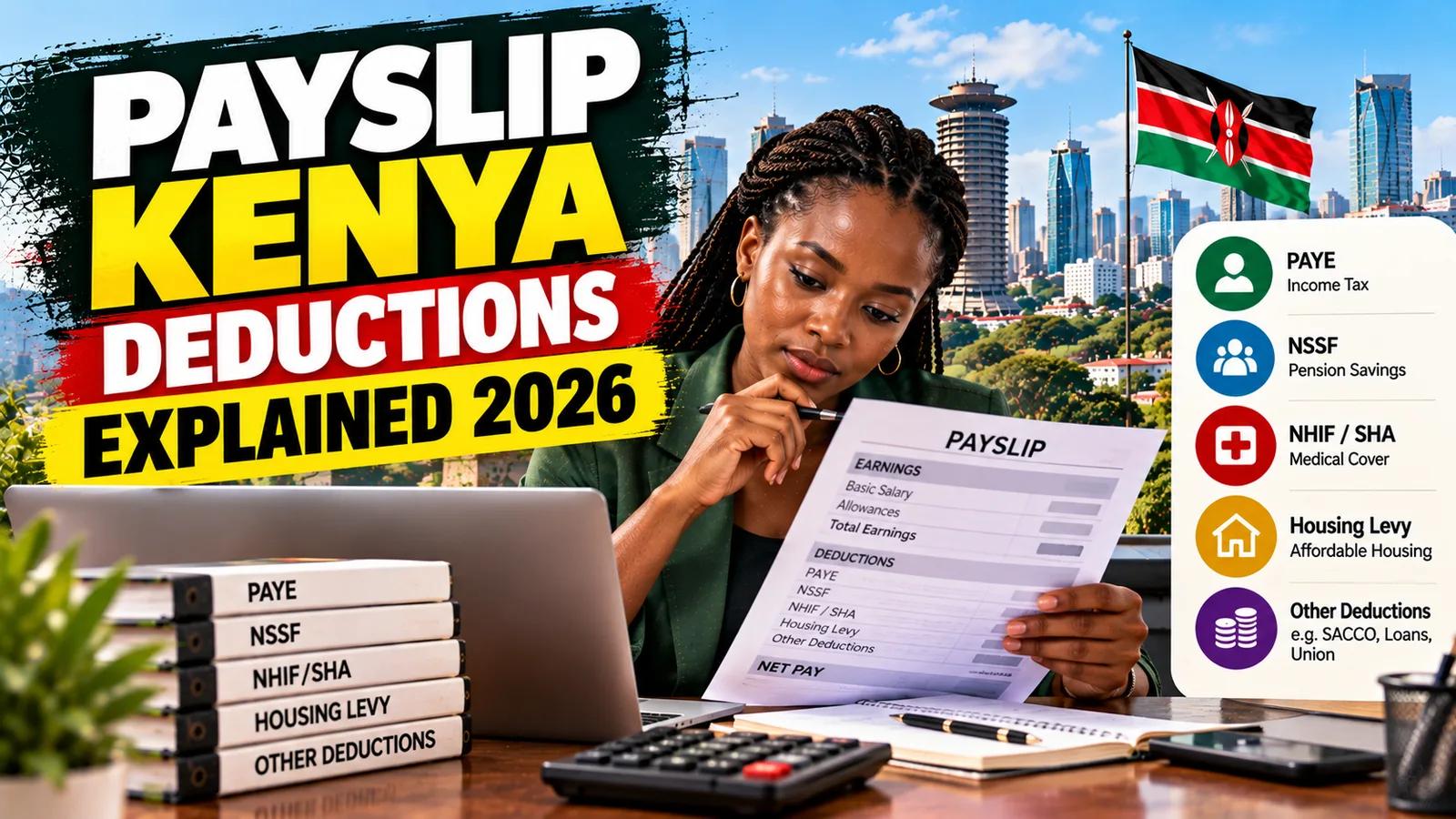
Payslip Kenya Decoded: Every Deduction Explained (PAYE, NSSF, SHIF, Housing Levy, HELB)
A payslip in Kenya shows what you earned, what was taken off and why, and what reached your bank account. This guide walks down the slip line by line: gross pay, PAYE, NSSF, SHIF, the Affordable Housing Levy, reliefs, HELB and voluntary deductions, then works a KES 100,000 salary through to net pay so you can check your own.
Read this slide as text
The Kenya Payslip Decoder. Every deduction explained: a step-by-step visual guide to gross pay, statutory deductions, PAYE and net pay.
Gross pay, deductions and net pay
The basic payroll formula is gross pay minus total deductions equals net pay. Gross pay is your basic salary plus regular cash allowances before anything is taken off. Net pay is the amount actually paid into your bank account. The main deductions are PAYE, NSSF, SHIF, the Affordable Housing Levy, HELB repayments where you have a loan, and authorised voluntary items such as SACCO contributions.
Read this slide as text
Gross pay (basic salary plus regular cash allowances) minus total deductions (PAYE, NSSF, SHIF, Housing Levy, HELB and voluntary items such as SACCO) equals net pay, the exact amount transferred to your bank account.
Start with the earnings section
| Payslip item | Meaning |
|---|---|
| Basic salary | Your fixed contractual monthly pay. |
| Allowances | Regular cash payments such as house, transport, commuter or car allowance. |
| Overtime and commission | Variable earnings, which should be shown separately. |
| Gross salary | Basic salary plus regular cash allowances and other applicable earnings. |
Read this slide as text
Included in gross salary: basic salary (fixed contractual monthly pay) and allowances (regular cash payments such as house, transport, commuter or car).
Excluded or separated: overtime and commission (variable earnings), and non-cash benefits and bonuses such as gratuities, leave allowances and terminal dues.
The foundation rule: for SHIF and the Affordable Housing Levy, gross monthly salary generally means basic salary plus regular cash allowances. Non-cash benefits and irregular payments are excluded from the housing-levy base.
This matters because SHIF and the Housing Levy are both percentages of gross. If payroll includes something it should not, or leaves out an allowance that belongs, every percentage-based deduction moves with it. Treatment of bonuses and overtime can differ between employers, so ask payroll how your own base is set.
NSSF, SHIF and the Housing Levy
Three statutory contributions come off most payslips before PAYE is worked out. They differ in who pays, how they are calculated and whether there is a ceiling.
Read this slide as text
| NSSF (retirement) | SHIF (health) | Housing Levy | |
|---|---|---|---|
| Rate | 6% of pensionable earnings | 2.75% of gross salary | 1.5% of gross salary |
| Limits | Tier I first KES 9,000, Tier II KES 9,001 to KES 108,000; maximum employee contribution KES 6,480 | Minimum KES 300, no upper limit | No upper limit |
| Employer match | Yes (6%) | No, employee-only | Yes (1.5%) |
NSSF: tiers and the KES 6,480 ceiling
The National Social Security Fund is mandatory retirement savings. Employee and employer each contribute 6% of pensionable earnings. From February 2026 the Tier I lower earnings limit is KES 9,000 and the Tier II upper earnings limit is KES 108,000, so the most an employee pays is KES 6,480 a month. Our NSSF rates guide has the full schedule.
| NSSF tier | Pensionable earnings | Employee contribution | Employer contribution |
|---|---|---|---|
| Tier I | First KES 9,000 | 6%, or KES 540 | 6%, or KES 540 |
| Tier II | KES 9,001 to KES 108,000 | 6% of the amount above Tier I | 6% of the amount above Tier I |
| Maximum | KES 108,000 | KES 6,480 | KES 6,480 |
Read this slide as text
- Tier I: first KES 9,000 × 6% = KES 540.
- Tier II: KES 9,001 to KES 108,000, the remaining amount up to the cap × 6%.
- Maximum deduction: KES 6,480, on limits effective February 2026.
- Payslip rule: only the employee’s 6% reduces your net pay. The employer’s matching 6% is a separate cost.
For an employee earning KES 100,000, Tier I is KES 540 and Tier II applies to the remaining KES 91,000, giving KES 5,460. The employee total is KES 6,000, which is simply 6% of KES 100,000. The KES 6,480 maximum applies only from KES 108,000 of earnings upward.
SHIF: 2.75% of gross
The Social Health Insurance Fund (SHIF), run by the Social Health Authority (SHA), replaced NHIF from 1 October 2024. For salaried employees it is 2.75% of gross monthly salary, with a minimum of KES 300 and no upper limit. It is employee-only: unlike NSSF and the Housing Levy, there is no matching employer contribution. Employers remit it by the ninth day of the following month.
| Gross monthly salary | SHIF calculation | SHIF deduction |
|---|---|---|
| KES 10,000 | 2.75% × 10,000 | KES 300 minimum applies |
| KES 20,000 | 2.75% × 20,000 | KES 550 |
| KES 50,000 | 2.75% × 50,000 | KES 1,375 |
| KES 100,000 | 2.75% × 100,000 | KES 2,750 |
Affordable Housing Levy: 1.5% from each side
The levy is set under the Affordable Housing Act, 2024, with KRA as collector. The employee and the employer each pay 1.5% of the employee’s gross monthly salary, and the employer remits the combined amount within nine working days after the end of the month. Only your 1.5% should appear as a deduction. The employer’s matching 1.5% should show separately as an employer contribution.
| Gross monthly salary | Employee levy | Employer levy | Total remitted |
|---|---|---|---|
| KES 50,000 | KES 750 | KES 750 | KES 1,500 |
| KES 100,000 | KES 1,500 | KES 1,500 | KES 3,000 |
Read this slide as text
- SHIF (2.75%): replaced NHIF from 1 October 2024 and is administered by SHA. KES 10,000 gross: KES 300 (minimum applies). KES 50,000: KES 1,375. KES 100,000: KES 2,750.
- Affordable Housing Levy (1.5%): remitted to KRA. Only the employee’s 1.5% appears as a deduction on your payslip; the employer’s 1.5% is separate. KES 50,000 gross: KES 750. KES 100,000: KES 1,500.
PAYE: taxable pay, bands and reliefs
PAYE (Pay As You Earn) is income tax deducted from employment income and remitted to the Kenya Revenue Authority. Employers must file the return and remit the tax on or before the ninth day of the following month. The key point for reading your slip is that PAYE is worked out on taxable pay, not gross salary.
Read this slide as text
Gross pay, minus statutory deductions (NSSF, SHIF, Housing Levy), minus allowable deductions (qualifying pension, mortgage interest), equals taxable pay. PAYE is calculated on taxable pay, not gross salary.
Taxable pay = gross pay − NSSF − SHIF − Housing Levy − qualifying allowable deductions. Since 27 December 2024, KRA treats SHIF and the employee’s Housing Levy as deductions with no cap, which is why they sit in the first diamond above.
Deductions that reduce taxable pay
Read this slide as text
- Mortgage interest: deductible if borrowed from an approved institution to purchase or improve occupied residential premises. Cap: KES 30,000 a month (KES 360,000 a year).
- Pension and retirement: contributions to registered pension, provident or individual retirement funds. Cap: KES 30,000 a month.
- Post-retirement medical: qualifying fund contributions. Cap: KES 15,000 a month.
These deductions are not automatic. Declare them to payroll and provide supporting documents such as mortgage interest certificates.
| Deduction | Limit | What payroll needs |
|---|---|---|
| Mortgage interest | KES 30,000 a month (KES 360,000 a year) | Interest certificate, for a loan from one of the first six institutions in the Fourth Schedule to the Income Tax Act, used to buy or improve a home you occupy |
| Registered pension, provident or individual retirement fund | The lowest of your contribution, 30% of pensionable pay and KES 30,000 a month | Scheme statement for the amount you contribute |
| Post-retirement medical fund | KES 15,000 a month | Fund statement |
A mortgage example: if your qualifying interest in a month is KES 45,000, only KES 30,000 is deductible for PAYE. The other KES 15,000 does not carry forward as a deduction for that month. A loan does not reduce PAYE just because it is a loan. What matters is its purpose, the lender, the paperwork and whether you declared it to payroll.
The tax bands
| Monthly taxable pay | Annual equivalent | Tax rate |
|---|---|---|
| First KES 24,000 | First KES 288,000 | 10% |
| Next KES 8,333 | Next KES 100,000 | 25% |
| Next KES 467,667 | Next KES 5,612,000 | 30% |
| Next KES 300,000 | Next KES 3,600,000 | 32.5% |
| Above KES 800,000 | Above KES 9,600,000 | 35% |
Read this slide as text
First KES 24,000: 10%. Next KES 8,333: 25%. Next KES 467,667: 30%. Next KES 300,000: 32.5%. Above KES 800,000: 35%.
The progressive tax trap: you are only taxed the higher rate on the specific amount of money that falls inside that band.
After the tax is calculated across the bands, payroll subtracts the resident employee’s monthly personal relief of KES 2,400 (KES 28,800 a year). That subtraction is a credit against the tax, not a reduction of taxable pay.
Tax reliefs
Read this slide as text
- Personal relief: KES 2,400 a month (KES 28,800 a year) for every resident employee, applied after the bands.
- Insurance relief: 15% of qualifying life, education or health premiums for you, your spouse or your child, capped at KES 5,000 a month (KES 60,000 a year). Education and health policies need a maturity period of at least 10 years.
- Housing Levy: now a deduction. Your 1.5% employee levy comes off taxable pay in full, before the bands. The old 15% housing relief ended on 27 December 2024.
HELB and voluntary deductions
A HELB deduction appears only if you have an outstanding Higher Education Loans Board student loan. It is a repayment, usually collected through payroll under a check-off arrangement with your employer, and the monthly amount should match your HELB schedule or loan statement. It is not a universal statutory deduction like NSSF, SHIF or the Housing Levy, and it does not reduce your PAYE.
Voluntary deductions are taken only where you authorised them, your contract provides for them or another lawful basis applies, and they should be separately identified on the slip. Common examples are SACCO contributions or loan repayments, bank or staff loan repayments, private pension or insurance contributions, and welfare or union contributions. Some of these, such as a registered pension or qualifying insurance, can also reduce your tax within the limits above, but only if declared to payroll.
Read this slide as text
- HELB: repayment collected through a check-off arrangement; must match your loan schedule.
- SACCO: monthly savings or loan repayments to a cooperative.
- Salary advances and loans: repayments remitted directly through payroll.
- Private pension and insurance: extra voluntary savings or cover beyond mandatory levies.
These deductions only occur if you authorised them, your contract dictates them, or a lawful basis (like a HELB mandate) applies.
KES 100,000 worked example
Take an employee on KES 100,000 gross (KES 90,000 basic plus a KES 10,000 house allowance). They contribute KES 10,000 a month to a registered pension, pay KES 10,000 a month in qualifying insurance premiums, have KES 30,000 of certificate-backed mortgage interest, repay HELB KES 3,000 and contribute KES 5,000 to a SACCO.
Step 1: statutory deductions
| Item | Calculation | Amount (KES) |
|---|---|---|
| NSSF | KES 540 + KES 5,460 | 6,000 |
| SHIF | 2.75% × 100,000 | 2,750 |
| Housing Levy | 1.5% × 100,000 | 1,500 |
| Taxable pay before other deductions | 100,000 − 6,000 − 2,750 − 1,500 | 89,750 |
Step 2: allowable deductions
The KES 10,000 pension and KES 30,000 mortgage interest are both within their KES 30,000 monthly limits, so both reduce taxable pay: 89,750 − 10,000 − 30,000 = KES 49,750.
Read this slide as text
Gross salary 100,000 (90,000 basic + 10,000 house allowance). Minus statutory: NSSF (6,000) + SHIF (2,750) + Housing (1,500) = subtotal 89,750. Minus allowable: qualifying pension (10,000) + supported mortgage interest (30,000). Taxable pay: KES 49,750.
Key insight: by declaring pension and mortgage interest, this employee sheltered KES 40,000 from KRA before the tax bands were applied.
Step 3: apply the bands
| Taxable band | Amount taxed (KES) | Rate | Tax (KES) |
|---|---|---|---|
| First KES 24,000 | 24,000 | 10% | 2,400 |
| Next KES 8,333 | 8,333 | 25% | 2,083 |
| Remaining KES 17,417 | 17,417 | 30% | 5,225 |
| Gross PAYE before relief | 49,750 | 9,708 |
Step 4: subtract the reliefs
| Relief | Calculation | Relief (KES) |
|---|---|---|
| Personal relief | Fixed monthly relief | 2,400 |
| Insurance relief | 15% × KES 10,000 | 1,500 |
| Total reliefs | 3,900 |
PAYE = 9,708 − 3,900 = KES 5,808, subject to payroll rounding and the employer’s final iTax calculation.
Read this slide as text
- First 24,000 @ 10% = KES 2,400.
- Next 8,333 @ 25% = KES 2,083.
- Remaining 17,417 @ 30% = KES 5,225.
- Gross PAYE before relief = KES 9,708.
- Minus KES 2,400 personal relief and KES 1,500 insurance relief (15% of a KES 10,000 premium).
- Final PAYE = KES 5,808.
The KES 1,500 Housing Levy was already removed from taxable pay, so no separate housing relief applies.
Step 5: net pay
| Payslip line | Amount (KES) |
|---|---|
| Gross salary | 100,000 |
| NSSF | (6,000) |
| SHIF | (2,750) |
| Housing Levy | (1,500) |
| PAYE | (5,808) |
| HELB | (3,000) |
| SACCO | (5,000) |
| Net pay | 75,942 |
Read this slide as text
100,000 − 6,000 − 2,750 − 1,500 − 5,808 − 3,000 − 5,000 = 75,942.
Notice how much the declared deductions are worth. Without the KES 10,000 pension and KES 30,000 of mortgage interest, taxable pay would be KES 89,750 and PAYE would be far higher. That is why payroll needs your certificates.
Payslip calculator and statutory check
Payslip calculator
NSSF, SHIF, Housing Levy
–Taxable pay
–PAYE
–Net pay
–Default example: the KES 100,000 salary above.
NSSF = 6% of earnings up to KES 108,000. SHIF = 2.75% of gross, minimum KES 300. Housing Levy = 1.5% of gross. Pension deduction = the lowest of your contribution, 30% of gross and KES 30,000. Mortgage interest is capped at KES 30,000. PAYE uses the bands above, less KES 2,400 personal relief and insurance relief of 15% of premiums up to KES 5,000. It assumes pay is only basic salary and regular cash allowances, no benefits or other reliefs, and is an illustration, not payroll software.
Check your statutory lines
Compares your slip with the standard rates on a salary that is basic pay plus regular cash allowances. A difference is a reason to ask payroll in writing for its calculation basis, not proof of an error.
How to audit your payslip
Read this slide as text
- Validate the base: gross salary only includes correct basic pay and regular cash allowances.
- Check the levies: SHIF is exactly 2.75% and the Housing Levy exactly 1.5% of gross.
- Audit NSSF: it caps at the Tier I and II limits.
- Verify deductions: PAYE is calculated after statutory levies and documented mortgage and pension deductions are removed.
- Confirm reliefs: personal and insurance reliefs are applied to shrink PAYE. The Housing Levy is a deduction, not a relief.
- Check the math: gross minus total deductions equals the net pay in your bank.
Action: if a deduction looks wrong, ask payroll in writing for the calculation basis. Keep every payslip as evidence of your earnings and deductions.
- Confirm gross salary includes only the correct basic pay and regular cash allowances.
- Check SHIF is 2.75% of gross, subject to the KES 300 minimum.
- Check the Housing Levy is 1.5% of gross.
- Check NSSF reflects the correct Tier I and Tier II amounts, and no more than KES 6,480.
- Confirm PAYE was calculated after NSSF, SHIF, the Housing Levy and your documented pension and mortgage-interest deductions.
- Confirm personal relief and insurance relief were applied.
- Confirm HELB and SACCO deductions match your repayment or authorisation records.
- Confirm net pay equals gross pay minus total deductions.
If something looks wrong, ask payroll in writing for the calculation basis and the supporting documents behind the disputed line. For PAYE reliefs, give them the mortgage-interest certificate, insurance-premium certificate, pension statement and anything else KRA requires. Keep every payslip. It is evidence of your earnings and deductions, and it helps when you file your own return: see our guide to filing your KRA return as an employee, and the shorter iTax employment return walkthrough. If you are saving beyond NSSF, read retirement planning beyond NSSF.
Frequently asked questions
What is the difference between gross pay and net pay on a Kenyan payslip?
Gross pay is basic salary plus regular cash allowances before deductions. Net pay is what is left after PAYE, NSSF, SHIF, the Housing Levy and any HELB or voluntary deductions, and it is the amount paid into your bank account.
Which deductions are compulsory on a Kenyan payslip?
PAYE, NSSF, SHIF and the employee’s Affordable Housing Levy apply to most salaried employees. HELB appears only if you have a student loan, and items such as SACCO contributions are taken only if you authorised them.
How is PAYE calculated in Kenya?
Payroll subtracts NSSF, SHIF, the Housing Levy and qualifying pension, post-retirement medical and mortgage-interest amounts from gross pay to get taxable pay. It applies the bands from 10% to 35% to that figure, then subtracts KES 2,400 personal relief and any insurance relief.
Are SHIF and the Housing Levy tax deductible?
Yes. Since 27 December 2024, SHIF contributions and the employee’s Housing Levy are deductible when working out taxable pay, with no cap. The old 15% housing relief has ended.
How much are SHIF and the Housing Levy on KES 100,000?
SHIF is 2.75% of gross, so KES 2,750. The employee’s Housing Levy is 1.5% of gross, so KES 1,500. The employer pays a matching Housing Levy of KES 1,500 on top, which is not deducted from you.
What is the maximum NSSF deduction?
From February 2026 the maximum employee contribution is KES 6,480 a month, which is 6% of pensionable earnings up to KES 108,000. The employer pays a matching KES 6,480 separately.
What tax reliefs can reduce my PAYE?
Personal relief of KES 2,400 a month applies to resident employees. Insurance relief is 15% of qualifying premiums, capped at KES 60,000 a year (KES 5,000 a month). Pension, post-retirement medical and mortgage-interest amounts reduce taxable pay if you declare them with documents.
Why is my PAYE higher than I expected?
Common causes are pension, mortgage-interest or insurance claims that payroll was never given the paperwork for, a gross figure that includes items it should not, or a second job taxed separately. Ask payroll for its calculation basis in writing.
What should I do if a deduction looks wrong?
Ask payroll in writing for the calculation basis and supporting documents for the disputed item, and provide any certificates that support a relief. Keep every payslip as evidence of your earnings and deductions.
How we researched this guide
This is an independent, source-based guide. We recalculated the worked example, the band tax and every table ourselves. We read KRA’s PAYE guide (January 2025) and its public notice on PAYE computation after the Tax Laws (Amendment) Act 2024 for the bands, the KES 2,400 personal relief, the SHIF, Housing Levy, pension, post-retirement medical and mortgage-interest treatment, and the insurance-relief rules, and PwC’s Kenya tax summaries for SHIF and Housing Levy rates, their deductibility and the February 2026 NSSF limits. The research draft and slides still subtracted the 15% housing relief, which ended on 27 December 2024, and charged NSSF of KES 6,480 on a KES 100,000 salary instead of KES 6,000. We corrected both, redrew five slides and moved the example result from PAYE KES 5,439 and net pay KES 75,831 to KES 5,808 and KES 75,942. Two points rest on our draft and we could not confirm them on a page we read: the KES 300 SHIF minimum for salaried staff, and the statement that bonuses and other irregular payments sit outside the Housing Levy base. KRA’s older tax-relief blog says only education policies carry the 10-year rule, while its 2025 guide says education and health policies do, and we followed the later guide. We have no commercial relationship with KRA, SHA or any payroll provider. Contact the editor to report an error.
Sources
- KRA, Pay As You Earn (PAYE) guide, January 2025 (bands, personal relief, deductions before PAYE, insurance relief, 9th-day due date)
- KRA, Amendments to PAYE computation pursuant to the Tax Laws (Amendment) Act, 2024 (SHIF and Housing Levy deductible, housing relief ceases, pension and mortgage limits)
- PwC Tax Summaries, Kenya individual deductions (SHIF and Housing Levy deductions, mortgage-interest and pension limits)
- PwC Tax Summaries, Kenya other taxes (SHIF 2.75%, Housing Levy 1.5%, NSSF maximum KES 6,480 from 1 February 2026)
- KRA, Tax reliefs in Kenya: personal and insurance reliefs (insurance relief 15%, KES 60,000 a year; an older page, personal relief figure outdated)
- WeCompare, NSSF rates in Kenya 2026 (tiers and limits)
- WeCompare, KRA return for employees: P9 guide (filing the return your payslips feed into)

Join the discussion
Please do not share account numbers, phone numbers, links or other personal details. Comments are general discussion, not advice. All comments are reviewed before they appear, and we may remove comments that break these rules.