Pensions & tax
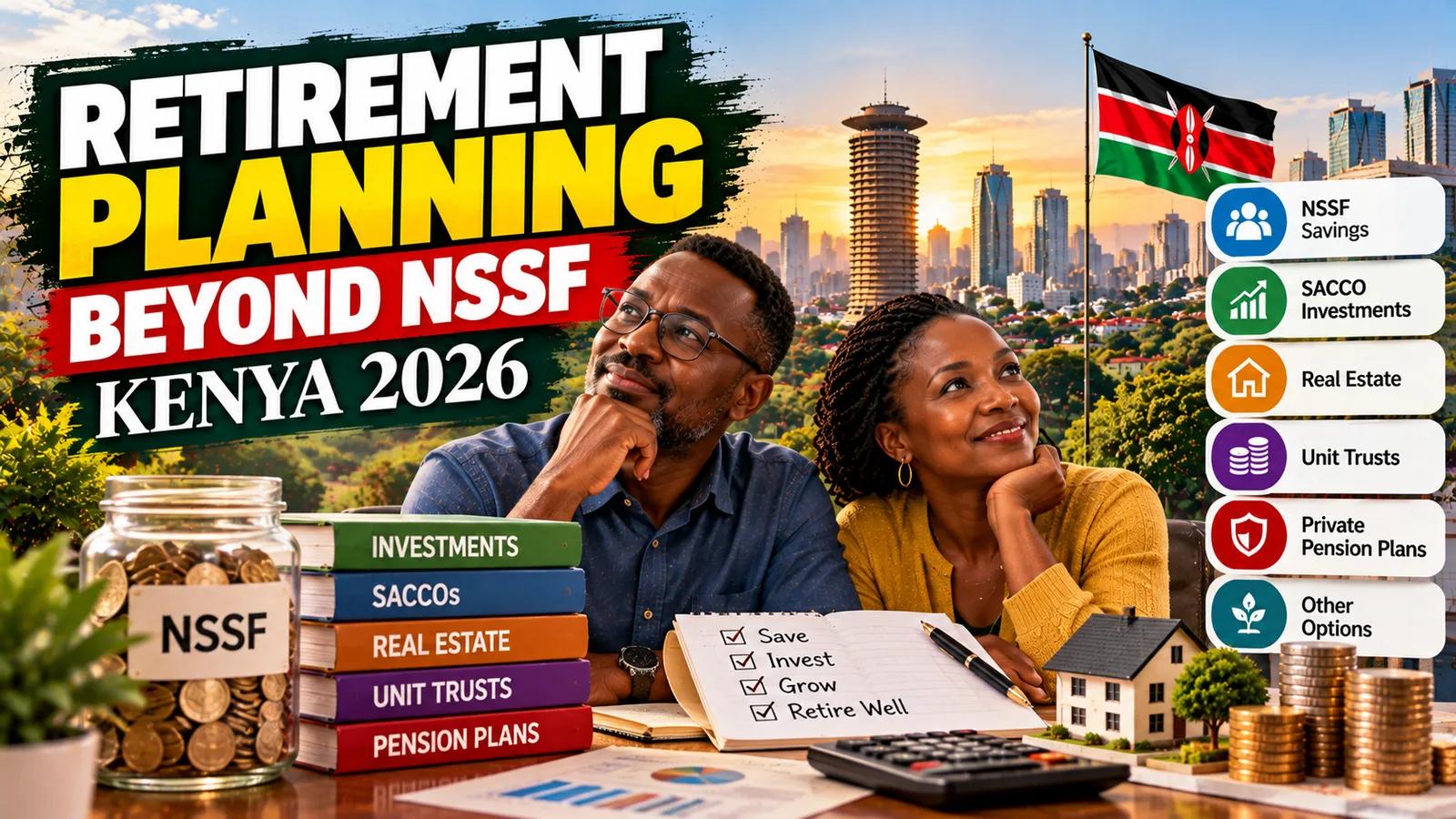
Retirement Planning Beyond NSSF in Kenya 2026: Pension Plans, Medical Cover and Retirement Income
NSSF is Kenya’s mandatory retirement base, but it was never designed to carry a comfortable retirement on its own. Here is how to build on it: the tax relief on extra pension savings, a medical fund that survives retirement, how SHIF treats retirees, how to turn a pot into income, and what starting late really costs.
Read this slide as text
A building diagram: NSSF as the foundation, core pension as the pillars, healthcare as the dome over them and income structuring as the roof. The aim is a retirement plan that is structurally sound, tax-efficient and inflation-proof.
Why NSSF alone is not enough
From February 2026, employees and employers each contribute 6% of pensionable earnings to NSSF. Tier I covers the first KES 9,000 of monthly earnings, and Tier II covers earnings from KES 9,001 to KES 108,000. The most an employee can pay is KES 6,480 a month, matched by the employer. Our NSSF rates guide has the full schedule.
Read this slide as text
- KES 6,480 is the absolute maximum monthly employee contribution.
- 6%: employee and employer contribution to NSSF.
- Tier I covers the first KES 9,000. Tier II covers up to KES 108,000.
- A KES 108,000 earner and a KES 250,000 earner pay the same; the surplus income of the higher earner is uncaptured by mandatory retirement savings.
That ceiling is the issue for higher earners. Someone earning KES 250,000 contributes no more to NSSF than someone earning KES 108,000, so NSSF is a universal floor and not a personalised retirement target. Everything above it is a decision you have to make yourself.
Inflation, returns and the actuarial reality
The adequacy problem is real. A Zamara survey reported by Business Daily found that Kenyan pension schemes earned a weighted average return of 1.4% in 2023, down from 1.7% in 2022. Our research draft sets that against 7.7% inflation for 2023, which means savers lost purchasing power in that year.
Read this slide as text
2023 inflation: 7.7%. 2023 pension return: 1.4%. The gap erodes purchasing power.
“Even if you have the best fund manager who triples it, you will get Sh450,000 in today’s money. You simply can’t retire with that.” Sundeep Raichura, CEO of Zamara Group.
Actuarial reality dictates that spectacular percentage returns cannot rescue a tiny balance. Contribution size and time in the market must come first.
Actuaries model the risks that decide whether a retirement is adequate: longevity, inflation, investment volatility, contribution gaps and the cost of turning savings into income. The RBA describes them as professionals who use mathematics to assess the probability and risk of future events in the retirement-benefits sector.
Sundeep Raichura, CEO of Zamara Group, makes the point with a blunt quote: even a fund manager who triples a very small lifetime pension still leaves about Sh450,000 in today’s money, which is not enough to retire on. His message is that contribution size and time in the market come first. A high percentage return on a tiny balance still produces a small pension. For late starters the usual answer is higher contributions, a longer working runway where possible, and no early withdrawals. We took the quote from our research draft and could not trace it to its original source, so check it before you repeat it.
Tax relief on voluntary savings, with a calculator
Contributions to an RBA-registered pension, provident or individual retirement fund are tax-deductible up to KES 30,000 a month, or KES 360,000 a year. The RBA says the limit rose from KES 20,000 a month with effect from 27 December 2024 under the Tax Laws (Amendment) Act 2024. The deduction is limited to the lowest of your actual contribution, 30% of pensionable income and the KES 360,000 annual cap.
Read this slide as text
- Limit: KES 30,000 a month (KES 360,000 a year).
- Example: a KES 50,000 contributor has KES 20,000 a month unshielded, or KES 240,000 a year.
- Relief is shared across all registered pensions. NSSF’s KES 6,480 eats into the same KES 30,000 limit.
- The deduction is limited to the lowest of the actual contribution, 30% of pensionable income, or KES 360,000 a year.
| Contribution level | Annual pension saving | Within annual relief cap | Outside cap |
|---|---|---|---|
| KES 10,000 a month | KES 120,000 | KES 120,000 | KES 0 |
| KES 20,000 a month | KES 240,000 | KES 240,000 | KES 0 |
| KES 30,000 a month | KES 360,000 | KES 360,000 | KES 0 |
| KES 50,000 a month | KES 600,000 | KES 360,000 | KES 240,000 |
On a KES 50,000 monthly IPP contribution, only KES 360,000 a year attracts the deduction. The other KES 240,000 can still be invested, but it does not get the same relief. The relief is shared across your registered pension contributions rather than granted product by product, and our draft says NSSF’s KES 6,480 uses part of the same allowance. We could not confirm that NSSF point on a KRA page, so ask your payroll team or an adviser how your NSSF is treated.
How much tax could you save?
Pension deductible a month
–PRMF deductible a month
–Tax saved a year
–Saved but not shielded a year
–Default example: KES 50,000 pension and KES 15,000 PRMF a month on KES 250,000 pay, at a 30% top rate.
Pension deduction = the lowest of your contribution, 30% of pensionable pay and KES 30,000 a month. PRMF deduction = the lower of your contribution and KES 15,000 a month, treated as a separate allowance. Tax saved = deductions × your top rate. Illustration only.
Post-retirement medical fund
A Post-Retirement Medical Fund (PRMF) is a sub-fund within a retirement scheme that lets members build savings for healthcare after retirement. Kenya Power Pension Fund describes it as a dedicated medical cushion for later life. From 27 December 2024, PRMF contributions are deductible from taxable income up to KES 15,000 a month, or KES 180,000 a year.
Read this slide as text
PRMF relief of KES 15,000 a month plus pension relief of KES 30,000 a month gives a maximum possible tax shelter of KES 45,000 a month (KES 540,000 a year).
- Contribution KES 10,000: fully deductible (KES 120,000 a year).
- Contribution KES 15,000: fully deductible (KES 180,000 a year, the maximum).
- Contribution KES 25,000: KES 15,000 deductible, KES 10,000 unshielded.
| PRMF contribution | Monthly deductible | Annual deductible | Annual amount outside relief |
|---|---|---|---|
| KES 5,000 | KES 5,000 | KES 60,000 | KES 0 |
| KES 10,000 | KES 10,000 | KES 120,000 | KES 0 |
| KES 15,000 | KES 15,000 | KES 180,000 | KES 0 |
| KES 20,000 | KES 15,000 | KES 180,000 | KES 60,000 |
| KES 25,000 | KES 15,000 | KES 180,000 | KES 120,000 |
Our draft treats this as separate from the KES 30,000 pension relief, so a saver who contributes the maximum to both can deduct KES 180,000 for the PRMF and up to KES 360,000 for pension contributions. The RBA’s analysis lists the two limits as separate amendments but does not say whether they share a cap. Confirm with your scheme or KRA before you plan around the full KES 45,000.
How SHIF works for retirees
Kenya replaced NHIF with the Social Health Insurance Fund (SHIF), run by the Social Health Authority (SHA), in October 2024. SHIF is a mandatory contributory health-insurance pool, and SHA also runs the Primary Healthcare Fund and the Emergency, Chronic and Critical Illness Fund.
For retirees the difference is how the contribution is set. Salaried employees pay 2.75% of gross monthly pay, deducted by the employer, with a KES 300 minimum. Retirees and other people without a payslip are assessed through SHA’s means-testing process, which estimates household ability to pay and sets a monthly contribution from KES 300.
Read this slide as text
| Retiree profile | Assessment method | Financial benchmark |
|---|---|---|
| Formal pension | Means-tested on household income, not a fixed band | KES 50,000 assessed income = about KES 1,375 a month (2.75%) |
| No pension | Evaluated through housing, utilities, business and banking indicators | KES 300 minimum or a higher means-tested amount |
| Investment or rental income | Household income assessed holistically, beyond pension receipts | KES 100,000 assessed income = about KES 2,750 a month (2.75%) |
The 2.75% is a planning benchmark. Retirees without a payslip must complete SHA’s means test.
Treat the 2.75% as a planning benchmark, not a quote. Retirees without a payslip should complete SHA’s means test rather than assume a fixed amount, because the instrument uses household circumstances to produce an income-estimation score. We took the means-testing details from our research draft and could not confirm them on an SHA page, so check the current rules at SHA before you budget.
Read this slide as text
- SHIF covers primary healthcare at accredited facilities under published rules. It is the mandatory pool.
- PRMF provides dedicated, tax-advantaged savings specifically for co-pays and chronic care.
- Supplementary cover is needed for private rooms and specialist exclusions.
Retirees must budget for exclusions, chronic medication and co-payments out of pocket or via a layered PRMF strategy.
SHIF matters, but it is not a complete retirement-health plan. It covers care at accredited facilities under published benefit rules. You should still budget for co-payments, exclusions, private-room preferences, chronic medication and specialist care, and consider a PRMF or supplementary private cover.
Drawdown vs annuity
At retirement a Kenyan saver generally chooses between keeping money invested in an income drawdown fund, buying an annuity, or both. An annuity is a regular pension paid by a life insurer, typically for life. Drawdown keeps the balance invested and pays withdrawals out of it.
Read this slide as text
| Income drawdown | Annuity | |
|---|---|---|
| Mechanism | Withdraw from invested account | Insurer pays contracted regular income |
| Risk bearer | You retain market risk | Insurer carries investment and longevity risk |
| Withdrawal limits | Max 12% a year of opening balance | Fixed by contract |
| Legacy | Balance passes to beneficiaries | Usually lower or no residual value without specific riders |
| Flexibility | Locked for 10 years, then open options | Generally locked for life |
| Feature | Income drawdown | Annuity |
|---|---|---|
| How it pays | You withdraw from an invested account, subject to limits | An insurer pays a contracted regular income, often monthly |
| Withdrawal rule | Maximum 12% a year of the opening balance for the financial year | Set by the annuity contract and pricing |
| Minimum duration | At least 10 years from commencement | Usually for life, subject to the contract |
| Investment risk | You keep market exposure; the balance can rise or fall | The insurer carries investment and longevity risk after purchase |
| Inflation protection | Possible if investments beat inflation, not guaranteed | Depends on whether you buy an escalating or index-linked annuity |
| Legacy | The remaining balance can pass to beneficiaries, subject to scheme rules | Usually lower or no residual value unless you buy a guarantee or dependant option |
| After 10 years | Continue drawdown, buy an annuity or take the balance as a lump sum | Generally locked into the agreed income |
The Retirement Benefits (Income Drawdown Funds) Regulations, 2023 require a minimum drawdown period of 10 years, cap annual withdrawals at 12% of the balance at the start of the fund’s financial year, and allow payments monthly, quarterly, half-yearly or yearly. Membership is open from the scheme’s early-retirement age and in any case from age 50. After the 10 years a member may continue drawdown, buy an annuity or take the balance as a lump sum.
Example: KES 10 million at retirement
Read this slide as text
- Year 1 start: KES 10,000,000. Maximum withdrawal at 12%: KES 1,200,000 (KES 100,000 a month).
- Year 2 start: KES 8,800,000. Maximum withdrawal: KES 1,056,000.
- The 12% cap prevents premature depletion; the minimum lock-in is 10 years; payments can be monthly, quarterly, semi-annually or annually.
With KES 10 million in drawdown, the 12% ceiling allows up to KES 1.2 million in the first year, or KES 100,000 a month before investment growth, fees and tax. Taking the maximum leaves KES 8.8 million invested at the start of year two, so that year’s ceiling would be KES 1.056 million if returns were zero. The same KES 10 million would buy an annuity whose income depends on your age, gender, interest rates, payment period and any spouse’s pension. You get predictability, but you generally give up the chance to withdraw more in one year or leave the full capital to heirs.
Read this slide as text
- The safe floor (annuity): a predictable, guaranteed income sized to cover essential, non-negotiable living expenses.
- The growth pot (income drawdown): market exposure for flexibility, inflation protection, emergency access and legacy for heirs.
KES 50,000 a month: the maths
Assume KES 50,000 goes into a registered pension plan every month, compounded monthly, with no withdrawals, and before fees, tax and inflation. The future value of the contributions is P × ((1 + r)n − 1) ÷ r, where P is the monthly contribution, r is the monthly return (the annual return divided by 12) and n is the number of months until age 60.
| Starting age | Years to 60 | Months | At 8% a year | At 10% a year |
|---|---|---|---|---|
| 35 | 25 | 300 | KES 47.55 million | KES 66.34 million |
| 40 | 20 | 240 | KES 29.45 million | KES 37.97 million |
| 45 | 15 | 180 | KES 17.30 million | KES 20.72 million |
| 50 | 10 | 120 | KES 9.15 million | KES 10.24 million |
| 55 | 5 | 60 | KES 3.67 million | KES 3.87 million |
We recalculated every figure from the formula above. These are nominal projections, not forecasts.
Read this slide as text
- Age 35 starter: contributed KES 15 million, growth KES 32.55 million, total KES 47.55 million.
- Age 50 starter: contributed KES 6 million, growth KES 3.15 million, total KES 9.15 million.
- The 35-year-old contributes 2.5 times more cash but ends up with 5.2 times more wealth.
The 35-year-old puts in KES 15 million and ends with KES 47.55 million, so about KES 32.55 million is growth. The 50-year-old puts in KES 6 million and ends with KES 9.15 million, with about KES 3.15 million of growth. Both stop at 60, even though the slide’s axis labels the second curve at age 50. The first saver contributes 2.5 times as much and ends with about 5.2 times as much, which is why starting age matters more than the contribution rate alone.
Pension projection calculator
Projected pot at retirement
–Total you put in
–Growth earned
–Pot in today’s money
–Default example: KES 50,000 a month at 8% from age 35 to 60.
Monthly compounding, contributions at the end of each month, no withdrawals, before fees and tax. “Today’s money” divides the pot by (1 + inflation) for each year to retirement. It is an illustration, not a forecast.
Early vs late starters
| Starting age | Total contributed by 60 | Projected value at 8% | Growth earned | Gap versus starting at 35 |
|---|---|---|---|---|
| 35 | KES 15.00 million | KES 47.55 million | KES 32.55 million | – |
| 40 | KES 12.00 million | KES 29.45 million | KES 17.45 million | KES 18.10 million less |
| 45 | KES 9.00 million | KES 17.30 million | KES 8.30 million | KES 30.25 million less |
| 50 | KES 6.00 million | KES 9.15 million | KES 3.15 million | KES 38.40 million less |
| 55 | KES 3.00 million | KES 3.67 million | KES 0.67 million | KES 43.88 million less |
KES 50,000 a month in every row, at an illustrative 8% a year. Our calculation.
Read this slide as text
- Age 35: baseline, projected value KES 47.55 million.
- Age 40: minus KES 18.10 million.
- Age 45: minus KES 30.25 million.
- Age 50: minus KES 38.40 million.
- Age 55: minus KES 43.88 million (projected value only KES 3.67 million).
Late starters are not doomed, but cannot rely on returns alone. They must compensate via higher contributions, later retirement and strict discipline.
The late starter is not doomed, but needs a higher contribution rate, a later retirement age where possible and disciplined investing. A 50-year-old saving KES 50,000 a month reaches about KES 9.15 million at 8%. To approach the 35-year-old’s KES 47.55 million in only 10 years would take a dramatically higher monthly contribution, stronger returns or both.
Late-starter playbook
Read this slide as text
- Ages 45 to 50, aggressive consolidation: maximise sustainable contributions, consolidate old pensions, avoid speculative concentration.
- Ages 50 to 55, the pivot: shift gradually toward capital preservation. You can enter an income-drawdown scheme from age 50 or the scheme’s early-retirement age.
- Age 55 and over, securing the floor: prioritise liquidity, lock in healthcare cover (PRMF and SHIF) and establish a dependable income floor.
Universal rule at any age: keep an emergency fund outside the pension so that job loss or medical bills do not force early, penalised access to retirement funds.
- Ages 45 to 50. Raise contributions to a level you can sustain, and consolidate old pensions where the transfer terms are favourable. Minet, for example, says it accepts transfers from earlier schemes and supports M-Pesa, bank and standing-order contributions, according to our draft. Avoid concentrating in speculative assets.
- Ages 50 to 55. Shift gradually toward capital preservation and plan how you will take an income. The drawdown rules open membership from age 50 or the scheme’s early-retirement age.
- Age 55 and over. Put liquidity, healthcare cover and a dependable income floor first, and budget separately for SHIF contributions and supplementary medical costs.
- At any age. Keep an emergency fund outside the pension. A money market fund is one place to hold it; see our CIC Money Market Fund review.
Choosing between plans
Read this slide as text
- Employed with company benefits? Choose an occupational scheme or AVCs. Employer funding accelerates the pot.
- Self-employed, freelance or lacking a company scheme? Choose an Individual Pension Plan (IPP).
- Run an SME? Choose an umbrella scheme for shared administration and governance.
Checklist: verify RBA registration; compare all-in annual fees; check terms for transfers, early access and retirement income options.
Choose an occupational scheme or additional voluntary contributions (AVCs) first if your employer offers one, because employer funding accelerates the pot. Choose an IPP if you are self-employed, freelance, between jobs or your employer’s scheme is weak. Choose an umbrella scheme if you run an SME and want shared administration and governance.
Before you sign, compare the RBA registration, all-in annual fees, guaranteed versus historical returns, investment options, and the cost of transfers, early access and retirement income. A lower-fee fund with steady net returns can beat a headline “high return” product once costs are counted.
The complete picture
Read this slide as text
NSSF (base), occupational scheme or IPP (core) and PRMF (medical) feed a converter when the corpus reaches age 60, helped by a tax engine of up to KES 45,000 a month of KRA tax shields. The outputs are an annuity (fixed essential bills), drawdown (flexible lifestyle and legacy) and SHIF plus PRMF (shielding the corpus from medical shocks).
The best Kenyan retirement plan is not NSSF alone. It is NSSF plus a funded occupational scheme or IPP, protected by medical savings, using the tax reliefs you qualify for, and converted at retirement into a deliberate mix of guaranteed income and drawdown flexibility.
Frequently asked questions
Is NSSF enough to retire on in Kenya?
For most people, no. Employee contributions stop at KES 6,480 a month, so NSSF works as a floor. Higher earners need an occupational scheme or an Individual Pension Plan on top of it.
How much tax relief do I get on pension contributions?
Contributions to an RBA-registered pension, provident or individual retirement fund are deductible up to KES 30,000 a month (KES 360,000 a year) from 27 December 2024, limited to the lowest of your contribution, 30% of pensionable income and the annual cap.
What is a Post-Retirement Medical Fund?
It is a sub-fund within a retirement scheme for healthcare costs after retirement. Contributions are deductible up to KES 15,000 a month (KES 180,000 a year) from 27 December 2024.
How is SHIF charged to retirees?
Salaried people pay 2.75% of gross pay, with a KES 300 minimum. Retirees without a payslip are means-tested by the Social Health Authority, from KES 300 a month. A 2.75% rate is a useful planning benchmark only.
What is the difference between drawdown and an annuity?
With drawdown your money stays invested and you withdraw up to 12% of the opening balance a year, keeping the market risk and any balance for your heirs. An annuity pays a contracted income from an insurer, usually for life, but generally leaves little or no residual value.
How long does income drawdown last in Kenya?
The regulations require a minimum drawdown period of 10 years. After that you can continue, buy an annuity or take the balance as a lump sum.
Can I start income drawdown at 50?
Membership is open from the scheme’s early-retirement age and in any case from age 50, under the Retirement Benefits (Income Drawdown Funds) Regulations, 2023. Check your scheme’s own rules.
How much will KES 50,000 a month grow to?
At an illustrative 8% a year, starting at 35 gives about KES 47.55 million at 60, starting at 45 gives about KES 17.30 million, and starting at 50 gives about KES 9.15 million. These are nominal projections before fees, tax and inflation.
Should I choose an IPP or an occupational scheme?
Take your employer’s scheme or AVCs first, because employer funding accelerates the pot. Choose an IPP if you are self-employed or your employer’s scheme is weak. Compare RBA registration and all-in annual fees before you sign.
How we researched this guide
This is an independent, source-based guide. We recalculated every projection and tax example ourselves. We read the KES 30,000 and KES 15,000 relief limits and the 27 December 2024 date on the RBA’s analysis of the Tax Laws (Amendment) Act 2024, the drawdown rules in the Retirement Benefits (Income Drawdown Funds) Regulations, 2023 on Kenya Law, and the 1.4% pension return for 2023 in Business Daily’s report of the Zamara survey. The NSSF rates match our NSSF guide. The 2023 inflation figure, the Raichura quote, the SHIF means-testing details, the Minet transfer point and the statement that NSSF uses the same relief allowance come from our research draft, and we could not confirm them on primary pages. We changed one slide that said the rules “expressly allow” combining an annuity with drawdown, corrected a typo on the late-starter slide, and rebuilt a footer that the watermark had covered. We have not been paid by any pension provider or insurer for this guide, and we do not recommend one. Contact the editor to report an error.
Sources
- Retirement Benefits Authority, The Tax Laws (Amendment) Act 2024: a detailed analysis (KES 30,000 and KES 15,000 monthly limits, effective 27 December 2024)
- Retirement Benefits (Income Drawdown Funds) Regulations, 2023 (12% cap, 10-year minimum, age 50, options after the minimum period)
- Business Daily, Pension returns trail inflation rate for the second year (Zamara survey, 1.4% return for 2023, 8 February 2024)
- WeCompare, NSSF rates in Kenya 2026 (contribution rates and limits)
- Social Health Authority (SHIF contributions and means testing; confirm current rules here)
Join the discussion
Please do not share account numbers, phone numbers, links or other personal details. Comments are general discussion, not advice. All comments are reviewed before they appear, and we may remove comments that break these rules.