Loans & credit
CRB Checks and Disputes in Kenya: Check, Clear or Challenge Your Listing
How to see what the credit bureaus hold on you, clear a genuine default the right way, and dispute a wrong listing using the rules in the Banking (Credit Reference Bureau) Regulations, 2020, including the 21-day deadline.
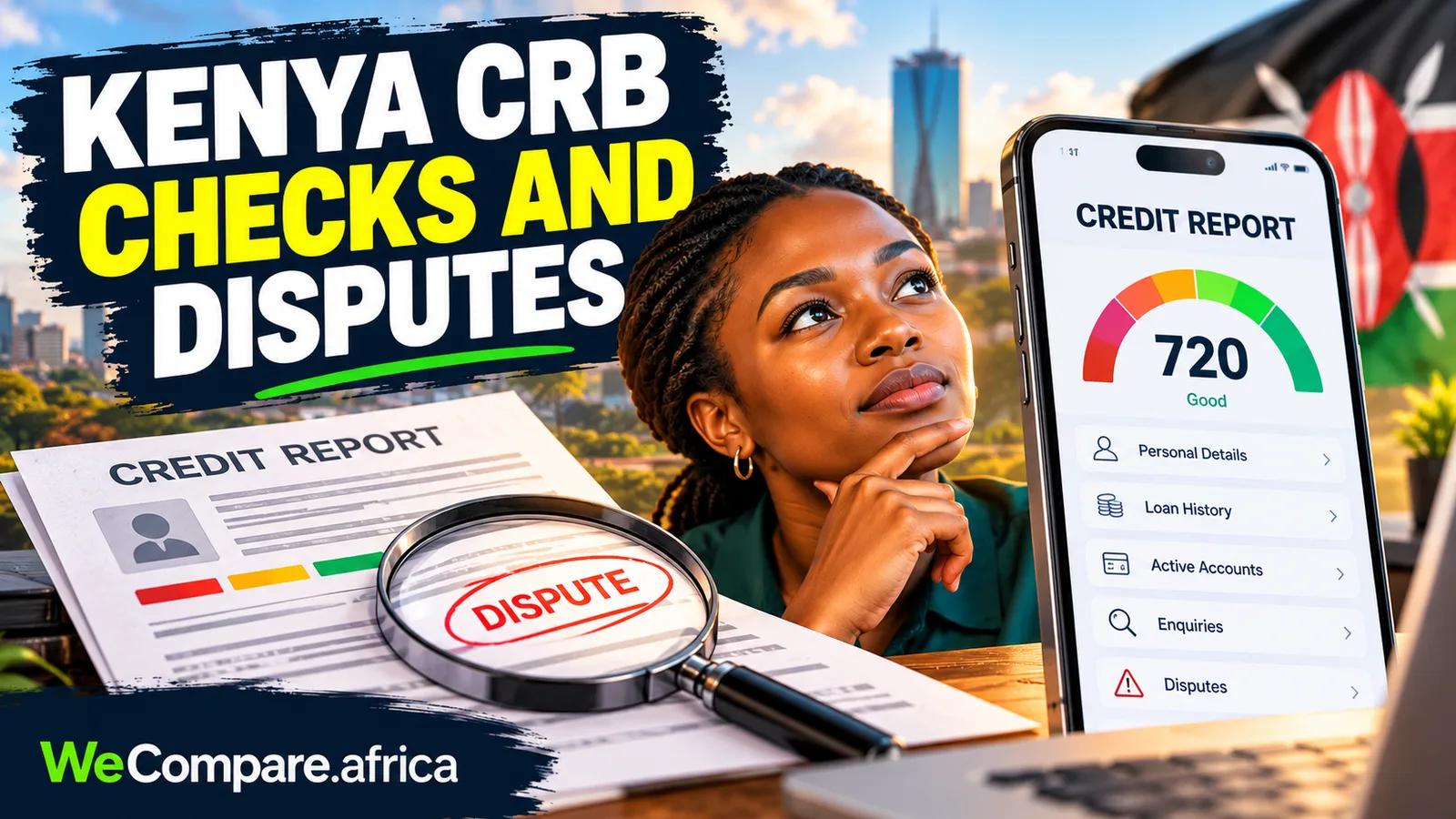
What a CRB actually does
Banks, mobile lenders and SACCOs send data on your loans to licensed credit reference bureaus: active and closed loans, repayment history, defaults, balances and default dates. The bureaus use it to produce your credit report and score, which future lenders consult. Metropol's FAQ says a loan not serviced for 90 days counts as non-performing.
Read this slide as text
What lenders report: active and closed loans, repayment history, defaults and non-performing loans, outstanding balances, dates of default.
What the CRB calculates: your overall CRB status and credit score.
The blacklist myth: a listing does not mean you can never borrow again. Lenders use this data to assess your current behaviour and income, not just past mistakes.
How to check your CRB status
The regulations entitle you to a copy of your credit report from each bureau at no charge at least once a year, and the bureau must give it within 5 working days of your request. Check all the bureaus before a major loan application, because a lender may report to only one.
Read this slide as text
- Metropol: dial *433# and register with your ID, or use the Crystobol app or metropol.co.ke.
- TransUnion: send your full name by SMS to 21272, or use the TransUnion Nipashe app.
- Creditinfo: creditinfo.co.ke or the MyCreditinfo portal, or request your report by email.
The annual rule: you are entitled to one free credit report per year from each bureau. Check all three before a major loan application.
What it costs
Your annual report from each bureau is free. Beyond that, bureaus may charge only fees the Central Bank has approved in writing, and they must publish them (Regulation 32). Disputes are free: Metropol says so, and TransUnion says it does not charge a fee for investigating.
| Service | What we could confirm |
|---|---|
| Annual credit report | Free, once a year per bureau (Regulation 37(3)(a)) |
| Report after a correction request | Free copy every 6 months (Regulation 37(3)(c)) |
| TransUnion Nipashe registration | KES 50 once, to paybill 212121 with your ID number as the account |
| Dispute investigation | Free at Metropol and TransUnion. The regulations let a bureau charge for investigation costs only if the disputed information turns out to be false (Regulation 37(14)) |
| Clearance certificate | Regulation 28(4) says no fee may be charged in the first instance. TransUnion said in 2021 that the first clearance certificate is free |
| Other reports and scores | Set by each bureau and approved by the CBK. Check the bureau's published tariff |
We have not published a bureau-by-bureau price list. The deck behind this guide listed approximate fees, including KES 2,200 for a clearance certificate, but we could not confirm them against the bureaus' published tariffs, and the figure conflicts with Regulation 28(4). Ask the bureau for its current approved tariff before you pay.
Clear it or fight it?
Everything depends on one question: is the listing genuine?
Read this slide as text
- Yes, I borrowed the money and defaulted: clear the loan. Contact the lender for a settlement figure. Outcome: the listing becomes settled or closed.
- No, I never borrowed it, I already paid it, the amount is wrong, or it is identity theft: fight the listing. Demand evidence and lodge a formal dispute. Outcome: the wrong listing is corrected or removed.
Never pay a fee to "erase" a wrong listing. Never dispute a genuine default without settling. Choose your path.
| Clear the loan | Fight the listing | |
|---|---|---|
| Use it when | You borrowed and did not repay | You never borrowed, already paid, the amount is wrong, or someone used your identity |
| You contact | The lender, for a settlement figure | The bureau in writing, plus the lender |
| Result | Listing shows settled or closed and stays on record for 5 years from settlement | Wrong data is corrected or deleted |
| Risk | Paying through unofficial channels | The regulations let a bureau charge investigation costs if the disputed data proves true |
Path A: clear a genuine default
Read this slide as text
- Identify: obtain your full CRB report to confirm the exact lender and outstanding balance.
- Negotiate: contact the lender directly for the final settlement figure and get any discount terms in writing.
- Execute: pay strictly through the lender’s official channels, never personal paybills or agents.
- Document: secure a written settlement or clearance letter confirming full payment.
- Update: instruct the lender to update your status with the CRB.
- Verify: pull a fresh CRB report after 14 to 30 days to ensure the listing reads settled or closed.
The 14 to 30 day check is sensible practice rather than a legal deadline. If the listing still shows an outstanding balance after you hold a clearance letter, raise a dispute with the bureau and attach the letter.
How long a settled default stays on your report
Regulation 34(1)(a) says a non-performing loan is kept until 5 years after final settlement of the amount in default, even if the debt was written off. After that the record must be expunged and you must be told within 7 days. Bankruptcy is kept until 7 years after your discharge.
Read this slide as text
- Day 0: final payment made.
- Day 30: status updates to settled/closed.
- Years 1 to 5: record remains visible but settled.
- Year 5: expunged from database.
Exceptions: bankruptcy, 7 years post-discharge; incorrect listings, expunged immediately on dispute.
Insight: no legitimate service can erase a genuine default for a fee before this 5-year legal retention period expires.
Path B: dispute a wrong listing
Read this slide as text
- Pull report: identify the exact error (amount, date, fraud).
- Collect evidence: M-PESA texts, statements, closure letters, ID.
- Write lender: send a formal dispute with a 7 to 14 day deadline.
- Lodge CRB dispute: use the official portal to force an investigation.
- Track: monitor the CRB and lender communication.
- The 21-day rule: monitor the legal deletion countdown.
- Escalate: take the case to the Central Bank if ignored.
- Confirm: pull fresh reports from all 3 bureaus to verify.
Under the regulations the legal process starts when you notify the bureau in writing (Regulation 37(5)). The bureau then has 5 working days to attach a note that the data is under investigation and ask the lender to confirm it is accurate, and 7 days to investigate (Regulation 37(6) and (7)). Writing to the lender at the same time, with a short deadline, often settles a simple error faster.
The 21-day clock
This is your strongest lever. Regulation 37(8) gives the institution that supplied the data 21 days from the notice of dispute to investigate and send every bureau a notice of resolution saying the data is deleted, corrected or unchanged. Regulation 37(10) adds that if the investigation is not completed within 21 days, the disputed information must be deleted as you requested.
Read this slide as text
Under Kenya’s Banking Regulations, a CRB must investigate a dispute with the lender. If the bureau or lender does not complete its investigation within 21 days, the disputed information must be deleted as requested by the customer.
Caveat: if the investigation concludes after deletion and proves the debt is valid, the CRB may legally reinsert the data. The 21-day forced deletion is your immediate shield against prolonged institutional delays.
Dispute letter: anatomy and template
Read this slide as text
- The header: "Formal Dispute of Inaccurate CRB Listing". Must include your ID number and the specific CRB name.
- The specifics: state the lender name, account number, amount and the exact nature of the error (for example "Account is not mine" or "Paid in full").
- The evidence block: list the attachments: ID, M-PESA confirmations, bank statements, loan closure letters.
- The kicker: demand resolution within 21 days under the Banking (CRB) Regulations, 2020, and state your intent to escalate to the Central Bank of Kenya.
Here is a template you can adapt. Send it to the bureau that holds the entry, copy the lender, keep proof of delivery, and keep your own copy.
[Your full name]
[ID number] · [Phone] · [Email]
[Date]

To: The Credit Bureau Manager, [Metropol / TransUnion / Creditinfo]
Copy: [Lender name], Customer Complaints

FORMAL DISPUTE OF INACCURATE CRB LISTING

I am disputing the following entry on my credit report:
Lender: [name]    Account number: [number]
Amount listed: KES [amount]    Date listed: [date]

The error: [choose one and explain in one or two lines]
- I have never held this account or borrowed from this lender.
- The loan was paid in full on [date] (see attached confirmation).
- The amount listed is wrong. The correct balance is KES [amount].

Attached evidence:
1. Copy of my national ID
2. Copy of my credit report highlighting the entry
3. [M-PESA confirmations / bank statements / loan closure letter]

Under Regulation 37 of the Banking (Credit Reference Bureau) Regulations, 2020, I request that you flag this information as disputed, investigate it with the lender, and confirm the outcome to me in writing. If the investigation is not completed within 21 days of this notice, I request that the disputed information be deleted.

If this is not resolved, I will refer the matter to the Central Bank of Kenya.

Yours faithfully,
[Signature and name]
Keep to facts and dates. Do not claim an account is not yours if it is, because the regulations let a bureau charge investigation costs if the disputed information is shown to be accurate.
Escalating to the Central Bank of Kenya
If you are dissatisfied with how the dispute was resolved, Regulation 37(15) lets you refer it to the Central Bank, and you keep your other remedies. The CBK's complaints guidance says to complain to the institution first, keep its reply, and then write to the CBK with full details of the grievance, the institution's response and copies of all correspondence. The CBK cannot consider matters already before the courts.
Read this slide as text
Escalation order: the lender (initial dispute), the CRB (formal investigation), the CBK (regulatory escalation).
Build the evidence pack: copy of National ID; CRB report highlighting the error; original dispute letter and delivery proof; all payment receipts and closure letters; a concise chronological timeline of events.
Alternative remedy: for severe mishandling of personal data or identity theft, escalate to the Office of the Data Protection Commissioner (ODPC).
What happens if the lender ignores your dispute?
That is exactly what the 21-day rule is for. If the investigation is not completed in 21 days, the disputed information must be deleted at your request. Send the bureau a short written reminder on day 22 that quotes Regulation 37(10) and asks for confirmation of deletion. If it still does not act, refer the matter to the CBK with your evidence pack. For serious mishandling of your personal data, the Office of the Data Protection Commissioner (odpc.go.ke) is a separate route.
Your score versus your report
A score summarises your history; the report shows the entries behind it. A good score does not mean your report is flawless, and one wrong default can still cause a rejection, so always read the underlying entries.
Read this slide as text
- Repayment history: consistency of on-time payments.
- Outstanding debt: total balances across all lenders.
- Credit mix: variety of credit types (cards, mobile, term).
- Recent activity: frequency of new applications (hard enquiries).
Score versus report: you can have a high score but still suffer from an incorrect default listing that will flag a future loan application. Always review the underlying data, not just the number.
How to check your TransUnion score
- Register for TransUnion's Nipashe service. TransUnion's page says you pay KES 50 once to paybill 212121, using your ID number as the account, or SMS your full name to 21272.
- After registering, request your credit status, credit report or clearance certificate by SMS or in the TransUnion Nipashe app.
- Compare the status with the full report, and read each entry.
Per-request prices come from TransUnion's published fee schedule. A 2021 TransUnion post listed KES 19 per status SMS, so confirm the current charge on its website before you pay.
Repairing your credit after clearing
Clearing a loan stops the damage but does not erase the history. What helps is a long run of boring, on-time behaviour. The blueprint below splits into defence, meaning getting your record right, and offence, meaning building a better one.
Read this slide as text
Defence
- Verify: check all 3 CRBs simultaneously.
- Cleanse: dispute all remaining errors.
- Document: keep files of all closure letters.
- Buffer: build a KES 5,000 to 20,000 emergency fund.
- Monitor: recheck your score every 3 to 6 months.
Offence
- Punctuality: set standing orders to pay bills on time.
- Pivot: reduce reliance on short-cycle mobile loans.
- Longevity: keep old, well-managed accounts active.
- Restraint: avoid multiple new credit applications.
- Rebuild: borrow small amounts and repay early.
The KES 5,000 to 20,000 buffer is a rule of thumb from the deck, not a regulation. Size yours to your own monthly expenses. Our guide to Hustler Fund, Fuliza and M-Shwari shows how short-cycle mobile loans can stack up.
Bureau contacts
We list only contacts we could confirm on an official page. Check each bureau's website for changes, and be careful with numbers shared on social media.
Metropol
Phone: +254 709 834 000
Email: creditbureau@metropol.co.ke
USSD: *433#
Office: KCB Towers, 15th Floor, Kenya Road, Upper Hill, Nairobi. Hours 8:00 am to 5:00 pm.
TransUnion Kenya
Email: keninfo@transunion.com or info@transunion.com
SMS: your full name to 21272
Phones listed on its Kenya page: +254 768 262 495, +254 768 617 074, +254 768 253 748, +254 706 565 285
Office: Delta Annex, 2nd Floor, Ring Road Westlands, Nairobi.
Creditinfo Kenya
Use the contact page on its official website. We could not confirm a phone number or email from an official page.
Central Bank of Kenya
Use the contact and complaints pages on centralbank.go.ke.
TransUnion says it does not handle disputes through social media or online classifieds, will not contact you from numbers not listed on its site, and does not charge a fee to investigate. Confirm contact details on each bureau's own site before you send documents. The original slide's WhatsApp number for TransUnion and the phone number for the CBK could not be confirmed, so we have left them out.
The three rules to remember
Read this slide as text
- Know your status: never guess your financial standing. Check all three bureaus (Metropol, TransUnion, Creditinfo) annually for free.
- Settle the truth: genuine defaults cannot be erased with a fee. Pay them through official channels, secure your clearance letter and let the 5-year retention clock run.
- Fight the errors: never tolerate or pay for an illegal listing. Build your evidence pack, enforce the 21-day deletion rule and escalate to the CBK when ignored.
Frequently asked questions
How do I check my CRB status in Kenya?
Request your report from each licensed bureau. Metropol offers *433# and the Crystobol app, and TransUnion offers SMS to 21272 and the Nipashe app. You are entitled to one free report per year from each bureau.
How long does a settled default stay on my CRB record?
Under Regulation 34(1)(a), a non-performing loan stays until 5 years after final settlement. Bankruptcy stays until 7 years after discharge.
Can I pay to remove a default from my CRB record?
No. A genuine default stays for the retention period, and no fee can lawfully remove it. A clearance certificate is a document, not a removal service. Be wary of anyone who offers to erase a listing for a fee.
How long does a CRB dispute take?
The regulations give the lender 21 days from your notice of dispute to investigate and report back. If the investigation is not completed in 21 days, the disputed information must be deleted at your request.
What if my dispute is rejected?
You can refer it to the Central Bank of Kenya under Regulation 37(15), attach a statement of up to 100 words to your report under Regulation 37(13), or seek other remedies such as the Data Protection Commissioner or the courts.
Is it free to dispute a listing?
Metropol and TransUnion say disputes are free. The regulations allow a bureau to charge investigation costs if the disputed information is found to be accurate, so dispute only what is genuinely wrong.
How we researched this guide
This is an independent, source-based guide. We checked the legal rules against the Central Bank of Kenya's Credit Reference Bureau Regulations, 2020, the bureau contacts and processes against Metropol's and TransUnion's own pages, and the escalation steps against the CBK's complaints guidance. Where the underlying deck made a claim we could not confirm, such as bureau fee amounts and some contact numbers, we left it out or flagged it. We update this page when rules or contacts change. Contact the editor to report an error.
Sources
- Central Bank of Kenya, Credit Reference Bureau Regulations, 2020 (Regulations 28, 32, 34 and 37)
- Metropol, common queries (reports, *433#, 90-day rule, disputes, contacts)
- TransUnion Kenya consumer page (Nipashe, 21272, KES 50 registration, contacts)
- TransUnion Africa newsroom, get your credit report safely (26 November 2021; scam warnings)
- Central Bank of Kenya, customer complaints handling mechanism
- The Kenya Times, CRB listing in Kenya (March 2026; cited a 30-day lender window, which differs from the regulations)
Join the discussion
Please do not share account numbers, phone numbers, links or other personal details. Comments are general discussion, not advice. All comments are reviewed before they appear, and we may remove comments that break these rules.