Loans & credit
Cheapest Personal Loans in Kenya 2026: Banks vs Apps, CRB Clearance and Credit Scoring
Banks usually beat mobile apps on real cost, but only if you can wait and qualify. Here is how to compare the two on APR, a worked KES 100,000 example, how a CRB listing works, how banks score you, and when a check-off loan beats Fuliza.
Compare real cost with APR
Do not compare a bank’s annual rate with an app’s “monthly fee”. Turn every offer into an annual percentage rate (APR) and count every mandatory charge.
APR = (total finance cost ÷ loan amount) × (365 ÷ loan days) × 100
Read this slide as text
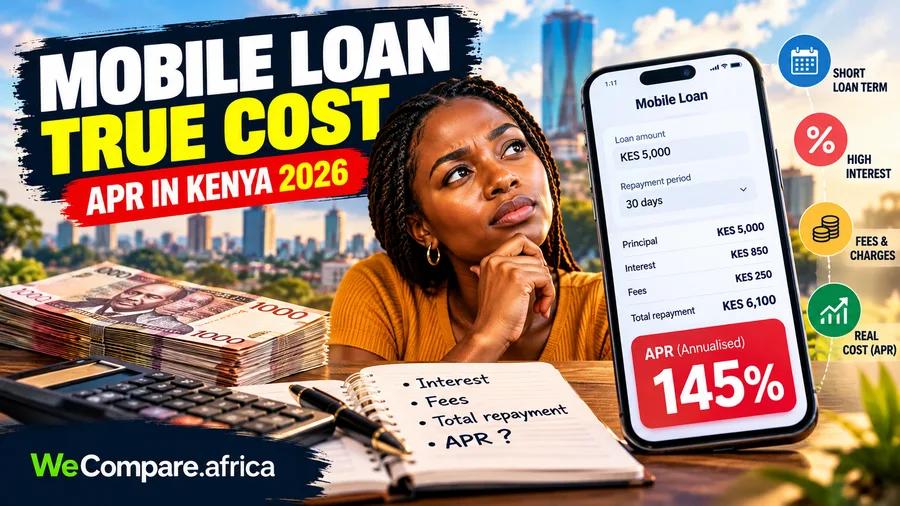
Borrowing KES 10,000 for 30 days with a KES 900 fee is not 9%. It is 109.5% APR (900 ÷ 10,000 × 365 ÷ 30 × 100).
Hidden fees to add up: interest rates and daily fees; processing and facilitation fees; insurance and excise duty; late-payment penalties; rollover charges.
Always ask for the total amount you will repay and the loan term, because short terms make small fees expensive once annualised.
Banks versus apps
The two products solve different problems. A bank loan is cheaper and larger but slower. An app loan is quick and small but costly per day.
For lender-by-lender terms, see the digital and mobile lenders on our personal loans page, including Tala, Branch, Timiza and M-Shwari.
Read this slide as text
- Typical annual cost: banks 10.5% to 18.7% (average 14.34%); apps 20% to 219%+, some above 1,000%.
- Loan size: banks KES 50,000 to millions; apps KES 500 to 300,000.
- Repayment period: banks 6 months to years; apps 7 to 61 days.
- Approval speed: banks days to weeks; apps minutes to hours.
- Assessment: banks look at income, check-offs and full CRB history; apps at M-PESA data, behaviour and algorithms.
- Best use: banks for planned expenses, school fees and business expansion; apps for very short-term emergencies only.
Banks also ask for more paperwork: ID, KRA PIN, payslips, bank statements and a CRB check, sometimes with collateral. Apps rely on your phone number, ID and M-PESA history, and recover repayments automatically from your M-PESA.
Bank rates, August 2026
These are CBK’s weighted average lending rates for each bank. They are not personal-loan quotes. Your own rate depends on income, credit history, employment, collateral, loan term and whether your salary is on check-off.
| Rank | Bank | Average lending rate | Reading it |
|---|---|---|---|
| 1 | Citibank N.A. Kenya | 10.52% | Lowest reported; eligibility is restrictive |
| 2 | Standard Chartered Bank Kenya | about 11.5% | Strong option for qualifying salaried borrowers |
| 3 | Stanbic Bank Kenya | 11.93% | Competitive average; personal-loan pricing may differ |
| 4 | KCB Bank Kenya | 14.78% | Near the market average |
| 5 | Equity Bank Kenya | 14.90% | Near the market average |
| 6 | Co-operative Bank of Kenya | 15.01% | Slightly above average |
| 7 | SBM Bank Kenya | 17.17% | Above average |
| 8 | Kingdom Bank | 17.21% | Above average |
| 9 | Access Bank (Kenya) | 17.32% | Above average |
| 10 | Bank of Africa Kenya | 17.45% | Above average |
| 11 | Credit Bank | 18.69% | Highest in the published list |
| – | Industry average | 14.34% | August 2026 weighted average |
Source: CBK August 2026 data as reported by The Kenya Times on 30 September 2026. That report gave Standard Chartered as 11.48% in its text and 11.45% in its table, so we show “about 11.5%”. The slide above shows 11.48%.
The Central Bank’s revised risk-based pricing model now sets a variable loan rate as the KESONIA reference rate plus a premium. The premium covers the bank’s costs, its return and your risk, which the bank judges with a credit-scoring model. The model applied to new variable-rate loans from 1 September 2025, and existing ones moved on 28 February 2026.
The mobile app landscape
App pricing is risk-based, so there is no permanent “cheapest app”. The slide groups the main lenders by cost.
Read this slide as text
- The floor: Hustler Fund, 8% APR, the lowest broadly available rate.
- Commercial tier 1 and 2: Chapeo / ZK Pesa 11% to 22% APR, the lowest published commercial range; Stawi 16% to 36% APR, bank-like pricing with restrictive eligibility.
- The 100%+ club: KCB M-PESA about 107% APR and M-Shwari about 110% APR; Branch 22% to 229% APR; Tala 109.5% to 219% APR.
- The ceiling: Zenka 30% to 4,432% APR, with daily late fees that scale costs quickly.
| Lender | Published pricing | Amount and term | What to know |
|---|---|---|---|
| Hustler Fund | 8% a year, calculated daily | KES 100 to 50,000; 14 days | Lowest broadly available rate. Limits start low and grow with repayment. See our Hustler Fund guide |
| Chapeo / ZK Pesa | 0.03% to 0.06% a day, about 11% to 22% APR | KES 1,000 to 100,000; 91 to 121 days | Lowest commercial range in one 2026 comparison. We could not check it against the lender’s own page |
| Stawi | About 4% to 9% per three months | Varies | Slide figure. We could not find a published source, so confirm before applying |
| Absa Timiza | 8.75% access fee plus 20% excise on the fee (30 days), per one 2026 comparison | Up to KES 150,000; 30 days | 10% penalty on outstanding principal. Our source differs from the 5% figure in some summaries |
| KCB M-PESA | About 9% per 30-day cycle | Up to 6 months | About 107% annualised on a 30-day cycle |
| M-Shwari | 7.5% facility fee plus 1.5% excise, 9% in all | KES 100 to 50,000; 30 days | About 110% annualised. A rollover costs 9% again |
| Branch | Listings show APR between about 20% and 229%, plus a processing fee | KES 1,000 to 300,000; 62 days to 1 year | Sources differ on the range, so read the offer screen |
| Tala | 0.3% to 0.6% a day, 109.5% to 219% APR | KES 1,000 to 50,000; up to 120 days | No access fee, but a one-time 8% late fee. Early repayment cuts the cost |
| Zenka | 2.45% to 39% of principal; APR 30% to 4,432% | Up to about KES 200,000; up to 91 days | 1.5% of outstanding principal per day as a late fee. Its listing and FAQ disagree |
These come from published listings and comparison articles in 2026, not from the lenders’ own terms. The figure shown on the loan offer screen before you accept is the one that binds you.
The practical answer. For a genuine mobile loan, the Hustler Fund has the lowest headline rate at 8% a year, but it is small and capped. Among commercial apps, Chapeo and ZK Pesa show the lowest published range, at about 11% to 22% APR. Every app that charges a flat fee per 30 days works out above 100% a year.
A worked KES 100,000 example
This is an illustration of how the pricing scales, not a quote. Several apps do not lend KES 100,000 at all: M-Shwari tops out at KES 50,000 and Tala at KES 50,000, so the app rows show what the published pricing would cost if you could borrow that much.
The bank loan: 12 months, reducing balance
| Bank rate | Monthly instalment | Total interest | Total repaid |
|---|---|---|---|
| 11% a year | About KES 8,838 | About KES 6,058 | About KES 106,058 |
| 14% a year | About KES 8,979 | About KES 7,745 | About KES 107,745 |
| 18% a year | About KES 9,168 | About KES 10,016 | About KES 110,016 |
Instalment = P × r(1+r)n ÷ ((1+r)n − 1), where r is the monthly rate and n the number of months. We recalculated these figures ourselves.
The app loans
| Pricing | Term | Finance cost | Total repaid | APR |
|---|---|---|---|---|
| Chapeo at 0.03% a day | 121 days | About KES 3,630 | About KES 103,630 | About 11% |
| Chapeo at 0.06% a day | 121 days | About KES 7,260 | About KES 107,260 | About 22% |
| Tala at 0.3% a day | 120 days | KES 36,000 | KES 136,000 | 109.5% |
| Tala at 0.6% a day | 120 days | KES 72,000 | KES 172,000 | 219% |
| M-Shwari-style 9% of principal | 30 days | KES 9,000 | KES 109,000 | About 109.5% |
| Zenka at 39% of principal | 91 days | KES 39,000 | KES 139,000 | About 156% |
Tala’s own example is KES 10,000 at 0.3% a day for 120 days, which costs KES 3,600 and totals KES 13,600. Scaled to KES 100,000, that is KES 36,000.
The same numbers as a chart
| Option | Cost of borrowing KES 100,000 | Term | APR | |
|---|---|---|---|---|
| Chapeo, 0.03% a day | KES 3,630 | 121 days | about 11% | |
| Bank at 11% a year | KES 6,058 | 12 months | 11% a year | |
| Chapeo, 0.06% a day | KES 7,260 | 121 days | about 22% | |
| Bank at 14% a year | KES 7,745 | 12 months | 14% a year | |
| M-Shwari-style 9% | KES 9,000 | 30 days | about 109.5% | |
| Bank at 18% a year | KES 10,016 | 12 months | 18% a year | |
| Tala, 0.3% a day | KES 36,000 | 120 days | 109.5% | |
| Zenka, 39% of principal | KES 39,000 | 91 days | about 156% | |
| Tala, 0.6% a day | KES 72,000 | 120 days | 219% |
Green is a bank, lime a low-cost app, orange a 30-day flat fee, red a high-cost app. The terms differ, so compare the APR column too. Bars are drawn to scale against the largest cost.
Read the chart against the term. A bank at 14% costs about KES 1,151 in simple interest for 30 days, against KES 9,000 for a 9% app fee over the same month. The bank loan costs less in total across 12 months than the app does in one. The difference is the price of speed and the price of a short term. The deck’s caption said “the cheapest loan is never the fastest loan”; “not always” is more accurate, because the Hustler Fund is both cheap and fast, but small.
Cost calculator
Put in your own loan to see a bank loan side by side with an app that charges a flat percentage of principal. It is an estimate.
Bank monthly instalment
–Bank total interest
–App finance cost
–App APR
–Default example: KES 100,000 at 14% for 12 months against a 9% fee for 30 days.
Assumptions: the bank loan is repaid in equal monthly instalments on a reducing balance with no extra fees. The app APR is the fee annualised on the loan term, with no rollover or late charges. Add processing, insurance and excise fees for a real offer.
Check-off loans versus mobile overdrafts
A check-off loan is a fixed bank loan repaid by automatic salary deduction. A mobile overdraft such as Fuliza covers an M-PESA shortfall and clears itself when money arrives.
Read this slide as text
- Bank check-off: fixed-term personal loan, repaid by automatic monthly salary deductions, annual reducing-balance interest, low risk of runaway costs if employment is stable.
- Mobile overdraft (Fuliza): continuous facility covering M-PESA shortfalls, one-off 1% access fee plus a daily maintenance fee plus 20% excise, auto-clears when funds arrive.
- The overdraft trap: a KES 1,000 Fuliza balance left unpaid for 30 days costs about KES 190, an annualised rate of roughly 231%.
| Factor | Bank check-off loan | Mobile overdraft (Fuliza) |
|---|---|---|
| Typical amount | Often KES 50,000 to millions, subject to income and employer agreement | Usually KES 100 up to about KES 70,000, depending on your limit |
| Approval | Employment verification, payslips, CRB check and a check-off agreement | Mainly M-PESA activity, repayment history and CRB status |
| Best use | Planned expenses and larger borrowing | An M-PESA shortfall of less than KES 5,000 for under three days that you can clear at once |
Before you take a check-off loan, remember the limit on salary deductions: under the Employment Act, total deductions from an employee’s wages cannot exceed two-thirds of those wages. A bank will usually also keep your repayments well inside that.
How banks score you
The exact model differs by bank, but most assess the same five things. They drive both whether you are approved and what rate you are offered.
Read this slide as text
- Repayment history: CRB record, settled accounts, past loans.
- Income and affordability: net salary, business cash flow, bank statements.
- Debt-to-income ratio: total monthly repayments against net income.
- Employment stability: employer category, 6 or more months of continuous tenure.
- Security and relationship: payroll check-offs, collateral, salary account activity.
Beyond those five, banks also look at recent applications (several in a short time can make you look credit-hungry), your mix of credit, and how heavily you rely on short-term mobile loans.
The debt-to-income check
Debt-to-income is your total monthly repayments divided by your net income. Banks commonly like it to stay somewhere between 35% and 50%, though each sets its own limit.
Read this slide as text
Scenario: KES 80,000 net monthly salary.
- KES 10,000 repayments: 12.5%, strong affordability.
- KES 25,000: 31.3%, manageable depending on other obligations.
- KES 40,000: 50%, borderline; approval or pricing may be affected.
- KES 55,000: 68.8%, high risk; likely to reduce loan size or decline.
For check-off loans, statutory deductions plus loan deductions legally cannot exceed two-thirds of gross pay.
The 35% to 50% band and the percentages on the slide are the deck’s illustration. We did not find a single CBK rule that sets them.
Getting the lowest bank rate
You can improve your pricing before you apply:
- Use a check-off arrangement. Payroll deduction lowers the bank’s repayment risk and often earns a lower rate.
- Keep a clean CRB record. Settle genuine defaults and dispute wrong listings first (see the CRB sections below).
- Show stable employment. Keep at least six months of continuous employment and have your payslips, employment letter and statements ready.
- Check the income threshold. Some banks look for a minimum monthly income, often quoted at about KES 15,000 to 30,000, but this varies by lender and product.
- Lower your debt-to-income ratio. Clear small mobile loans and avoid new credit just before you apply.
- Bank where you earn. A salary account lets the bank see your cash flow and may bring better offers.
- Ask for a realistic amount your income can carry comfortably.
- Compare the APR, not the instalment. A slightly higher rate with no processing fee can beat a lower rate loaded with charges.
- Consider security only if you can afford to lose it. A secured loan can carry a lower rate, but you pledge an asset.
If a bank is out of reach, a SACCO may be cheaper than an app. See our SACCO guide.
CRB listing rules for late repayments
A late payment does not put you on a bureau’s negative list straight away. Lenders must follow notice and threshold rules first. We checked each rule below against the CBK’s Credit Reference Bureau Regulations, 2020.
| Rule | What it means | Where it comes from |
|---|---|---|
| KES 1,000 threshold | Negative information on amounts of KES 1,000 or less must not go to a bureau | Regulation 18(2) |
| 30-day notice | The lender must tell you at least 30 days before submitting negative information, or a shorter period if your contract says so | Regulation 26(1) |
| Non-performing | Principal or interest unpaid for 90 days or more at banks; more than 30 days at microfinance institutions | Definition in the regulations |
| Digital loan cap | After default, a digital lender cannot charge interest above the principal owing | Digital credit rules, as reported by The Standard |
| Retention | A non-performing loan stays until 5 years after final settlement. Bankruptcy stays until 7 years after discharge | Regulation 34(1) |
| Disputes | If an investigation is not finished in 21 days, the disputed data must be deleted as you requested | Regulation 37(10) |
CRB clearance and score recovery
A clearance certificate confirms that your account is settled. It does not erase a genuine default, which stays visible for the retention period above. A settled default is still far better than an unsettled one, because it shows future lenders that you resolved it.
Read this slide as text
- Day 0: pull your credit report (Metropol, TransUnion, Creditinfo).
- Day 1 to 7: confirm the listing and settle through official lender channels, never unofficial agents.
- Within 30 days: the lender officially updates the CRB.
- Day 30 and after: pull a fresh report to confirm the closed status; apply for a clearance certificate if required.
- Months 3 to 6: pay new obligations on time to rebuild your score.
A CRB clearance certificate confirms your account is settled. It does not erase the historical record of a genuine default.
In practice, work through it in this order: pull your report from all three bureaus; confirm whether each negative listing is genuine; settle genuine ones only through the lender’s official channel (never an agent or an unofficial paybill); get written proof of settlement; and dispute anything wrong.
Rebuilding your score
Clearing a listing is only the first step. The score improves as you build a clean record.
Read this slide as text
- Check all bureaus: verify Metropol, TransUnion and Creditinfo.
- Dispute errors: duplicate accounts, or settled loans showing as active.
- Cut mobile reliance: repeated Fuliza, Tala and M-Shwari borrowing signals stress.
- Protect old accounts: long on-time histories anchor your profile.
- Space out applications: many recent enquiries make you look credit-hungry.
- Keep settlement proof: clearance letters and receipts, in case an old listing reappears.
- Borrow micro, pay early: small amounts, cleared before the due date.
- Build a buffer: KES 5,000 to 20,000 in savings reduces the need for emergency loans.
Check your report every three to six months. If your standing does not improve after several months of clean repayment, look for unresolved errors or new negative listings. Your free annual report from each bureau makes this cheap.
Choosing between a bank and an app
Run through this before you borrow, then use the decision tree to confirm.
- Define the need. Is it a planned expense or an emergency? How much do you need, when will you be paid, and can you wait 3 to 14 days for a bank?
- Check the lender. Banks must be CBK-licensed. An app should appear on CBK’s Digital Credit Provider register and the licence number in the app should match it.
- Calculate the true cost. Get the APR, the total repayable, every fee (processing, facilitation, insurance, excise), the late penalty, any rollover charge and whether the rate is fixed.
- Test affordability. Would the instalment push your debt-to-income toward the top of the 35% to 50% band? Could you still cover rent, food and transport? Would you need another loan to repay this one?
- Compare flexibility. Can you repay early without penalty, and extend, and at what cost? On daily-interest apps such as Tala, early repayment saves real money.
- Check the CRB consequences. Does the lender report to bureaus, give 30 days’ notice, and respect the KES 1,000 threshold?
Read this slide as text
- Need KES 50,000 or more, or can wait for approval: choose a bank.
- Need less than KES 20,000 today: can you repay within the stated days? If no, do not borrow.
- Will you need another loan to repay this one? If yes, do not borrow.
- Otherwise use an app, and check the APR first.
Choose the bank if you need KES 50,000 or more, can wait for approval, have stable income and a clean CRB record, and qualify for check-off. Choose an app only for a small, urgent amount you can repay within days or weeks, after comparing the APR and total repayment.
Red flags when comparing loans
- A low weekly rate with no APR. A 5% weekly rate annualises to a very high cost.
- Fees quoted apart from interest. Processing, facilitation, insurance and excise can add a lot.
- No published maximum rate. “From 0.3% a day” without your worst case means you cannot know the cost before applying.
- Very short repayment periods. A small 30-day fee still annualises above 100%.
- Heavy late penalties. Zenka’s published late fee is 1.5% of outstanding principal per day.
- Pressure to roll over. Rollovers extend the debt and multiply the original cost.
- Unlicensed lenders. Confirm the lender is on CBK’s register before sharing data or accepting funds.
Mistakes that raise the cost of a loan
- Borrowing the maximum offered rather than what you need. A bigger loan means more total interest, even at the same rate.
- Applying to only one lender. Checking a couple of current rates first can show a real difference between the cheapest and the dearest offer.
- Valuing fast approval over total cost. A quick approval and a low true cost are different things; a slower application can cost less overall.
Final recommendation
For the lowest rate, start with a bank, especially Citibank, Standard Chartered or Stanbic if you meet their criteria. Use check-off where you can, keep your CRB record clean, reduce existing debt, and compare the APR and every fee in writing.
Use apps only for small, short emergencies. The Hustler Fund has the lowest headline rate, 8% a year, and Chapeo and ZK Pesa show the lowest published commercial range, about 11% to 22%. Never roll over a balance, and never borrow if you would need another loan to repay it.
Frequently asked questions
Which is the cheapest personal loan in Kenya?
Usually a bank loan, especially for salaried borrowers on check-off. In CBK’s August 2026 data, Citibank had the lowest average lending rate at 10.52%, followed by Standard Chartered and Stanbic, against an industry average of 14.34%. Your own rate depends on your income, credit record and loan term.
Which mobile loan app has the lowest APR?
The Hustler Fund has the lowest headline rate at 8% a year, but its loans are small and last 14 days. Among commercial apps, Chapeo and ZK Pesa show about 11% to 22% APR in one 2026 comparison. Pricing is risk-based, so check the APR in the app before you accept.
How do I calculate the APR of a loan?
Divide the total finance cost by the loan amount, multiply by 365 divided by the loan days, then by 100. KES 900 on KES 10,000 for 30 days gives 109.5%.
Does one late payment put me on the CRB list?
Not automatically. The lender must give you at least 30 days’ notice before submitting negative information, and it cannot list amounts of KES 1,000 or less. A bank loan is non-performing after 90 days past due, and a microfinance loan after more than 30.
How long does a settled default stay on my record?
Up to 5 years after final settlement. Bankruptcy stays up to 7 years after discharge. A clearance certificate does not shorten that.
Is a check-off loan cheaper than Fuliza?
Usually, for a larger or longer need. A check-off loan charges annual reducing-balance interest, while Fuliza charges daily fees that can annualise above 200% if a balance sits for weeks. Fuliza is fine for a one-day M-PESA shortfall that you clear at once.
How we researched this guide
This is an independent, source-based guide. We checked the CRB rules against the CBK’s Credit Reference Bureau Regulations, 2020, the pricing model against the CBK’s revised risk-based credit pricing model, and bank rates against CBK data as reported by The Kenya Times. We recalculated every loan figure ourselves and corrected the deck’s bank interest numbers and its 30-day update claim. App pricing comes from published listings and 2026 comparison articles, not the lenders’ own terms, so we say so beside each table. Contact the editor to report an error.
Sources
- Central Bank of Kenya, Credit Reference Bureau Regulations, 2020 (Regulations 18, 26, 34, 35, 37 and the non-performing definitions)
- Central Bank of Kenya, Revised Risk-based Credit Pricing Model (KESONIA plus premium; effective 1 September 2025)
- The Kenya Times, CBK list of banks offering the cheapest loans (30 September 2026; August 2026 CBK data)
- PesaMarket, Best loan apps in Kenya 2026 (app pricing; secondary source)
- PesaMarket, Tala loan review 2026 (0.3% to 0.6% a day; 8% late fee)
- The Standard, CBK rescues borrowers from digital loan sharks (interest cap and CRB notice for digital lenders)
- WeCompare, Hustler Fund vs Fuliza vs M-Shwari (Fuliza, M-Shwari and Hustler Fund pricing)
Join the discussion
Please do not share account numbers, phone numbers, links or other personal details. Comments are general discussion, not advice. All comments are reviewed before they appear, and we may remove comments that break these rules.