Borrowed KES 1 Million, Now Owe 2 Million? What Kenyan Law Says About Your Bank Loan
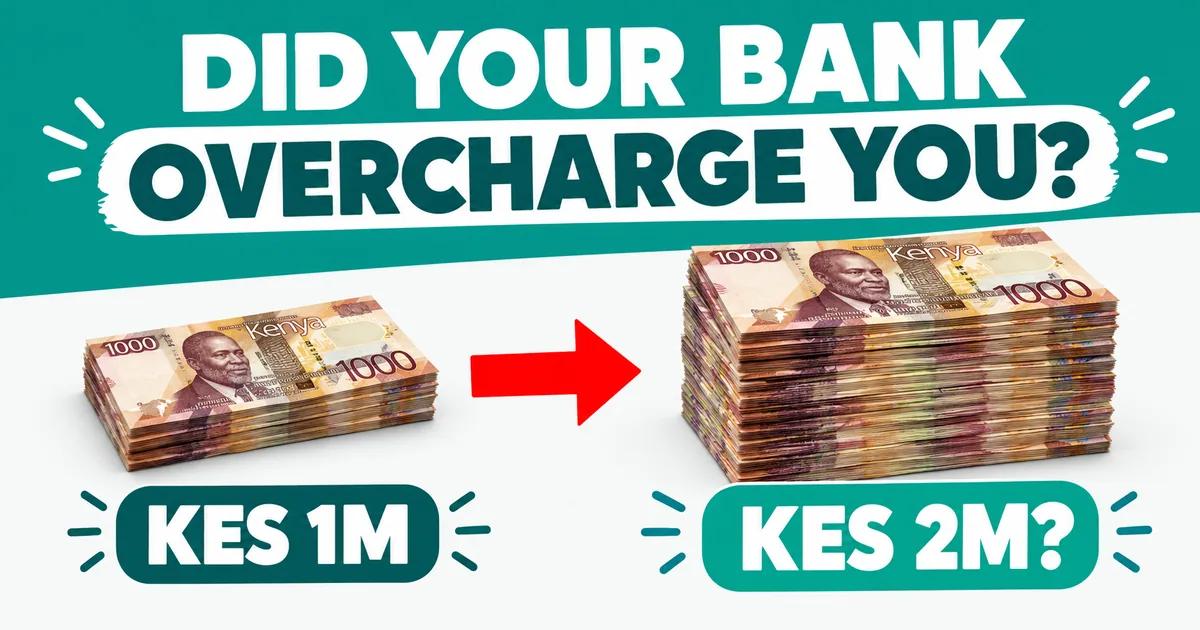
You borrowed KES 1 million. Your statement shows you have paid, or still owe, about KES 2 million. Is that legal?
Short answer: Often yes, and it is just the maths of a long or flat-rate loan. It becomes illegal when a bank adds interest beyond the legal cap on a loan that has gone bad, charges fees it never disclosed, or changes your rate in a way your contract or the law does not allow. This guide shows how to tell the difference, with examples.
Think your loan statement is wrong? Talk to us on +254 724 671 596 or info@wecompare.africa.
Part 1: Why the total can reach 2 million
Tenure: time makes interest grow
Interest is charged month after month, so a long loan costs a lot even at a fair rate.
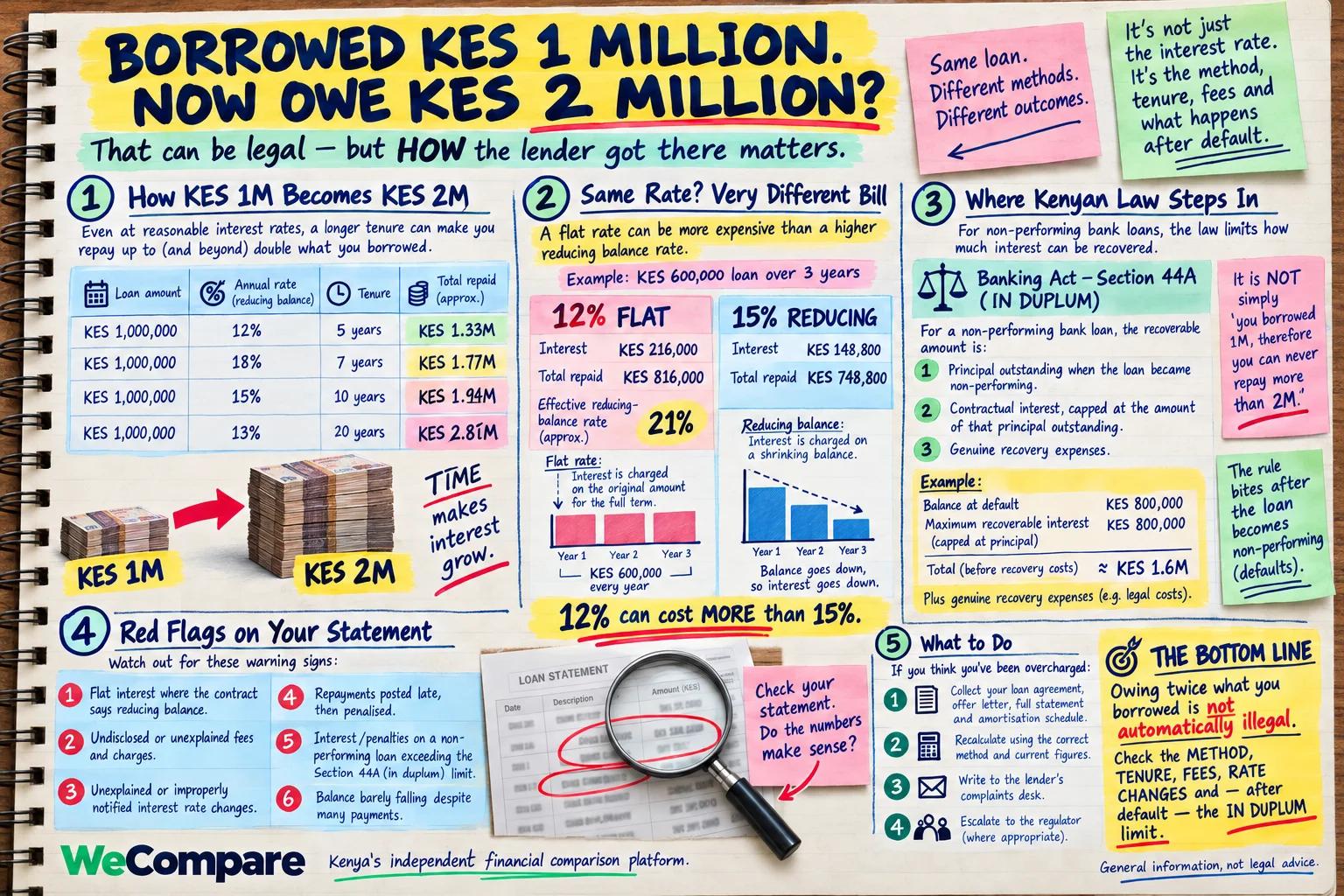
| Loan of KES 1M | Monthly payment | Total repaid |
|---|---|---|
| 12% reducing balance, 5 years | KES 22,244 | KES 1.33M |
| 18% reducing balance, 7 years | KES 21,018 | KES 1.77M |
| 15% reducing balance, 10 years | KES 16,133 | KES 1.94M |
| 13% reducing balance, 20 years (mortgage) | KES 11,716 | KES 2.81M |
Flat vs reducing balance: the same percentage, very different cost
A reducing balance rate charges interest only on what you still owe. As you repay, the balance shrinks and so does the interest. A flat rate charges interest on the original amount for the whole loan, even after you have repaid most of it.
A 14% flat rate over 5 years on KES 1 million means KES 700,000 in interest, which is about 23% reducing balance. A 10% flat rate over 3 years is about 17.9% reducing.
Why a SACCO's flat 12% can cost more than a bank's 15%
It looks backwards, but it is simple once you see the calculation. Take the same KES 600,000 loan over 3 years (36 months):
| SACCO: 12% flat | Bank: 15% reducing | |
|---|---|---|
| How interest is worked out | 12% of the full KES 600,000, every year, for 3 years | 15% only on the balance still owing each month |
| Total interest | KES 216,000 | about KES 148,800 |
| Monthly payment | about KES 22,667 | about KES 20,799 |
| Total you repay | KES 816,000 | about KES 748,800 |
| Real (reducing-balance) rate | about 21% | 15% |
In plain words: The SACCO's "12%" is never reduced, even in month 35 when you owe almost nothing. So you pay about KES 67,000 more, even though 12 sounds smaller than 15. Always ask: is this flat or reducing? Then compare the total you will repay.
Fees add to the total
CBK's consumer protection guidelines define the total cost of credit as everything payable beyond the amount borrowed. That includes interest, fees, charges, commissions, and third-party costs like legal fees, insurance and valuation. The lender must display it prominently before you sign.
Default: this is where the law steps in
If you stop paying, penalties and interest can balloon. That is what the law in Part 2 is designed to limit.
Part 2: The laws that protect you
Sections are paraphrased below. For exact wording, read the Acts on Kenya Law (new.kenyalaw.org).
1. Banking Act (Cap. 488), section 44A: the in duplum rule
This is the rule behind the "2M" ceiling. In duplum is Latin for "in double".
- What it says: on a non-performing loan, a bank can recover only the principal owing when the loan became non-performing, contractual interest not exceeding that principal, and its recovery expenses.
In plain words: Imagine you borrowed KES 100 and stopped paying. The bank cannot keep adding interest forever. Once the interest added equals the KES 100 you owed when you stopped, it must stop. The most the bank can ask for is about KES 200, plus the real costs of collecting.
Example: Wanjiru repays her KES 1 million loan until she owes KES 800,000, then stops paying for over 90 days. The bank can recover the KES 800,000, plus interest up to another KES 800,000, plus its genuine recovery costs, so about KES 1.6 million. If the bank later demands KES 2.3 million, she has strong grounds to challenge it.
- Origin: introduced on 1 May 2007 through the Banking (Amendment) Act No. 9 of 2006.
- When it bites: only once a loan is non-performing, meaning no payment for 90 days or more. If you pay on time, interest accumulates normally.
- Section 44A(4), the court-order exception: the rule does not limit interest that accrues under a court order after the order is made.
In plain words: If the bank sues and the judge orders you to pay, that order starts a new chapter. Interest that the court allows to run after the order is not covered by the cap.
Example: A court orders Wanjiru to pay KES 1.6 million. If she ignores the order, interest on that judgment can keep running. Lesson: do not ignore court papers. Negotiate a settlement or restructure early.
- Who it covers: "institutions" as defined in section 2 of the Act, meaning a bank, financial institution or mortgage finance company.
- Case law:
- Mwambeja Ranching Company Ltd v Kenya National Capital Corporation [2019] KECA 436: the Court of Appeal held the rule applies to the total outstanding debt, including arrears and accumulated interest.
- Kenya Hotels Ltd v Oriental Commercial Bank [2019] KECA 250: the Court of Appeal upheld retrospective application of section 44A.
- National Bank of Kenya v Onkoba (2025): the High Court held that a bank demand of over four times the principal was a clear breach.
Does it apply to lenders that are not banks?
Courts are split. The statute speaks of banks and similar institutions, but judges have applied the same fairness idea more widely.
- Momentum Credit Ltd v Kabuiya [2022] KEHC 13705 (KLR): the High Court held that non-deposit-taking lenders are not bound by the Banking Act rule.
- HELB case: a court held the rule applies to all lenders, including HELB.
- Digital lenders (2022 Digital Credit Providers Regulations): these regulations apply the rule to digital lenders.
In plain words: Loan apps and online lenders have their own rulebook from CBK, and it includes the same idea: the lender cannot pile fees and interest far beyond what you originally owed.
Example: You borrow KES 10,000 from a licensed loan app and cannot repay. The interest, fees and penalties should not balloon beyond roughly another KES 10,000. If the app demands KES 35,000, you can challenge it.
- SACCOs: courts have applied the principle to SACCO and similar loans on public-policy grounds, even though SACCOs fall under the Sacco Societies Act and SASRA, not the Banking Act.
In plain words: The written rule does not automatically cover SACCOs, but judges can say that charging far more than double is simply unfair and cut it down. It is not guaranteed, so each case depends on its facts.
Example: A SACCO member borrows KES 500,000, defaults, and the SACCO demands KES 1.4 million. The member can go to court arguing the charge is oppressive, and the court may cap it near double.
- Reform: in September 2025 a petition asked Parliament to write the in duplum rule into the Consumer Protection Act. The Business Laws (Amendment) Act 2024 did not directly amend section 44A.
In plain words: Today the rule sits in a banking law that mainly covers banks. The petitioner wants it moved into general consumer law so every lender is covered. A petition is only a request, not law, and section 44A is unchanged for now.
2. Banking Act, section 44: approval before rate increases
Section 44 requires prior approval from the Cabinet Secretary for the National Treasury before a bank increases its rates or banking charges. Courts have held that the approval must come from the Cabinet Secretary directly, not just through delegated authority, and recent judgments expose banks to refund claims for increases made without it.
This provision is under challenge. The High Court upheld section 44 in December 2025. On 13 August 2026 it issued a conservatory order suspending the section while the Court of Appeal hears the matter. CBK's position is that changes to the policy rate should flow straight into lending rates.
3. Land Act, 2012: loans secured on land
If your house or land is the security (a "charge" or mortgage), the Land Act adds protections.
- Section 84, variation of interest rate: reported to require 30 days' written notice before a variable rate changes.
In plain words: If your land secures the loan, the bank cannot quietly raise your rate. It must tell you in writing well before the new rate starts.
Example: If the bank wants the new rate from 1 January, your notice should reach you by about 2 December. A rate increase with no notice is something to challenge.
- Section 90, notice of default: the chargee must serve a written notice of the default and allow a period, typically three months, to fix it before enforcing.
In plain words: The bank cannot take your land the day after you miss a payment. It must first warn you in writing and give you time to catch up.
Example: You miss three instalments. The bank must serve a notice listing what you owe and giving you roughly three months to pay the arrears. An auction notice with no earlier default notice is a serious defect.
- Section 92, right to redeem: you can redeem the charge at any point before the chargee completes the transfer to a buyer.
In plain words: Until the land is actually transferred to a new buyer, you can still pay off what you owe and keep your property.
Example: The bank advertises your plot for sale. Before the transfer is signed, you raise the full amount owed, including the bank's lawful costs, and the land stays yours.
4. Consumer Protection Act, 2012 (No. 46 of 2012)
- Unconscionable conduct: the Act prohibits unconscionable representations by suppliers, including lenders.
In plain words: "Unconscionable" means so unfair that it takes advantage of someone who cannot protect themselves, for example by misleading or pressuring them.
Example: A lender advertises a loan as "no hidden charges", then deducts a processing fee and insurance from the amount paid out. Or a lender rushes a borrower who cannot read the contract into signing. Both are the kind of conduct this protection targets.
- Recovering unlawful charges: a consumer can bring an action to recover an amount charged in contravention of the Act.
In plain words: If you were charged something the Act does not allow, you can ask a court to order the money back. (This refers to the Consumer Protection Act's own enforcement section, which is separate from section 84 of the Land Act above.)
Example: You discover a fee on your statement that breaks the Act. You can demand a refund and, if refused, sue to recover it.
- Prepayment rights: the Act gives consumers rights on loan prepayment, so lenders cannot simply prohibit it.
In plain words: If you get a bonus and want to clear your loan early, the lender cannot just say no. It may still have lawful terms about the payoff amount, so read your contract.
- Rate-setting considerations: the Act sets out matters lenders must consider when setting interest rates.
In plain words: Lenders are not free to pick any number they like. They must act fairly and give you the information you need about the rate.
- Case law: in Margaret Njeri Muiruri v Bank of Baroda (Kenya) Ltd [2014] eKLR, the Court of Appeal found that failing to give the borrower information on interest rates was unfair, and that lenders have no unfettered discretion to charge exorbitant interest.
Example: A bank raises the rate but never tells the borrower what the new rate is or why. Under this case, that silence counts against the bank.
5. Constitution of Kenya, 2010
- Article 46 protects consumer rights, including fair treatment and protection of economic interests.
- Article 43 protects economic and social rights.
In plain words: In the HELB case, three former students found their loans had grown to more than double what they borrowed. The court said students should not face harsher terms than bank borrowers, and held that charging interest and penalties beyond the principal violated these constitutional rights. Once the amount owed reached double the principal, interest and fines had to stop.
Example: A graduate borrowed KES 200,000 for university. After years of penalties the balance is KES 650,000. Under that ruling, the balance should not have grown past about KES 400,000.
6. CBK Prudential Guidelines (consumer protection)
- Total cost of credit must be disclosed before you sign.
- Complaints: institutions should acknowledge a complaint within 7 days.
In plain words: Seven days is for the bank to confirm it received your complaint and is handling it. It does not mean the problem is solved in seven days.
- Draft revisions: CBK opened public comment on revised draft Prudential Guidelines on 10 September 2026.
In plain words: CBK is updating its rulebook and asking the public for views. Nothing has changed yet, but numbers and timelines in the guidelines may change later.
7. CBK's KESONIA pricing framework
This is a regulatory framework, not an Act of Parliament.
In plain words: KESONIA stands for Kenya Shilling Overnight Interbank Average. Banks often borrow from each other overnight to balance their books. KESONIA is the average rate they charge each other. CBK now uses it as the common starting point for variable loan rates, so every bank begins from the same number and then adds its own premium.
- New variable KES loans are priced at the KESONIA base rate plus a risk-based premium, from 1 September 2025.
- Existing variable loans had to migrate by 28 February 2026.
- The Central Bank Rate can be used where KESONIA is not practical.
- Fixed-rate and foreign-currency loans are outside the framework.
For context, KESONIA was 8.7519% on 22 September 2026, and the average bank lending rate was 14.39% in July 2026. The gap is the bank's premium and costs. It is not automatic proof of overcharging, and two borrowers at one bank can lawfully pay different rates.
| Amina (clean credit record) | John (weak credit record) | |
|---|---|---|
| KESONIA base (rounded) | 8.75% | 8.75% |
| Bank premium for risk and costs (illustrative) | 4% | 9% |
| Rate charged | 12.75% | 17.75% |
The premiums above are illustrative only. Real premiums differ by bank and borrower.
There is also no statutory cap on lending rates. The 2016 cap was repealed in 2019.
Part 3: Fixed vs variable interest
| Fixed | Variable | |
|---|---|---|
| Rate | Locked for an agreed period | Moves with the KESONIA or CBR benchmark |
| Payment | Predictable | Can rise or fall |
| Main risk | Overpaying if rates fall | Higher payments if rates rise |
| Watch for | Review or reset clauses | How the premium is set and changed |
Can the bank change your rate mid-loan?
- Fixed: not during the fixed period, unless your contract has a review clause.
- Variable: yes, but only as your agreement allows and in line with the benchmark. For land-secured loans, check the Land Act notice rules. Section 44's approval requirement is currently in legal limbo.
Example: KES 1M at 15% over 5 years is KES 23,790 a month. If the rate rises to 17% after 2 years, the payment on the remaining balance becomes about KES 24,468 for the last 3 years, roughly KES 700 more a month.
Part 4: Red flags on your statement
- Interest charged flat when your contract says reducing balance.
- Fees missing from your offer letter or disclosure.
- A rate change with no written notice, or one that does not match your contract.
- Repayments not posted on time, followed by penalties.
- Interest and penalties on a non-performing loan exceeding the principal, which breaches section 44A.
- A balance that barely falls after many months of payments.
Part 5: How to dispute
- Collect documents: loan agreement, offer letter, full statement, amortisation schedule.
- Recalculate using a reducing-balance calculator (try the WeCompare loan calculator) and compare it to the statement.
- Write to the bank's complaints desk and keep proof of delivery.
- Escalate to CBK if unresolved. CBK cannot consider matters already before a court.
- Go to court: the Small Claims Court for smaller claims (confirm the current monetary limit), or the High Court for larger ones. Disputes about land and mortgages go to the Environment and Land Court.
- Keep paying the undisputed amount if you can, to avoid default, penalties and CRB listing.
In plain words: The Environment and Land Court is the specialist court that hears land disputes, including fights over charges and mortgages. It was created under the Environment and Land Court Act, 2011, and the Land Act refers to it as "the Court" for land-related claims. If the bank is threatening to sell your land, this is where you would go.
The bottom line
Owing twice what you borrowed is not automatically illegal. Check the method (flat or reducing), the tenure, the fees, any rate changes, and, if you have defaulted, whether the section 44A in duplum limit has been breached. Then compare personal loans on total cost, not just the headline rate.
Borrowers in debt are also a target for fake "quick fix" offers. Before you move money anywhere, read our guide to the 5 red flags of an investment scam in Kenya.
Frequently asked questions
Is it legal to pay back double what I borrowed?
Yes, if the loan is long or quoted at a flat rate. For example, KES 1 million at 15% reducing balance over 10 years costs about KES 1.94 million in total. It is not legal if the loan has gone bad and the bank has added interest beyond the cap in section 44A of the Banking Act, or if it charged fees you were never told about.
Why is my loan balance barely falling?
In the early months most of each payment goes to interest. On KES 1 million at 15% over 10 years, about KES 12,500 of the first KES 16,133 payment is interest and only about KES 3,600 reduces the loan. Ask your bank for the amortisation schedule and compare it with your statement.
What is the difference between flat and reducing balance interest?
Reducing balance charges interest only on what you still owe, so interest falls as you repay. Flat rate charges interest on the original amount for the whole loan. A 12% flat rate over 3 years on KES 600,000 costs about KES 816,000 in total, which is equivalent to roughly 21% reducing balance.
Can my bank change my interest rate after I sign?
On a fixed rate, not during the fixed period unless your contract has a review clause. On a variable rate, yes, but only as your agreement allows and in line with the benchmark. If the loan is secured on land, the Land Act also deals with notice before a variable rate changes, so check your charge documents.
What is KESONIA?
KESONIA is the average rate at which banks in Kenya lend to each other overnight in shillings. Under CBK rules, new variable-rate shilling loans are priced at KESONIA plus a bank premium based on your risk profile. Existing variable loans had to move to this model by 28 February 2026.
What is the in duplum rule in Kenya?
It is a rule in section 44A of the Banking Act that stops interest piling up forever on a loan that has gone bad. On a non-performing loan, a bank can recover the principal, interest up to the same amount as that principal, and its recovery costs. For example, if you stopped paying when you owed KES 800,000, the interest is capped at about KES 800,000.
Does the in duplum rule apply to SACCO and mobile loans?
The statute covers banks and similar institutions. Courts have been divided on other lenders, digital lenders are covered by the 2022 Digital Credit Providers Regulations, and courts have applied the principle to some SACCO and HELB loans on fairness grounds. Get advice on your specific lender.
Can I repay my loan early to save interest?
On a reducing balance loan, yes. Interest is charged on what you still owe, so paying early cuts it. On KES 600,000 at 15% over 3 years, clearing the loan after 12 payments saves roughly KES 70,000 in future interest. The Consumer Protection Act gives consumers prepayment rights, but check for early repayment fees, and check whether a flat-rate loan gives any rebate.
Is there a cap on bank interest rates in Kenya?
No. The 2016 cap was repealed in 2019. Banks must still disclose the total cost of credit before you sign, and the in duplum rule limits what they can recover on defaulted loans.
How do I complain about wrong loan charges?
Request your agreement and full statement, recalculate the charges, write to the bank with proof of delivery, then escalate to the Central Bank of Kenya if unresolved. CBK cannot handle matters that are already in court. For court action, smaller claims can go to the Small Claims Court and larger ones to the High Court.
Why would a flat-rate loan not save interest if I pay early?
On a reducing balance loan, early repayment cuts interest because it is charged on what you still owe. On a flat-rate loan the total interest is worked out up front on the original amount, so many lenders still count the full amount unless the contract gives a rebate. Example: on a KES 600,000 SACCO loan at 12% flat over 3 years, the KES 216,000 interest is fixed at the start. If you clear the loan after one year, ask in writing how much of it is still due.
General information, not legal advice. Laws, rates and court orders change, so confirm the current position with CBK or an advocate before acting. Figures in examples are illustrations.
Join the discussion
Please do not share account numbers, phone numbers, links or other personal details. Comments are general discussion, not advice. All comments are reviewed before they appear, and we may remove comments that break these rules.