5 Red Flags It's an Investment Scam in Kenya
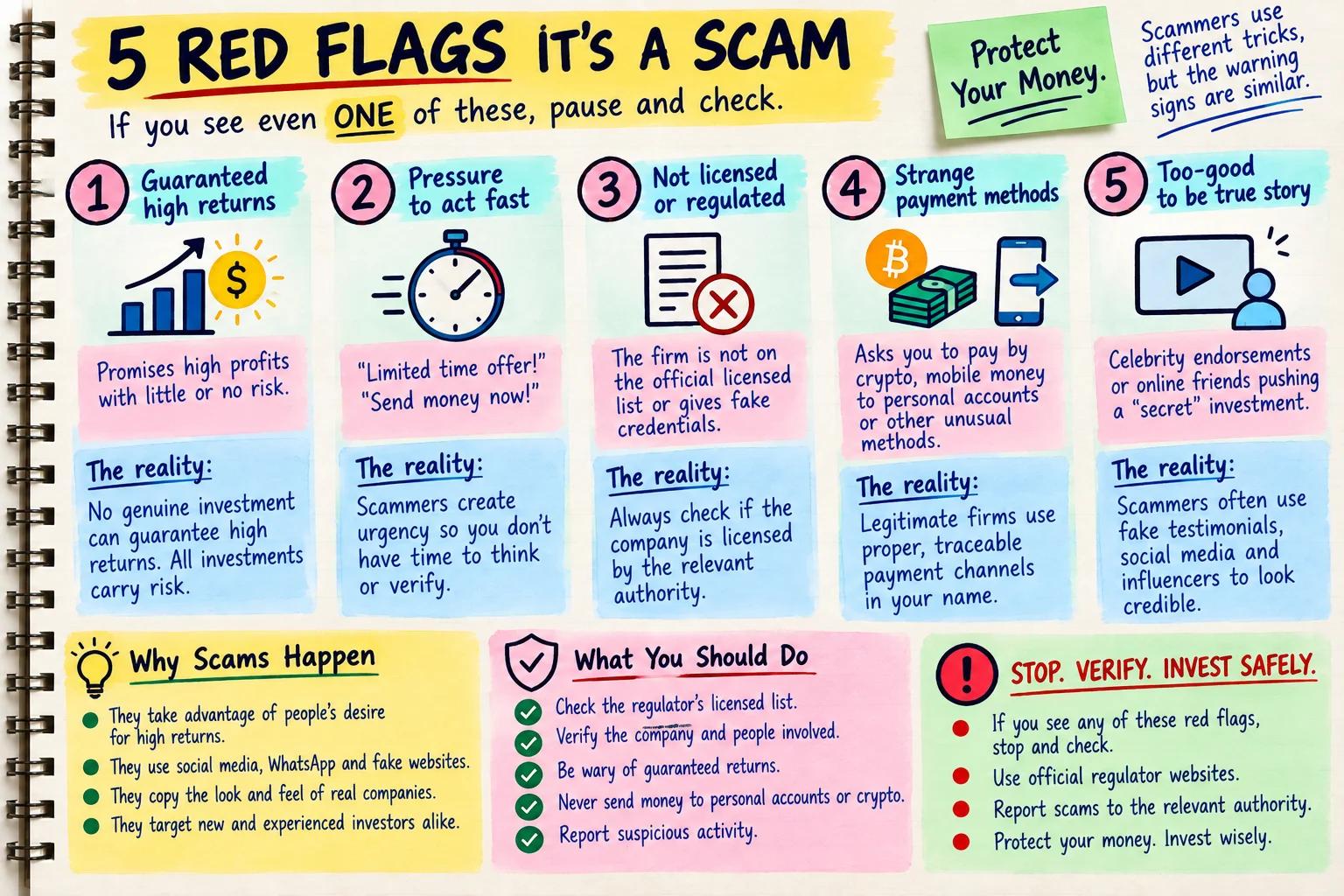
Scammers use different tricks, but the warning signs are similar. If you see even one of the five red flags below, pause and check before you send any money.
Short answer: Be suspicious of any offer that promises high returns with little or no risk, rushes you to pay, cannot be found on the regulator's licensed list, asks you to pay into a personal account or in crypto, or leans on celebrity endorsements. Verify the firm with the regulator first, then invest only through traceable channels in your own name.
The 5 red flags
1. Guaranteed high returns
What you hear: a promise of high profits with little or no risk.
The reality: no genuine investment can guarantee high returns. All investments carry risk. Some products do have a stated rate set out in a contract, such as a bank fixed deposit or a Treasury bill, but those rates are in line with the market and come from a regulated institution. A promise of returns far above what comparable products pay, with "no risk", is the red flag. Fund yields, such as those of money market funds, move over time. You can see current figures on our money market fund comparison.
2. Pressure to act fast
What you hear: "Limited time offer!" "Send money now!"
The reality: scammers create urgency so you do not have time to think or verify. A real investment will still be there tomorrow, after you have checked it.
3. Not licensed or regulated
What you hear: the firm claims to be licensed, or shows you a certificate.
The reality: the firm is not on the official licensed list, or it gives fake credentials. Always check that the company is licensed by the relevant authority, using the regulator's own website and not a link or document the firm sends you. See "Check the regulator's list" below.
4. Strange payment methods
What you hear: you are asked to pay by crypto, by mobile money to a personal account, or by some other unusual method.
The reality: legitimate firms use proper, traceable payment channels in your name. Never send money to a personal account or in crypto to "secure" an investment.
5. A too-good-to-be-true story
What you hear: celebrity endorsements, or online friends pushing a "secret" investment.
The reality: scammers often use fake testimonials, social media and influencers to look credible. A famous face or a screenshot of someone's "profits" proves nothing.
Not sure whether an offer is genuine? Send us the details and we will point you to the right regulator list. Talk to us on +254 724 671 596 or info@wecompare.africa.
Why scams happen
- They take advantage of people's desire for high returns.
- They use social media, WhatsApp and fake websites.
- They copy the look and feel of real companies.
- They target new and experienced investors alike.
In plain words: Scams work because they look and sound like the real thing. Being smart or experienced does not protect you; checking does.
What you should do
- Check the regulator's licensed list. See below for which regulator covers what.
- Verify the company and the people involved. Look for a real office, named directors and a track record you can confirm independently.
- Be wary of guaranteed returns. See red flag 1.
- Never send money to personal accounts or crypto. See red flag 4.
- Report suspicious activity. Tell the relevant regulator, and report fraud to the police.
Check the regulator's list
The right regulator depends on what is being sold. Type the address in yourself rather than following a link from the offer.
| If the offer is… | Check with | Where to look |
|---|---|---|
| Investment schemes, funds, stockbrokers, fund managers or investment advisers | Capital Markets Authority (CMA) | CMA licensees list (covers fund managers, investment advisers, stockbrokers and approved collective investment schemes) and CMA investor protection (complaints procedure) |
| A bank or other financial institution | Central Bank of Kenya (CBK) | CBK regulations and licensing (see "Licensed Institutions") |
| A SACCO taking deposits | SACCO Societies Regulatory Authority (SASRA) | SASRA licensed deposit-taking SACCOs (SASRA says it is illegal to take deposits without a licence and asks the public to verify a SACCO against this list) |
| A fraud, or an offer that is already taking money | Directorate of Criminal Investigations (DCI) | DCI investigative services (lists investigation of financial fraud and scams) |
In plain words: If you cannot find the firm on the list for what it is selling, treat it as unlicensed until proven otherwise. A licence for one activity does not cover another, so check that the exact product is covered. Regulator websites change, so if a page has moved, search from the regulator's home page.
Stop. Verify. Invest safely.
- If you see any of these red flags, stop and check.
- Use official regulator websites.
- Report scams to the relevant authority.
- Protect your money and invest wisely.
Once you have verified a provider, compare regulated options side by side: money market funds, Treasury bills, fixed deposits, unit trusts and SACCOs. New to money market funds? Start with 6 questions everyone asks about money market funds in Kenya. Our investments pillar lists everything we compare.
Frequently asked questions
Can an investment in Kenya guarantee high returns?
No genuine investment can guarantee high returns, because all investments carry risk. A fixed deposit or Treasury bill has a stated rate, but a promise of far-above-market returns with no risk is a red flag.
How do I check whether an investment company is licensed in Kenya?
Use the relevant regulator's own website: the Capital Markets Authority for funds and brokers, the Central Bank of Kenya for banks, and SASRA for deposit-taking SACCOs. Type the address yourself rather than following a link from the offer.
Is it safe to send money to a personal M-Pesa number or crypto wallet to invest?
No. Legitimate firms use proper, traceable payment channels in your name. A request to pay a personal account or send crypto is a red flag.
What should I do if I think I have found a scam?
Stop and send no further money. Report the offer to the relevant regulator and to the police, and keep your messages, receipts and payment records.
General information, not financial or legal advice. WeCompare is not a regulator. Regulator websites and licensed lists change, so confirm directly with the regulator before you invest.
Join the discussion
Please do not share account numbers, phone numbers, links or other personal details. Comments are general discussion, not advice. All comments are reviewed before they appear, and we may remove comments that break these rules.