Banking & payments
Unclaimed Assets in Kenya: How to Check, Claim and Protect Your Money (2026 Guide)
How to check for unclaimed assets in Kenya with *361# or the UFAA portal, the dormancy periods, the documents and forms you need, and how to stop your money going dormant.
This content is editorially independent. We do not currently receive payment from the companies we feature.

Key facts
- The Unclaimed Financial Assets Authority (UFAA) holds dormant money from banks, Saccos, insurers, employers and utilities until the owner or heirs claim it.
- You can search for free by dialling *361# or using the UFAA search portal with your National ID number.
- Dormancy periods run from 1 year (unpaid wages) to 5 years (bank and Sacco deposits).
- UFAA says you do not lose your money once it is remitted to the Authority, and there is no deadline to claim.
- Original owners claim with Form 4A. Heirs of a deceased owner claim with Form 4B and need a death certificate and a court grant.
What are unclaimed assets in Kenya?
An unclaimed asset is money or property that a financial institution, employer or utility has held for a set number of years without hearing from you. Under the Unclaimed Financial Assets Act, 2011, the holder must then hand it over to UFAA. The agency keeps it safe until the rightful owner makes a valid claim.
Common examples are an old bank or Sacco account you stopped using, a refund of a utility deposit, life insurance or annuity proceeds nobody collected, and wages an employer never paid out.
Dormant does not mean lost
Many people assume that once a bank marks an account dormant, the money is gone. It is not. Dormancy is not closure. The money stays legally yours, and UFAA simply acts as the safe-keeper until you make a valid claim.
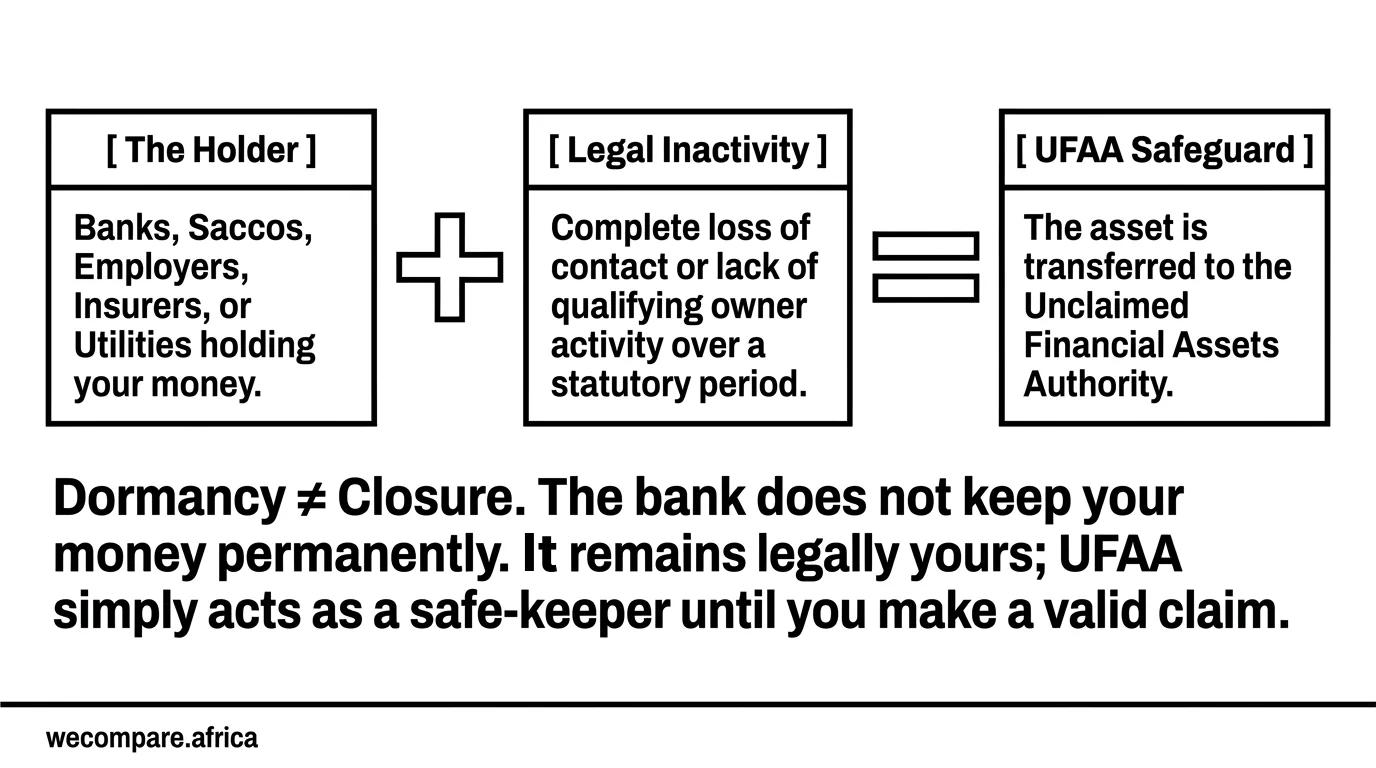
UFAA's own FAQ says you do not lose any unclaimed financial assets once they are remitted to the Authority, and that there is no deadline for filing a claim. The Act also says no interest accrues for the period after an asset became unclaimed, so do not expect your balance to have grown while it sat there.
When does money become unclaimed? The dormancy periods
The clock starts when you last had contact with the holder or when the money became payable. The periods below come from the Unclaimed Financial Assets Act and UFAA's FAQ.
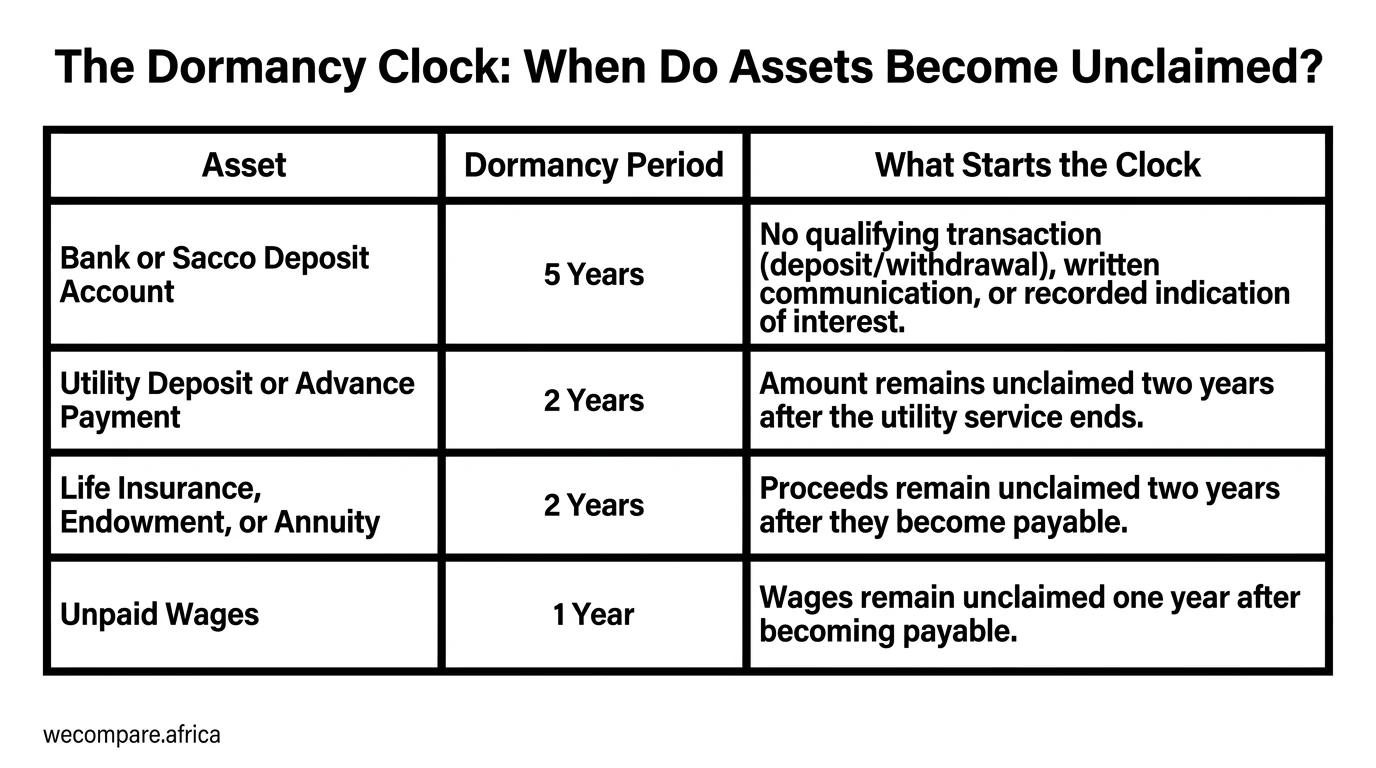
| Asset | Dormancy period |
|---|---|
| Bank or Sacco deposit account (demand, savings, matured time deposits) | 5 years |
| Utility deposit or advance payment | 2 years after service ends |
| Life insurance, endowment or annuity proceeds | 2 years after the money became due |
| Cheques, drafts, money orders and traveller's cheques | 2 years |
| Shares and other ownership interests | 3 years |
| Gift cards and gift certificates | 5 years |
| Unpaid wages and related benefits | 1 year after they became payable |
| Safe deposit box contents | 2 years after the rental period ends |
For bank and Sacco accounts, the clock resets when you make a deposit or withdrawal, write to the institution, or otherwise show you are interested in the account. Ask your institution exactly what it records as activity, because practice can differ.
How banks move dormant money to UFAA
Banks and other holders follow 3 steps before they hand money over.
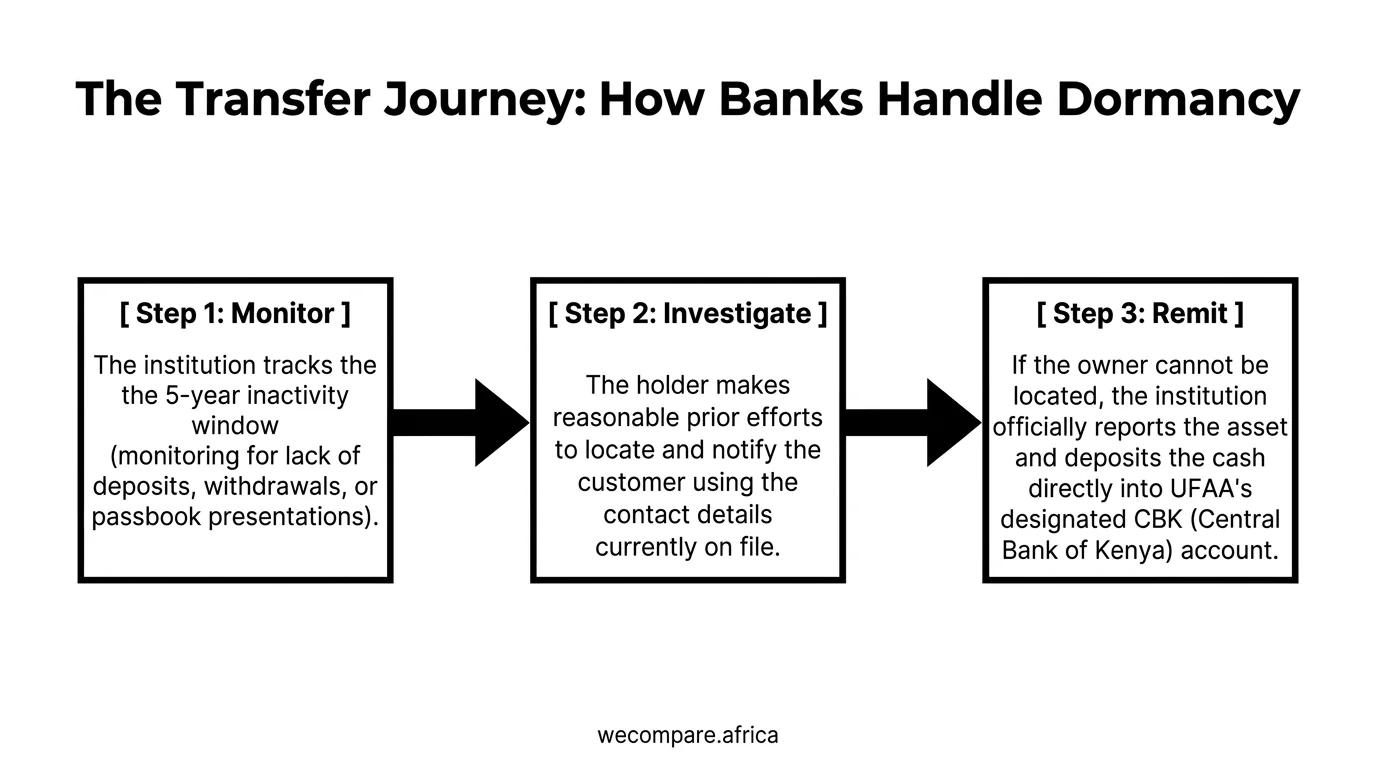
- Monitor. The institution watches the inactivity window, such as no deposits or withdrawals on an account.
- Investigate. It makes reasonable efforts to find and notify you using the contact details on file. This is why outdated phone numbers and addresses are the biggest cause of lost money.
- Remit. If it cannot reach you, it reports the asset and pays the money to UFAA's account at the Central Bank of Kenya.
How to check if you have unclaimed assets
There are 3 ways to search. All are free to use.
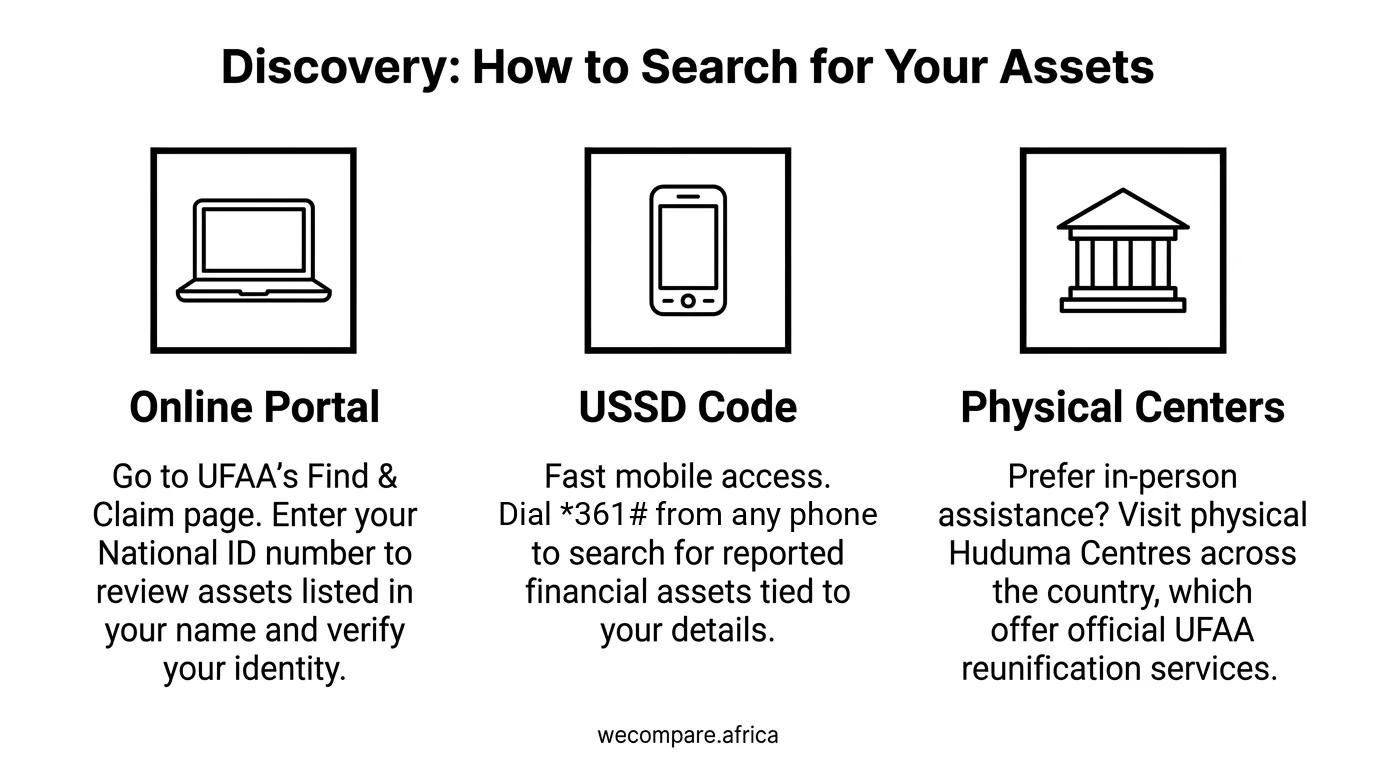
- Online. Go to the UFAA website at ufaa.go.ke and use the "Find and claim assets" link. Enter your National ID number to see assets listed in your name. Always reach the portal from the official ufaa.go.ke site, not from an advert or a message.
- USSD. Dial *361# on your phone and follow the prompts to search for assets tied to your details.
- In person. UFAA services are available at Huduma Centres, and you can visit the UFAA offices at Pacis Centre, 2nd Floor, Slip Road, off Waiyaki Way, Westlands, Nairobi.
You can also call UFAA on 020 4023 000 or 0706 866 984, or email info@ufaa.go.ke.
Search for your own name, your spouse's, your parents' and, if you ran one, your business or Sacco membership. Try spelling variations of your name, because records often differ from your ID.
What you need to claim
Documents differ slightly by asset type, so always check UFAA's current claiming instructions before you submit. The standard set for an original owner is below.
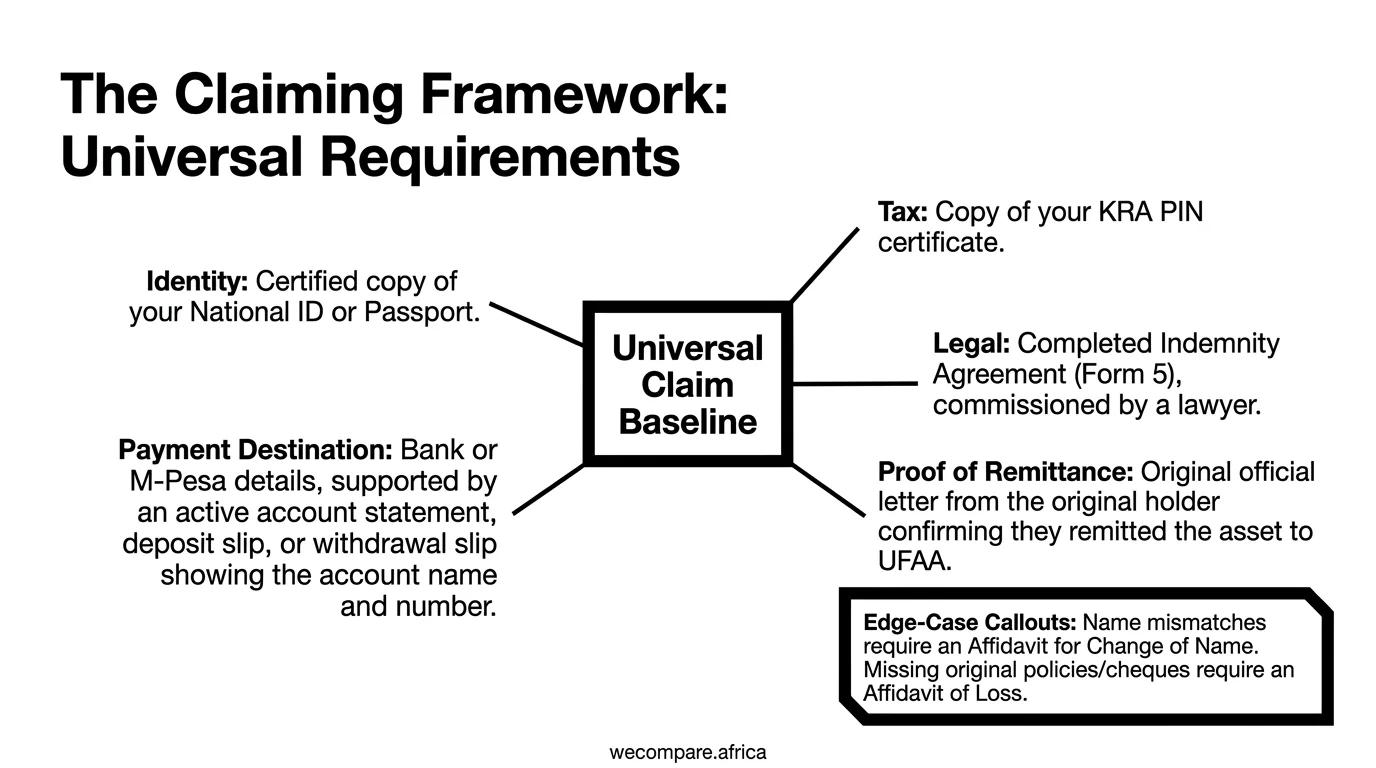
- Claim form. Original Owner's Claim Form (Form 4A), completed and commissioned.
- Indemnity agreement. Form 5, completed and commissioned by a lawyer.
- Identity. A copy of your National ID or passport, certified by a lawyer.
- Tax. A copy of your KRA PIN certificate. If you need one, see our KRA iTax guide.
- Proof from the holder. An original official letter from the bank, Sacco, insurer or employer confirming it remitted the asset to UFAA.
- Payment details. The Claimant Bank Details Form, with a recent 1-page bank or M-Pesa statement, or a deposit or withdrawal slip, showing the account name and number.
2 common problems:
- Names that do not match. If your name differs between your ID, KRA PIN and the holder's records, or any name is only an initial, UFAA asks for an affidavit to explain it.
- Lost insurance policy. If you cannot find the original policy document for an insurance claim, UFAA asks for a lawyer's affidavit.
UFAA says searching and claiming is free of charge. You will still pay for the lawyer to certify and commission your documents, so budget for that. Be wary of anyone who asks you for a fee to "release" your money.
Original owner or heir: which path applies?
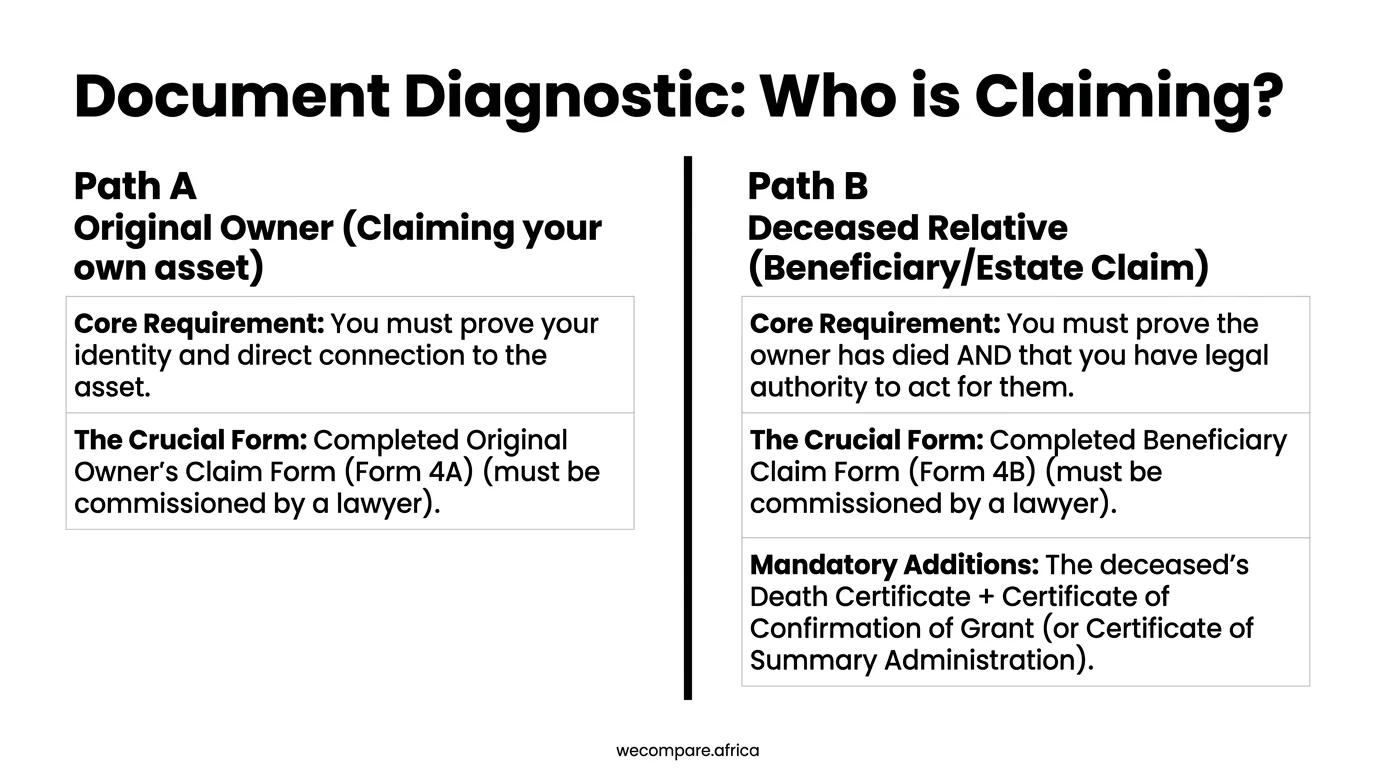
Path A: you are the owner. You prove your identity and your link to the asset, and file Form 4A.
Path B: the owner has died. You file the Beneficiary Claim Form (Form 4B) and add the deceased's death certificate plus a Certificate of Confirmation of Grant or a Certificate of Summary Administration. If the grant names several administrators, all of them must sign the forms.
Why heirs cannot skip the court grant
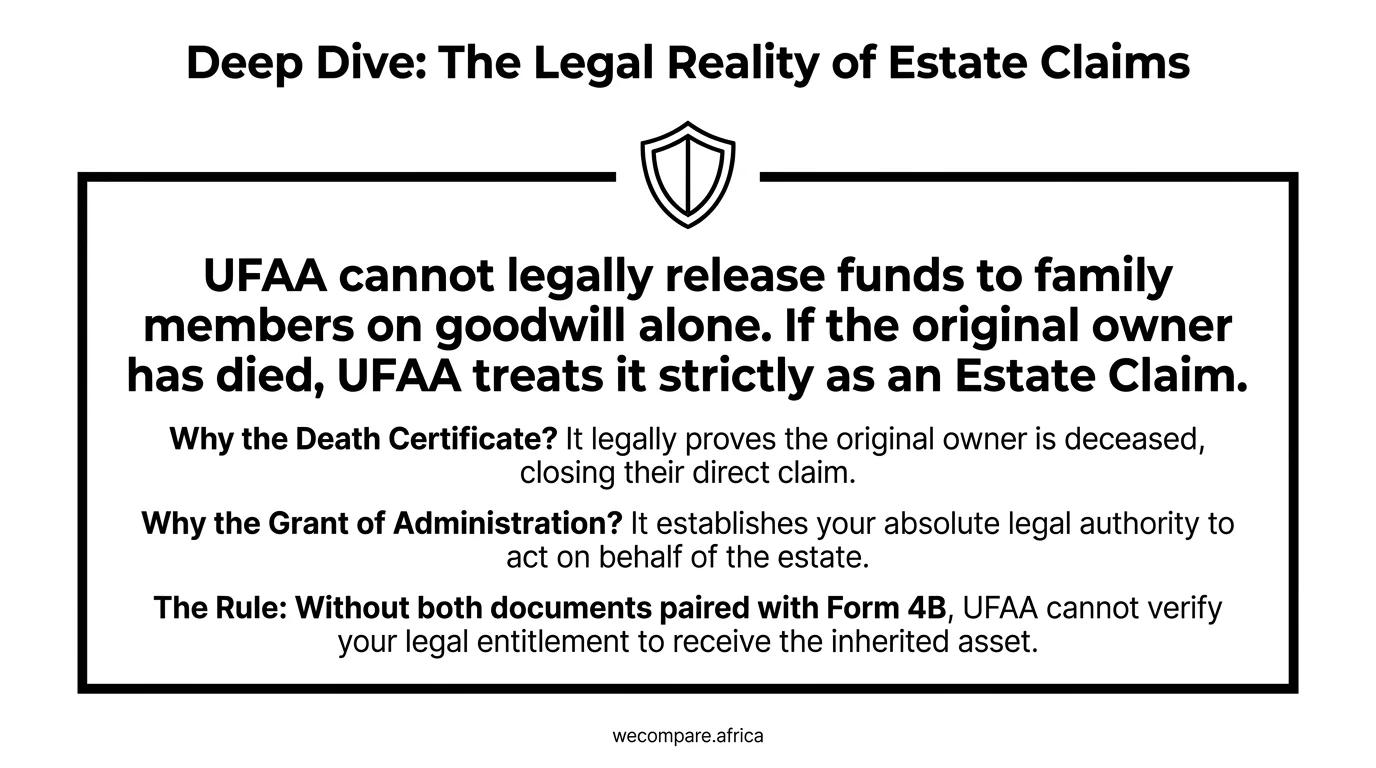
UFAA cannot release money to relatives on goodwill alone. When the owner has died, it treats the claim as an estate claim. The death certificate proves the owner is deceased and closes their own claim. The court grant proves you have legal authority to act for the estate. Without both, paired with Form 4B, UFAA cannot confirm that you are entitled to the money.
If the succession process has not started yet, do that first. A lawyer or the Public Trustee can guide you.
How long does a claim take?
UFAA's FAQ says that once it has a fully supported claim, it takes up to 30 days for an original owner and up to 90 days for a beneficiary. The Act requires the Authority to decide within 90 days of filing and to tell you in writing. If you disagree with the decision, or hear nothing in 90 days, the Act lets you sue the Authority, within strict time limits (90 days after the decision, or 180 days after filing if there was no decision).
How to stop your money becoming unclaimed
Prevention is cheaper than a claim, and it takes minutes.
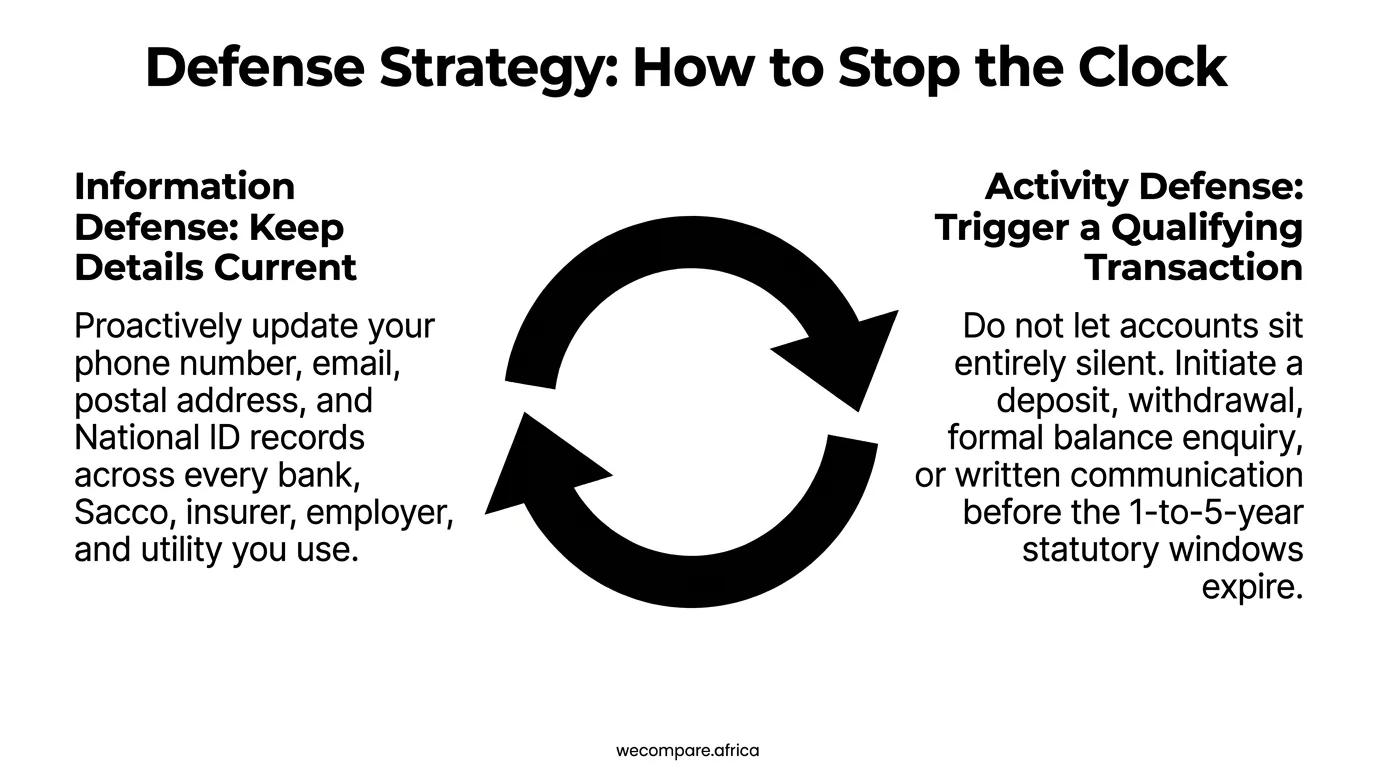
- Keep your details current. Update your phone number, email, postal address and ID details at every bank, Sacco, insurer, employer and utility you use.
- Keep accounts active. Do not let an account sit silent. Make a deposit, a withdrawal or a written request before the dormancy window ends. Ask your institution what counts as activity.
- Tell your family. Keep a simple list of where you hold money, and who your beneficiaries are, so heirs do not have to hunt for it. If you are choosing where to keep savings, see our guide to the best Saccos in Kenya and how Saccos compare with banks.
Your 4-step action plan
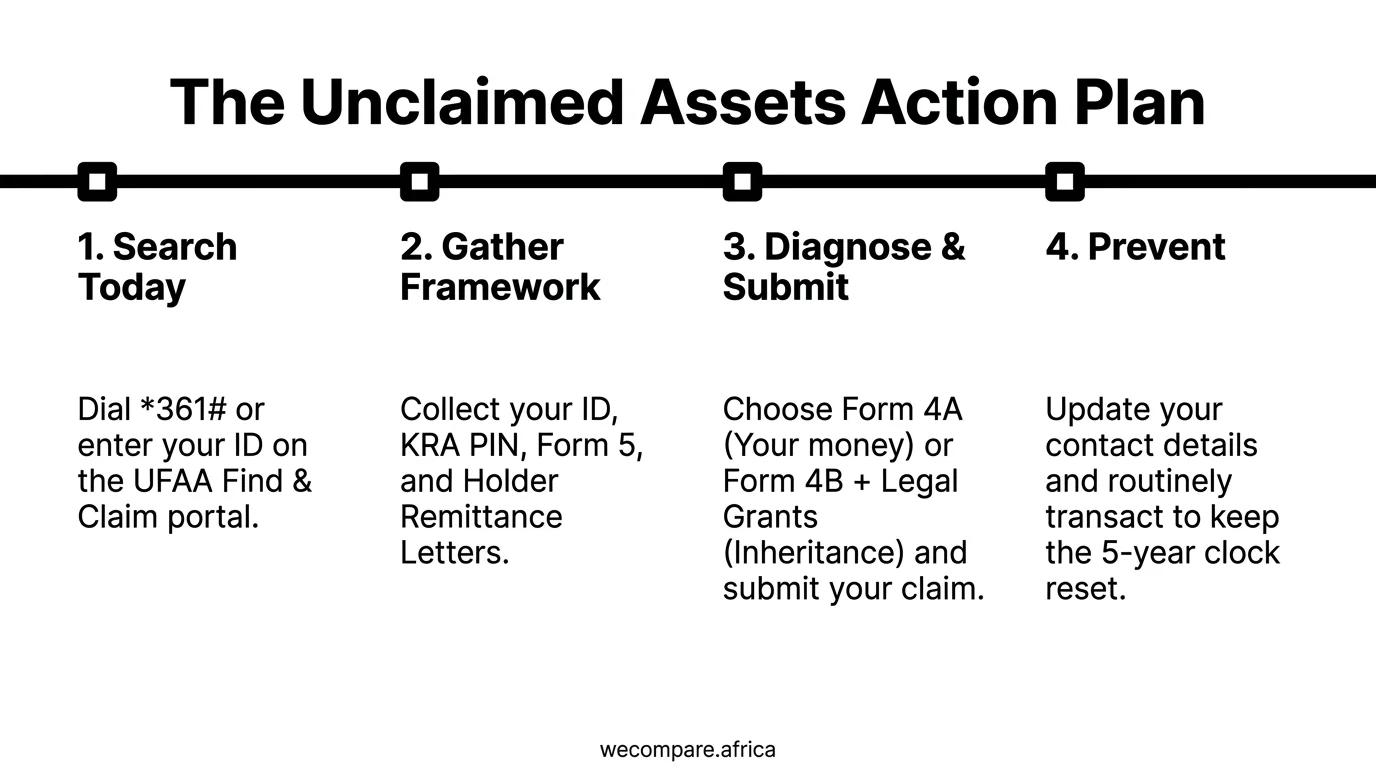
- Search today. Dial *361# or enter your ID on the UFAA search portal.
- Gather your documents. ID, KRA PIN, Form 5 and the holder's remittance letter.
- Choose your form and submit. Form 4A for your own money, or Form 4B with the legal grant for an inheritance.
- Prevent a repeat. Update your contact details and use your accounts regularly.
Frequently asked questions
Is the money still mine if my account went dormant?
Yes. UFAA holds it for you. UFAA's FAQ says you do not lose your assets once they are remitted to the Authority.
Is there a deadline to claim unclaimed assets in Kenya?
UFAA says there is no deadline for filing a claim, so you can claim at any time.
How do I check unclaimed assets with *361#?
Dial *361# on your phone and follow the prompts. You can also search on the UFAA website with your National ID number.
How much does it cost to claim?
UFAA says searching and claiming is free. You will pay for a lawyer to certify your ID and commission your forms. Do not pay anyone who promises to release your money faster.
Can I claim money that belonged to a deceased relative?
Yes, as a beneficiary. You file Form 4B with a death certificate and a Certificate of Confirmation of Grant or Certificate of Summary Administration.
How long does a UFAA claim take?
UFAA says up to 30 days for an original owner and up to 90 days for a beneficiary, counted from when it has a fully supported claim.
Sources and how we checked this guide
We checked the dormancy periods, forms and timelines against the Unclaimed Financial Assets Act, 2011 (No. 40 of 2011, Kenya Law) and UFAA's own pages: the FAQ, the claiming instructions and the home page. Rules, forms and contact details can change, so confirm on ufaa.go.ke before you submit. The graphics were made by WeCompare with AI tools from the same material. This guide is general information, not legal advice. For estate claims, speak to a lawyer.
Found something out of date? Report an error.
How WeCompare earns money: This content is editorially independent. We do not currently receive payment from the companies we feature. See our advertiser disclosure.
Written by Oscar Radido Oyomba. Last checked: 23 November 2026.
Share this guide
Get WeCompare updates
New guides and rate changes, by email. Unsubscribe any time.
Join the discussion
Please do not share account numbers, phone numbers, links or other personal details. Comments are general discussion, not advice. All comments are reviewed before they appear, and we may remove comments that break these rules.