Banking & payments
Did KCB and Equity Slip in Africa's Bank Rankings in 2026?
Reports differ on whether KCB and Equity slipped in Africa's 2026 bank rankings. What the numbers say, why a dollar ranking can move, and what it means for customers.
This content is editorially independent. We do not currently receive payment from the companies we feature.
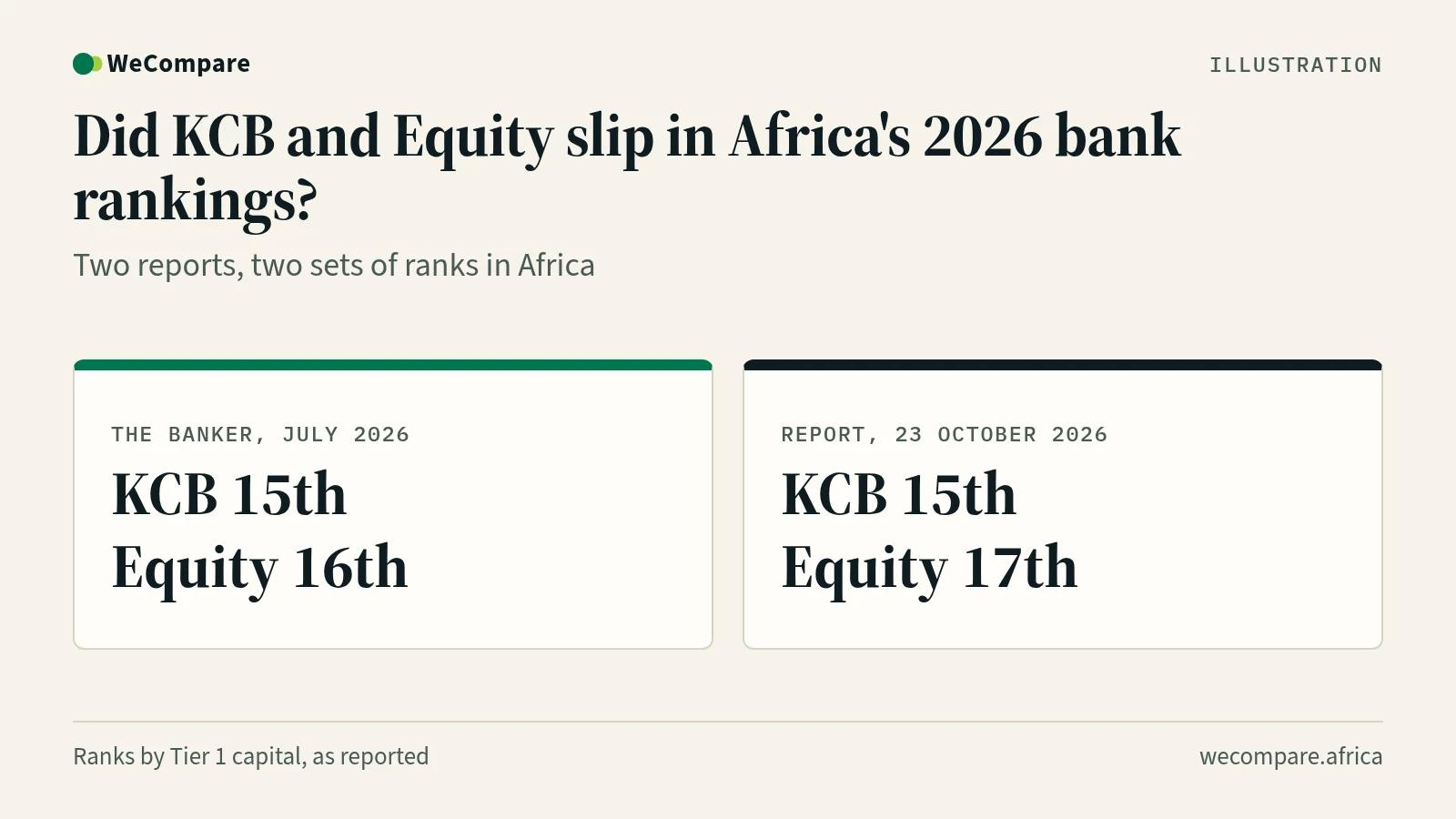
In The Banker's 2026 Top 1000 World Banks, ranked by Tier 1 capital, KCB Group came 15th in Africa and Equity Group 16th. A later report says both banks lost ground in Africa's rankings, with Equity at 17th. That sounds like bad news, yet both banks reported strong first-half 2026 results. This guide sets out which ranks are confirmed, which are not, and why a ranking in dollars can move even when a bank is doing well at home.
What the ranking measures
The Banker ranks banks by Tier 1 capital, converted into US dollars. Tier 1 capital is mainly shareholders' funds and reserves, the cushion that absorbs losses. It does not measure fees, service, loan rates or how safe your deposit is. Because the ranking is in dollars, a bank can grow in shillings and still slip if other currencies and banks grow faster.
What the reports say, and where they differ
The table shows the ranks as each report states them. The Banker publishes its Top 1000 World Banks ranking each year. The July figures appear in several independent reports. The October ranks appear in one.
| Report | KCB Group | Equity Group |
|---|---|---|
| The Banker, Top 1000 World Banks, July 2026 (as reported by Abojani, Streamlinefeed and TechTrendsKE) | 15th in Africa, 549th globally | 16th in Africa, 573rd globally |
| TechTrendsKE, 23 October 2026, citing The Banker | 15th in Africa, "down two places"; 542nd globally | 17th in Africa, "down two places"; 573rd globally |
The two reports agree on KCB at 15th in Africa and Equity at 573rd globally. They disagree on Equity's Africa rank (16th or 17th) and on KCB's global rank (549th or 542nd). The October report also has both banks moving "from 590th" globally, which does not fit the July report that KCB climbed 23 places. Until The Banker's tables settle it, treat the "fell two places" claim as reported, not confirmed.
Why a dollar ranking can move
The shilling. TechTrendsKE reports that the shilling strengthened sharply in 2024, which raised the dollar value of Kenyan banks' capital and assets, and then traded in a narrow band of about KES 129.00 to KES 129.92 per dollar. When the currency stops rising, that boost fades. A stronger shilling raises the dollar value of the same shilling capital, so a flat shilling can leave a Kenyan bank behind rivals whose currencies or capital grew.
Other countries grew faster. The Central Bank of Nigeria raised minimum capital requirements for banks in March 2024, and Nigerian banks raised equity. Two reports on The Banker's Africa ranking, from Legit.ng and Les Afriques, say the combined Tier 1 capital of Nigerian banks rose 48%, from US$10.3 billion to US$15.2 billion. TechTrendsKE quotes a smaller figure of 36%, so we use the 48% reported by two sources. TechTrendsKE also says banks in Egypt and Morocco gained ground. Standard Bank Group of South Africa stays first in Africa in The Banker's rankings.
Movers and returns. TechTrendsKE reports that no Kenyan bank was among Africa's 10 highest movers this year, against four last year (KCB, Co-operative Bank, Equity and NCBA), and that Kenyan lenders lost places among Africa's five highest return-on-assets banks. The report adds that margins, costs, loan-loss provisions and non-interest income need examining before anyone blames narrower interest spreads. These points are reported only by TechTrendsKE (23 Oct 2026).
What our H1 2026 numbers show
At home, both banks improved. The figures below are from our H1 2026 bank performance guide, for the six months to 30 June 2026.
| Equity Group | KCB Group | |
|---|---|---|
| Profit after tax | KES 45.5 billion | KES 36.9 billion, up 14.0% |
| Gross NPL ratio | 9.5% (13.7% a year earlier) | 15.1% (18.7% a year earlier) |
| Other | Return on average equity 26.5%; shareholders' funds up 27.0% to KES 350.0 billion | Gross NPL stock down KES 17.3 billion; cost-to-income 44.4%, the lowest among tier 1 banks |
Equity earned the highest post-tax profit of any Kenyan bank in the period. The takeaway is that any ranking change looks like a dollar-conversion and relative-growth story, not a sign of weaker banks. KCB's asset quality is still its weak point: its 15.1% NPL ratio is the highest among the tier 1 banks in our guide and above CBK's 14.8% industry average.
What it means for you
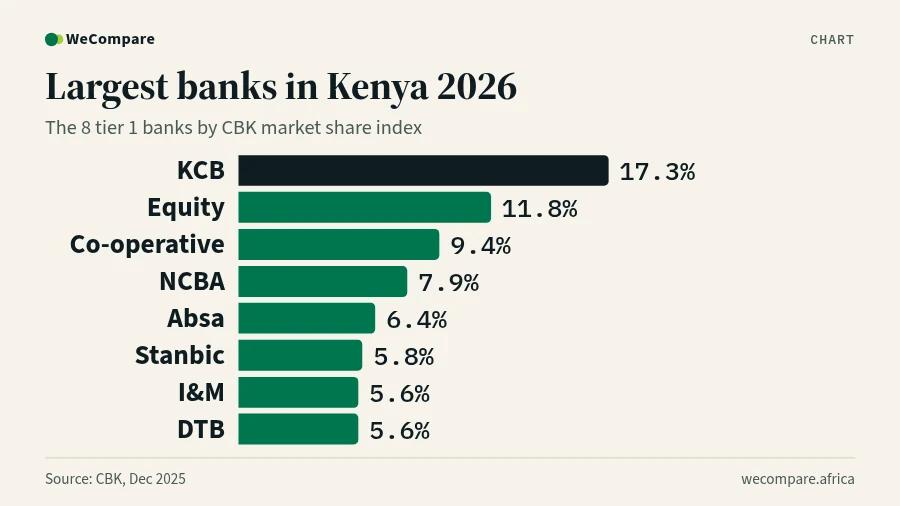
Almost nothing for a customer. A Tier 1 capital ranking says nothing about ledger fees, transfer charges or loan pricing. For those, see our bank charges guide. For how Kenya's banks rank at home by CBK's market share index, see our largest banks guide.
One risk is worth knowing. Moody's said Kenyan banks held government securities worth 1.7 times their equity at the end of December 2025, which ties their capital and earnings closely to the government's finances.
Frequently asked questions
Is KCB still bigger than Equity?
Yes on both measures we have. By CBK's market share index, KCB is at 17.3% and Equity at 11.8%. By Tier 1 capital in The Banker's July 2026 ranking, KCB has US$2.455 billion against Equity's US$2.312 billion, as reported by Kahawatungu and Abojani, so KCB ranks ahead in Africa.
Did KCB and Equity lose money?
No. In the first half of 2026 KCB's profit after tax rose 14.0% to KES 36.9 billion, and Equity earned KES 45.5 billion, the highest post-tax profit of any Kenyan bank. Both also cut their NPL ratios.
Why does a stronger shilling raise a bank's rank?
The ranking is in US dollars. A stronger shilling raises the dollar value of the same shilling capital, so a bank's Tier 1 capital looks larger in the ranking even if its shilling figures have not changed.
Sources
- The Banker, Top 1000 World Banks 2026 ranking (July 2026), figures as reported by Abojani, Streamlinefeed and TechTrendsKE, 16 July 2026.
- TechTrendsKE, Currency gains fade as Kenyan banks face a tougher race for continental growth, 23 October 2026: the October ranks, the shilling range, the highest movers and the return-on-assets point, each from this one report.
- Nigerian banks' Tier 1 capital: Legit.ng and Les Afriques, reporting African Business and The Banker's Africa's Top 100 Banks 2026.
- Moody's, as reported by TechTrendsKE, 1 October 2026 and Zawya: government securities at 1.7 times equity at end-December 2025.
- Our H1 2026 bank performance guide for the half-year results, and the CBK Bank Supervision Annual Report 2025 for the market share index.
Share this guide
Get WeCompare updates
New guides and rate changes, by email. Unsubscribe any time.
Join the discussion
Please do not share account numbers, phone numbers, links or other personal details. Comments are general discussion, not advice. All comments are reviewed before they appear, and we may remove comments that break these rules.