Banking & payments
Bank Charges in Kenya Compared: Ledger Fees, Transfers and ATM Withdrawals
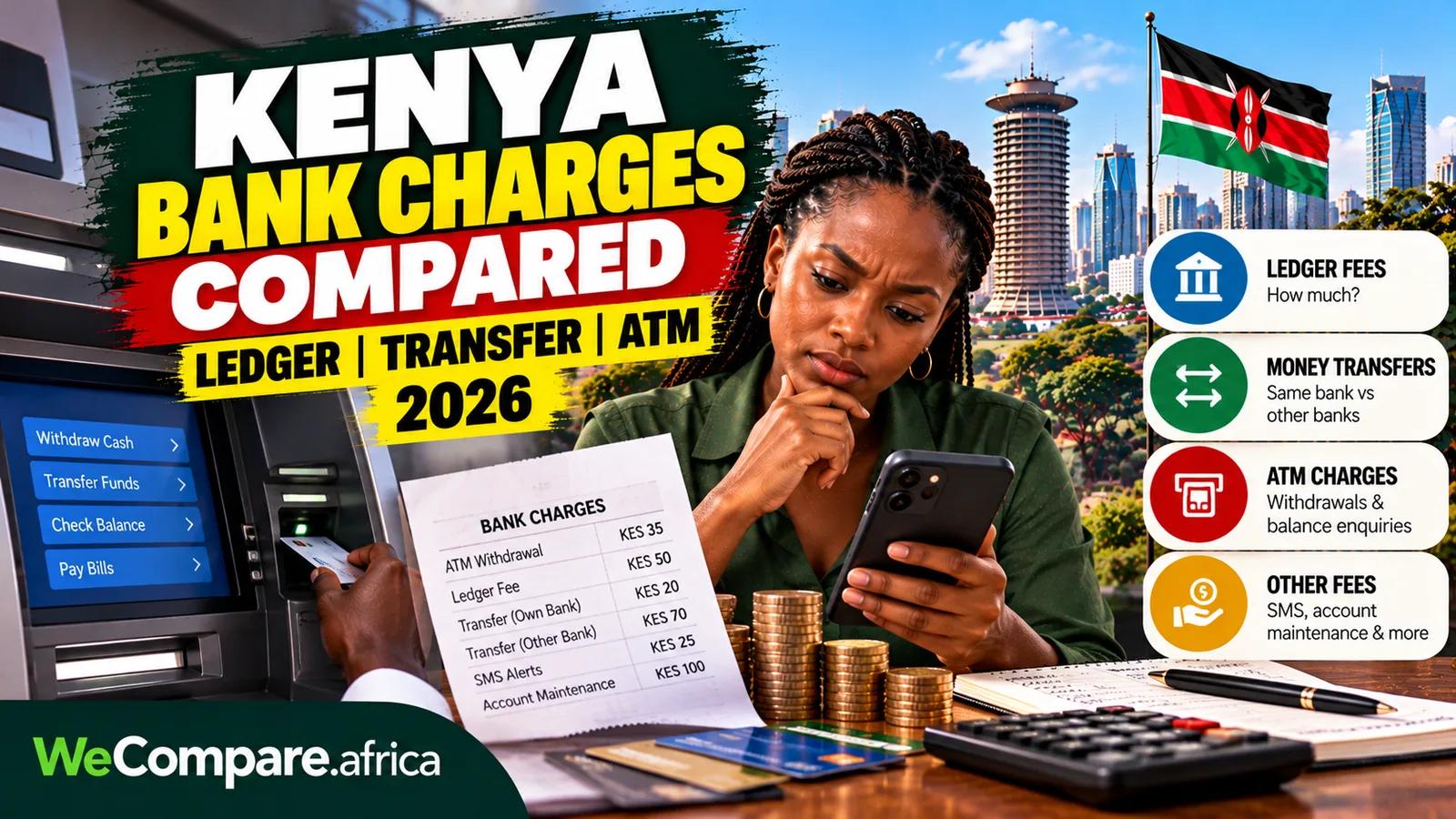
Two bank accounts can both look cheap and still cost very different amounts once you send money and withdraw cash. This guide compares the published ledger and maintenance fees, EFT and RTGS transfer charges and ATM withdrawal fees of major Kenyan banks, shows where the tariffs do not line up like for like, and gives you two calculators to price your own habits.
Read this slide as text
Unmasking the “Free” Bank Account. A comparative teardown of Kenyan bank charges, ledger fees, and the real cost of your money.
The illusion of a free account
Banks advertise the ledger fee because it is the number people look for. It is also the easiest charge to set at zero, since banks earn on the things you do next: moving money out and taking cash out. The charges you pay depend on how often you transfer, which channel you use and which ATM you walk up to.
Read this slide as text
The Illusion of Zero Ledger Fees. What banks advertise: “Nil Ledger Fees!” Below the surface: transfer penalties (EFT and RTGS fees); out-of-network ATM charges (up to KES 200 per transaction); 15% excise duty (the government tax applied to all money-transfer services, inflating every hidden fee).
A low ledger fee does not automatically make an account cheap. Your actual cost depends on how often you move money and access cash.
Read this slide as text
The Anatomy of Banking Behavior. Pillar 1, Maintaining the Account: the cost of keeping your money in the vault (ledger and maintenance fees). Pillar 2, Moving the Money: the cost of digital and manual transfers (EFT, PesaLink and mobile). Pillar 3, Accessing Cash: the cost of physical extraction (in-network vs out-of-network ATM withdrawals).
What bank charges include
- Ledger fees are charges for account entries, often per transaction or monthly.
- Maintenance fees are recurring service charges. Some banks use them instead of, or alongside, ledger fees.
- Transfer fees cover EFT, RTGS, PesaLink, internal transfers and bank-to-mobile-money transfers.
- ATM fees depend on whether you use your own bank’s ATM, another Kenyan bank’s, or an international one.
- Excise duty is added to many fees. KCB says its published prices are inclusive of 15% excise, and Co-operative Bank says excise applies to all its fees, charges and commissions on top.
The practical rule is to read the tariff footnote before you compare two numbers. A KES 34.50 fee that includes tax is not the same price as a KES 30 fee that adds tax later.
If the account is mainly for saving rather than daily spending, fees matter alongside interest: see how they interact in our guide to the best savings accounts in Kenya.
Ledger and maintenance fees
Ledger and maintenance fees are the most predictable cost of a current account. They matter most if you keep a low balance or use the account often. The table shows the figures the deck relied on, with our notes where other sources disagree.
| Bank and account | Published fee | Tariff date | Our note |
|---|---|---|---|
| Equity Bank, current account | Nil ledger fee | Current guide per the deck | An older listing on Money254 (April 2021) also shows nil ledger and maintenance fees. |
| KCB Bankika Business Account | Nil ledger and nil monthly maintenance | Product page | Business account. A KCB Bankika personal transactional account also shows no monthly fee in press reports. |
| KCB Entrepreneurs Current Account | Nil ledger and maintenance | Product page | Business account. |
| KCB Sahl Banking current account | KES 300 monthly maintenance; KES 350 listed as a ledger fee | Product page | Kenya Times (August 2026) lists a KES 35 ledger fee per entry and a KES 350 minimum monthly charge for the personal account. The KES 350 may be that minimum, not a ledger fee. |
| NCBA, one personal product | KES 210 a month | Flier, listed as February 2025 | The flier we read maps KES 210 to the Salary Current Account with no waiver stated. |
| NCBA, another personal product | KES 350 a month, waived with a KES 50,000 balance maintained through the month | Flier, listed as February 2025 | This is the only KES 50,000 waiver in the flier. It shows no issue date. |
| Access Bank KESSP Account | No ledger fees | Current guide per the deck | Account-specific. |
| Access Bank Lawyers Account | KES 300 ledger fee | Current guide per the deck | Specialist account. |
| Co-operative Bank, current account | KES 35 per ledger entry | As of 10 February 2025 | Not on the deck’s ledger slide. Shows that nil is not the only model. |
Read this slide as text
Battleground 1: The Ledger Matrix.
Zone 1, unconditionally free (KES 0): Equity Bank (standard current account); KCB Bankika Business Account; KCB Entrepreneurs Current Account; Access Bank KESSP Account.
Zone 2, conditionally free: NCBA Personal Banking (KES 210 or KES 350/mo, waived if conditions are met).
Zone 3, fixed fee imposed: Access Bank Lawyers Account (KES 300); KCB Sahl Business Current (KES 300 maintenance + KES 350 ledger).
Always verify the specific account tier; banks mix free and premium products.
Read this slide as text
The Catch Behind “Conditionally Free”. Do you maintain a strict minimum balance of KES 50,000 every single day of the month? Yes: NCBA fee waived (KES 0 monthly charge). No: the penalty drop. You are charged KES 210 or KES 350 for that month’s maintenance.
Banks leverage conditional waivers knowing that occasional dips in balance will trigger recurring monthly revenue.
The flier says the balance must be maintained throughout the month, which is how the deck reads it. The final line, that banks rely on dips to earn recurring revenue, is the deck’s opinion. We did not find evidence for it, so read it as a caution about the condition rather than a finding about how banks behave. The useful question is whether tying up KES 50,000 costs you more in lost interest than the fee you avoid.
Transfer charges
Transfer charges vary by channel. Mobile and online transfers are generally cheaper than manual, branch-based or same-day RTGS transfers.
| Bank | Transfer type | Published charge | Tariff date |
|---|---|---|---|
| Equity Bank | EFT outward | KES 200 | Current guide per the deck; Kenya Times (August 2026) agrees |
| Equity Bank | RTGS to another bank | KES 500 | Same |
| KCB digital channels | To another KCB account | KES 34.50 | November 2024 guide; prices include 15% excise |
| KCB digital channels | EFT | KES 150 | Same |
| KCB digital channels | RTGS | KES 500 | Same |
| NCBA | Online or mobile EFT | KES 90 | May 2026 guide per the deck; Kenya Times agrees |
| NCBA | Online or mobile RTGS | KES 200 per the deck | Kenya Times (August 2026) lists mobile RTGS at KES 300. We could not settle which is current. |
| NCBA | Manual EFT and manual RTGS | KES 500 each | May 2026 guide per the deck |
| Co-operative Bank | Transfer to another bank account | KES 0 to KES 35, tiered | Updated 22 October 2026 per the deck; Feb 2025 guide also shows KES 0 to KES 35 |
| GTBank Kenya | Local EFT | KES 100 | Guide dated 24 September 2025 |
| GTBank Kenya | RTGS outgoing | KES 500 | Same |
Read this slide as text
Battleground 2: The ‘Channel Tax’. The hidden penalty for walking into a branch. NCBA Tariff May 2026. EFT transfer: KES 90 online/mobile app, KES 500 manual/branch. RTGS transfer: KES 200 online/mobile app, KES 500 manual/branch.
Key Insight (corrected by WeCompare): moving money manually costs up to 455% more than digital channels for the exact same transaction.
Read this slide as text
Why RTGS Costs More Than EFT. Path A, RTGS (Real-Time Gross Settlement): instant / same day; cleared individually in real time; cost premium: expensive (KES 200 to 500). Path B, EFT (Electronic Funds Transfer): delayed (1 to 3 business days); bundled and processed in batches at end of day; cheaper (KES 90 to 200).
Takeaway: never use an RTGS to pay a non-urgent bill. You are paying a premium for speed.
The advice holds: if the payment is not urgent, the cheaper route usually costs less. We would soften the timing, though. The deck says EFT takes 1 to 3 business days, and we did not find a bank or central bank source for that, so ask your bank how long its EFT takes before relying on it for a deadline.
Read this slide as text
The Digital Transfer Matrix. Comparing outbound digital transfer costs across major networks.
- Co-operative Bank: outward transfer KES 0 to 35 (tiered).
- KCB: internal KES 34.50; local EFT KES 150; RTGS KES 500.
- NCBA: local EFT KES 90; RTGS KES 200.
- GTBank: local EFT KES 100; RTGS KES 500.
- Equity Bank: local EFT KES 200; RTGS KES 500.
Rates based on published digital channel tariffs (Nov 2024 to Oct 2026). KCB prices include 15% excise (edited by WeCompare).
ATM withdrawal charges
ATM fees depend mainly on the machine network. Using your own bank’s ATM is usually cheaper than another bank’s or an international machine.
| Bank | ATM withdrawal type | Published charge | Source and date |
|---|---|---|---|
| Equity Bank | Equity ATM | KES 30 | Equity guide per the deck; Kenya Times (August 2026) agrees |
| Equity Bank | Another bank’s ATM | KES 200 | Same |
| Equity Bank | Declined cash transaction at another bank’s ATM | KES 30 | Equity guide per the deck; we could not open it to confirm |
| KCB | KCB ATM | KES 30 | KCB guide effective April 2026 per the deck; Kenya Times agrees |
| NCBA | NCBA ATM | KES 30 | Kenya Times (August 2026). NCBA charges KES 68 at PesaConnect ATMs and KES 150 at Visa ATMs. |
| Co-operative Bank | Digital banking tariff, ATM | KES 30 | Co-op guide, as of 10 February 2025 |
We could not find published other-bank ATM fees for KCB, NCBA or Co-operative Bank in the sources we could read, so the table does not guess them. The deck’s warning is therefore best read as a question to ask your own bank: what do I pay at someone else’s machine?
Read this slide as text
Battleground 3: The ATM Network Penalty. The Safe Zone (in-network): Equity ATM KES 30; KCB ATM KES 30. The Penalty Zone (out-of-network): Equity user at another bank’s ATM: KES 200 (a 567% increase, corrected by WeCompare).
The “Declined” Trap: Equity charges KES 30 even if your cash transaction is declined at another bank’s ATM.
Insight: a bank with zero ledger fees becomes instantly expensive if their ATM network is small and forces you to use competitors’ machines.
Cash over the counter is a separate cost the deck does not cover. Kenya Times (August 2026) lists KES 100 at Co-operative Bank for a transactional account, KES 200 at KCB on a Bankika account, KES 100 to KES 325 at NCBA depending on the amount, and KES 310 to KES 400 at Absa. These are press-reported and vary by account, so treat them as a reason to avoid branch withdrawals rather than as quotes.
Which bank fits your behaviour
The deck sorts people into two types. The digital transactor sends many transfers and rarely uses cash, so transfer fees matter most. The heavy cash user withdraws often, so the ATM network matters most.
Read this slide as text
Which Bank Fits Your Behavior?
The Digital Transactor. Behavior: rarely uses cash, heavy app usage, pays vendors via EFT/RTGS. The trap: high transfer fees. The optimization: prioritize Co-operative Bank (KES 0 to 35 transfers) or NCBA (KES 90 EFTs). Avoid Equity Bank (KES 200 EFT fees). Ledger fees matter less than transfer costs.
The Heavy Cash User. Behavior: needs physical cash daily, lower average balance. The trap: ledger fees and out-of-network ATM penalties. The optimization: prioritize Equity Bank (unconditionally nil ledger fees) or KCB Bankika (nil ledger fees). Stick strictly to their vast, native ATM networks to maintain the KES 30 withdrawal baseline.
These are sensible rules of thumb, not recommendations for your account. They rest on the fees we could confirm, and your answer will change with the account tier, your balance and your usage. Co-operative Bank’s KES 35 ledger fee per entry (February 2025) is the kind of detail that can flip the result for a heavy digital user, so price your own pattern with the calculators below.
Read this slide as text
The Bottom Line. “Never choose a bank account based on the headline fee alone. Choose it based on your transactional velocity.”
- Audit your channels: if you transfer frequently, manual branch visits are draining your wealth. Go digital immediately.
- Beware the condition: “Free” often requires locking up liquidity (e.g., KES 50,000 minimums). Calculate if that cash could earn more elsewhere.
- Factor the tax: always mentally add the 15% government excise duty to every transfer and withdrawal fee you calculate.
Calculators
Your monthly bank-fee bill
Ledger and maintenance
–Transfers
–ATM withdrawals
–Excise added
–Total a month
–Total a year
–The default case is an Equity-style pattern: nil ledger fee, 8 EFTs at KES 200, 1 RTGS at KES 500, 4 own-bank withdrawals at KES 30 and 3 other-bank withdrawals at KES 200, with 15% excise added to every fee. Applying the same rate to ledger and ATM fees is an assumption, so set the rate to 0 if your tariff says otherwise. Use fees from your own bank’s current tariff.
What a branch transfer costs you
Digital cost a month
–Manual cost a month
–Extra for going manual
–Extra a year
–Manual premium
–The defaults are NCBA’s listed EFT fees, KES 90 online or mobile and KES 500 manual. The premium is the extra cost as a percentage of the digital fee, which is 455.6% here. It ignores excise and the time cost of a branch visit.
Frequently asked questions
Which Kenyan bank has the cheapest current account?
It depends on how you bank. A nil ledger fee suits someone who rarely transfers or withdraws, while a bank with cheap transfers suits someone who pays by EFT often. On the fees we confirmed, NCBA lists the lowest EFT charge at KES 90 and Equity lists a nil ledger fee, but no bank is cheapest on every charge.
What is the difference between a ledger fee and a maintenance fee?
A ledger fee is usually a charge for account entries, applied monthly or per transaction. A maintenance fee is a recurring service charge. Some banks charge one, some both, and some charge neither on specific accounts.
How much does an EFT or RTGS transfer cost in Kenya?
Published online EFT fees range from KES 90 at NCBA to KES 200 at Equity, with KCB at KES 150 and GTBank at KES 100. RTGS is KES 500 at Equity, KCB and GTBank. NCBA lists online RTGS at KES 200 in the deck, though one press report puts mobile RTGS at KES 300.
Is it cheaper to transfer money online than at a branch?
Usually yes. NCBA lists KES 90 for an online or mobile EFT against KES 500 for a manual one, which is about 455% more. Manual RTGS at NCBA is KES 500 against KES 200 online in the deck.
How much does it cost to use another bank’s ATM?
An Equity customer pays KES 200 at another bank’s ATM against KES 30 at an Equity ATM. We did not find published other-bank ATM fees for KCB, NCBA or Co-operative Bank, so check your own tariff.
Does excise duty apply to bank charges in Kenya?
Excise duty applies to fees on money-transfer services at 15% since the Finance Act 2023, according to PwC. KCB says its published prices include 15% excise, while Co-operative Bank says excise applies to all fees on top. Check whether your bank’s tariff is inclusive or exclusive.
What does a conditional ledger fee waiver mean?
The bank waives the fee only if you meet a condition, usually a minimum balance. NCBA’s flier waives its KES 350 fee if you maintain KES 50,000 throughout the month. If your balance dips below it, the fee applies for that month.
Are these bank charges still current?
Not necessarily. Tariff dates in this guide run from November 2024 to October 2026, and banks change fees with notice. Use the figures to compare, then confirm the current charge in your bank’s latest tariff guide before you open or switch an account.
How we researched this guide
This is an independent, source-based guide. We checked the deck and its research draft against PwC’s Kenya excise duty summaries, KCB’s and Co-operative Bank’s tariff guides, NCBA’s personal banking flier, a Money254 listing for Equity and a Kenya Times comparison of bank charges dated 23 August 2026. We could not open the Equity, GTBank, Access or NCBA May 2026 tariff PDFs directly, so figures that rest only on the deck are marked “per the deck”. We corrected 2 percentages on the slides (455% and 567%) and changed the KCB excise note on slide 8. We flagged the NCBA RTGS conflict, the KCB KES 350 label, the NCBA waiver wording, the mix of personal and business accounts and the unverified EFT timing. The research draft ended partway through the ATM table, so we finished that section from the slides and the sources above. We have no commercial relationship with any bank named. Contact the editor to report an error.
Sources
- PwC Worldwide Tax Summaries, Kenya other taxes (excise on money transfer fees)
- PwC Kenya, Finance Act insights: excise duty
- KCB tariff guide (prices inclusive of 15% excise; EFT and RTGS)
- KCB digital channel tariff guide, November 2024
- Co-operative Bank tariff guide, February 2025 (ATM, ledger fee, PesaLink, excise)
- NCBA personal banking products flier (KES 210 and KES 350 fees, KES 50,000 waiver)
- Equity Bank tariff guide (cited by the deck; we could not open it)
- Money254, Equity Bank current account (listing dated April 2021)
- Kenya Times, Kenya’s most expensive bank charges compared (23 August 2026)
- WeCompare, Hustler Fund vs Fuliza vs M-Shwari
- WeCompare, best SACCOs in Kenya
- WeCompare, CRB checks and disputes

Join the discussion
Please do not share account numbers, phone numbers, links or other personal details. Comments are general discussion, not advice. All comments are reviewed before they appear, and we may remove comments that break these rules.