Banking & payments
CBK Rate at 8.75%: What Falling Interest Rates Mean for Kenyan Savers and Borrowers
The CBK rate is 8.75%, down from 12% in 2024. Rate history, loan savings worked out in shillings, and what savers earn after tax.

Current CBK rate: 8.75% (as of 7 October 2026, when the MPC held it; next MPC meeting: December 2026). Source: CBK MPC press release, 7 October 2026.
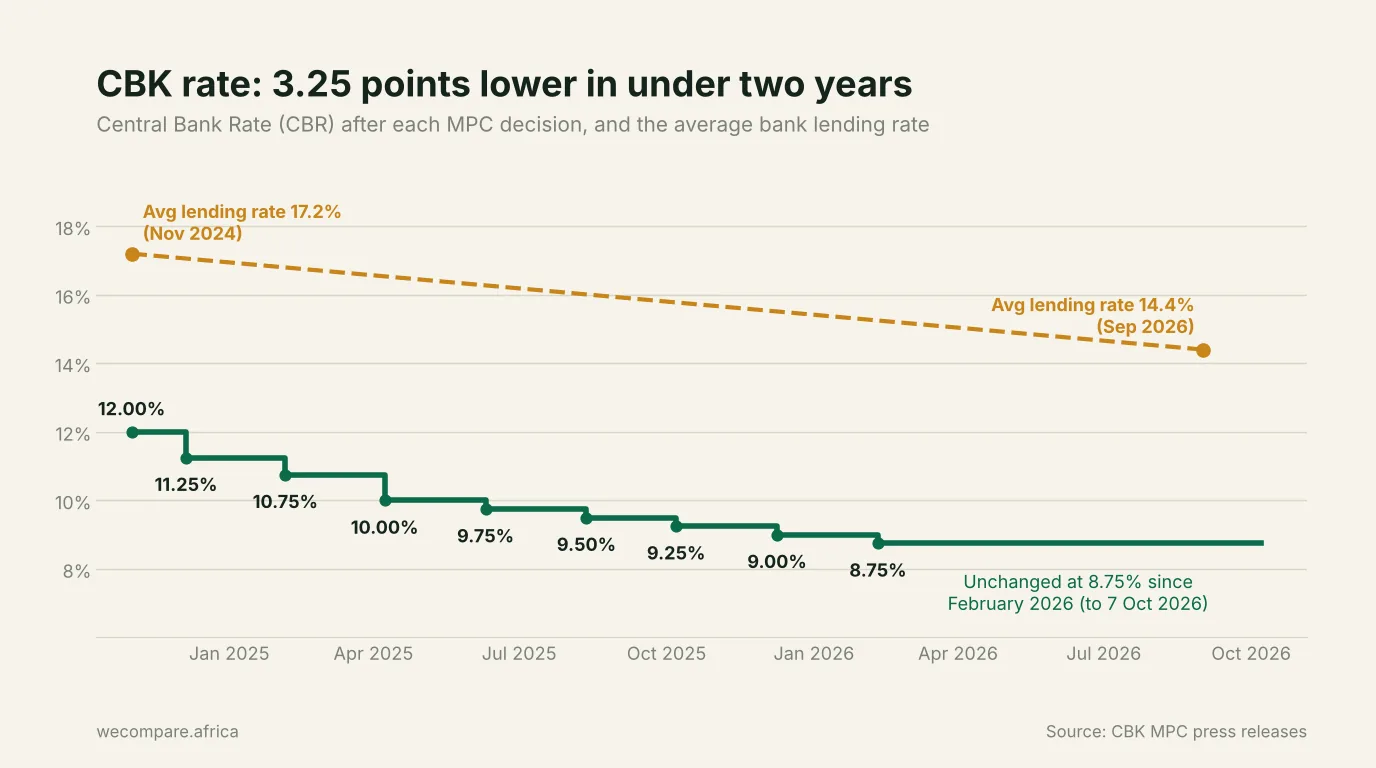
The Central Bank of Kenya (CBK) held its policy rate at 8.75% on 7 October 2026. That is 3.25 percentage points below the 12.00% of late 2024, and the average bank lending rate has fallen from 17.2% to 14.4% over the same period. For borrowers that means cheaper repayments if their bank has passed the cut on. For savers it means lower yields, and after the 15% withholding tax only some products still beat inflation of 6.8%.
This guide shows the full rate history, works through real loan and savings examples with the numbers, and explains what to check on your own accounts.
The CBK rate today
| Indicator | Latest |
|---|---|
| Central Bank Rate (CBR) | 8.75% (held on 7 October 2026) |
| Average commercial bank lending rate | 14.4% (September 2026), down from 17.2% in November 2024 |
| Inflation | 6.8% (September 2026) |
| Gross NPL ratio (banking sector) | 13.9% (September 2026), down from 17.6% in August 2025 |
The CBR is the rate the CBK's Monetary Policy Committee (MPC) sets to signal how expensive money should be across the economy. Banks use it as an anchor when they price loans, and it also feeds through to yields on government securities and money market funds.
How the CBK rate fell, meeting by meeting
The MPC cut the rate at eight consecutive meetings from December 2024 to February 2026, then held it.
| MPC meeting | Decision | CBR after |
|---|---|---|
| Before December 2024 | Starting point | 12.00% |
| 5 December 2024 | Cut 0.75 points | 11.25% |
| 5 February 2025 | Cut 0.50 points | 10.75% |
| 8 April 2025 | Cut 0.75 points | 10.00% |
| 10 June 2025 | Cut 0.25 points | 9.75% |
| 12 August 2025 | Cut 0.25 points | 9.50% |
| 7 October 2025 | Cut 0.25 points | 9.25% |
| 9 December 2025 | Cut 0.25 points | 9.00% |
| 10 February 2026 | Cut 0.25 points | 8.75% |
| 7 October 2026 | Held | 8.75% |
The pace slowed after April 2025: the early cuts were 0.50 to 0.75 points, and every cut since June 2025 has been 0.25 points. The rate has been unchanged at 8.75% since February 2026.
Did banks pass on the cuts?
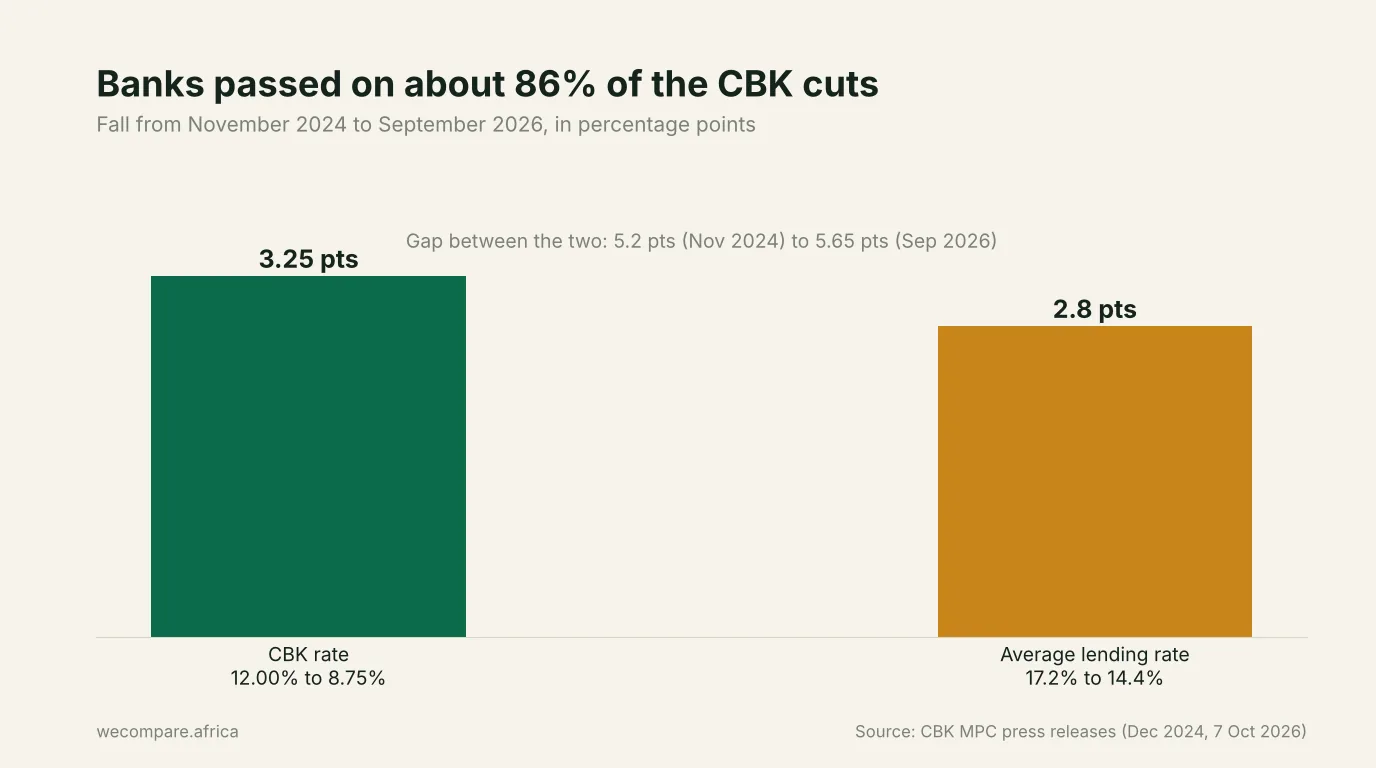
Mostly, yes. Between November 2024 and September 2026 the CBR fell 3.25 points (12.00% to 8.75%) and the average lending rate fell 2.8 points (17.2% to 14.4%). That is a pass-through of about 86%.
The gap between the two actually widened, from 5.2 points to 5.65 points. Banks cut what they charge, but not by as much as the CBK cut its own rate, so the spread banks earn over the policy rate is slightly higher than before.
Averages hide a lot. Your own rate depends on your bank, the product, your credit profile and whether your loan is priced on a floating or fixed basis, so the figures below are illustrations, not quotes.
What it means for borrowers: worked examples
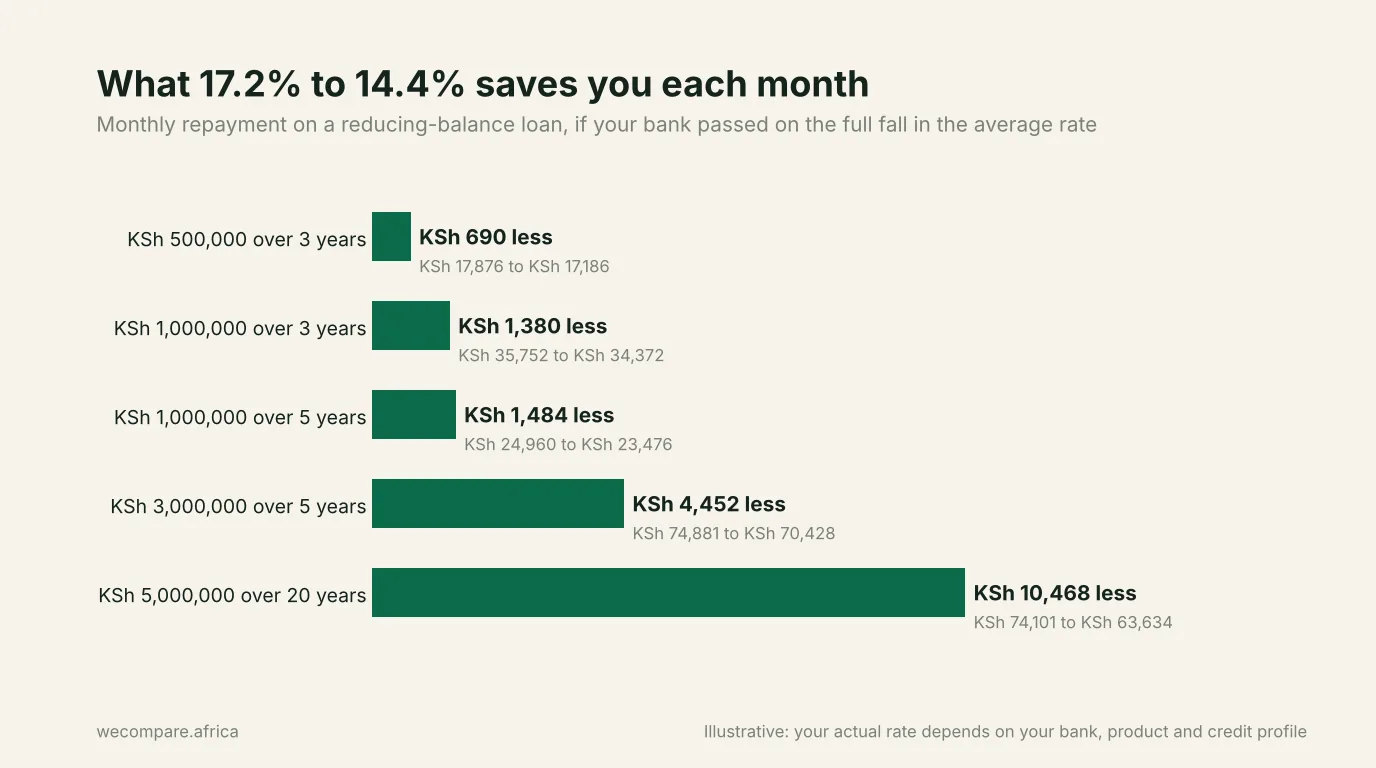
The table shows the monthly repayment on a reducing-balance loan at 17.2% (the average in November 2024) and at 14.4% (September 2026). Use it as a guide to what a full pass-through of the fall in the average rate would save you, or run your own numbers in our loan repayment calculator.
| Loan | Term | Monthly at 17.2% | Monthly at 14.4% | Saved per month | Saved over the loan |
|---|---|---|---|---|---|
| KSh 500,000 | 3 years | KSh 17,876 | KSh 17,186 | KSh 690 | KSh 24,842 |
| KSh 1,000,000 | 3 years | KSh 35,752 | KSh 34,372 | KSh 1,380 | KSh 49,684 |
| KSh 1,000,000 | 5 years | KSh 24,960 | KSh 23,476 | KSh 1,484 | KSh 89,046 |
| KSh 2,000,000 | 4 years | KSh 57,917 | KSh 55,055 | KSh 2,862 | KSh 137,382 |
| KSh 3,000,000 | 5 years | KSh 74,881 | KSh 70,428 | KSh 4,452 | KSh 267,137 |
| KSh 5,000,000 | 20 years | KSh 74,101 | KSh 63,634 | KSh 10,468 | KSh 2,512,226 |
| KSh 10,000,000 | 20 years | KSh 148,203 | KSh 127,268 | KSh 20,935 | KSh 5,024,453 |
Figures are rounded, so the columns may differ by KSh 1.
Three things stand out from the examples.
Long loans gain the most. On a KSh 1,000,000 loan, the 5-year borrower saves KSh 89,046 in total against KSh 49,684 for the 3-year borrower, because interest compounds on the balance for longer. On a KSh 5,000,000, 20-year loan the total interest saving is over KSh 2.5 million.
Even a quarter-point matters on big loans. A 0.25-point fall from 14.4% to 14.15% saves about KSh 130 a month on a KSh 1,000,000 five-year loan, about KSh 912 a month on a KSh 5,000,000 20-year loan and about KSh 1,825 a month on a KSh 10,000,000 20-year loan.
You may not get the saving automatically. Many loans are priced on a bank's own base rate, and some facilities are fixed. If your repayment has not moved, ask your lender whether your rate is floating, how it is linked to its base rate and whether you can reprice or refinance. Compare other lenders' rates before you ask, because a competing offer is your strongest argument.
Remember to check the total cost, not just the rate. Arrangement fees, insurance and early-repayment charges can erase part of a rate saving. Our guide to Kenya bank performance in H1 2026 shows which banks have the cheapest funding and the most room to cut.
What it means for savers: worked examples
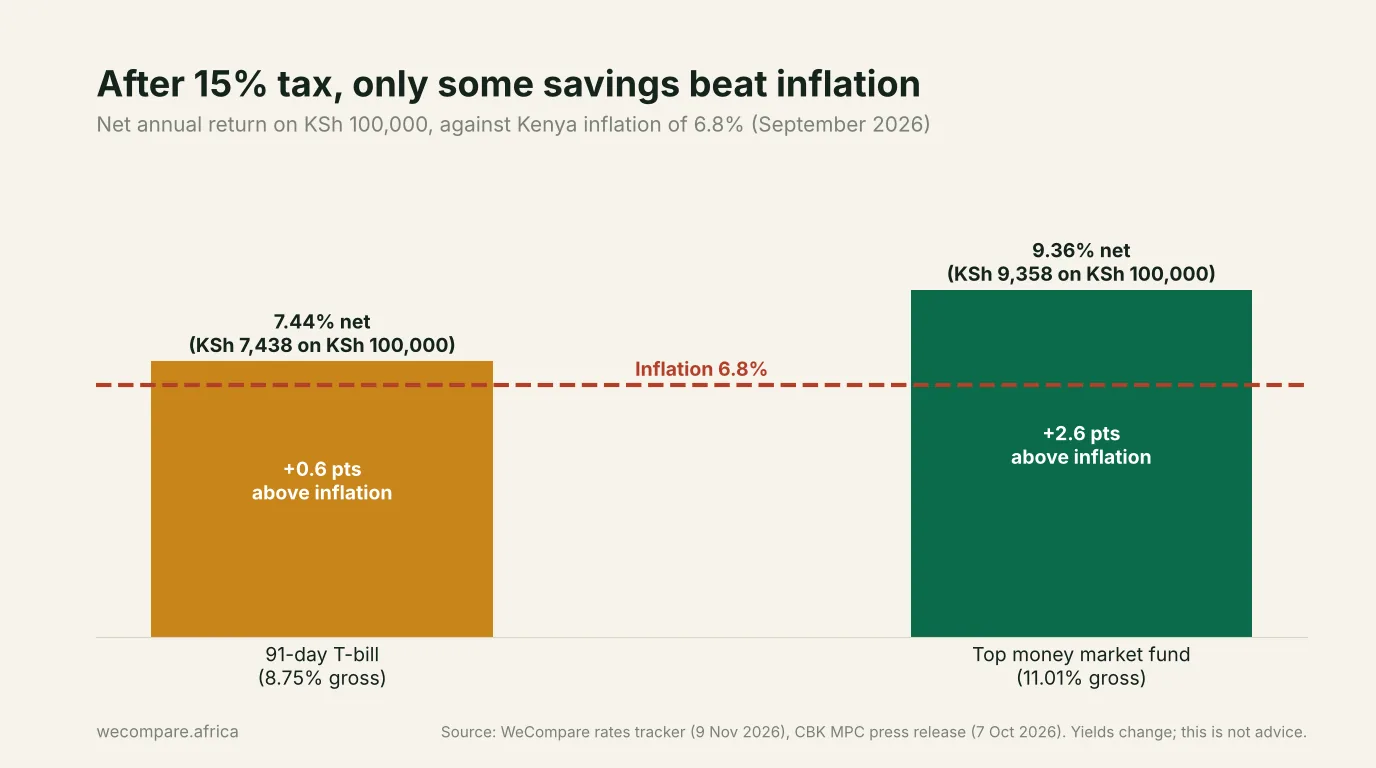
Lower policy rates pull down what savers earn, but the effect depends on where the money sits. Interest on most savings products attracts 15% withholding tax, so the figures that matter are net returns against inflation.
| Product | Gross yield | Net after 15% tax | Net on KSh 100,000 | Real return vs 6.8% inflation |
|---|---|---|---|---|
| 91-day Treasury bill | 8.75% | 7.44% | KSh 7,438 | +0.6 points |
| Top money market fund (as of 19 Oct 2026, Cytonn) | 11.01% | 9.36% | KSh 9,358 | +2.6 points |
| Inflation | 6.8% | n/a | KSh 6,800 of lost purchasing power | Benchmark |
Rates checked: 91-day T-bill, CBK auction of 9 November 2026; money market fund, Cytonn, 19 October 2026. Yields change daily. Test other amounts in our money market fund calculator.
Scaling those yields up shows what is at stake:
| Amount invested | T-bill net per year | Money market fund net per year | Inflation erodes |
|---|---|---|---|
| KSh 100,000 | KSh 7,438 | KSh 9,358 | KSh 6,800 |
| KSh 500,000 | KSh 37,188 | KSh 46,792 | KSh 34,000 |
| KSh 1,000,000 | KSh 74,375 | KSh 93,585 | KSh 68,000 |
A sensitivity example: if a money market fund's gross yield fell by one percentage point, you would lose about KSh 850 a year on every KSh 100,000 invested, after tax. That is why savers are the group that feels falling rates first.
Ordinary bank savings accounts are another story. When we compared six large banks, only two published a numerical savings rate, and both said "up to", so you cannot assume the headline rate applies to your balance. See best savings accounts in Kenya for what each bank actually states.
What it means for different people
A salaried borrower with a car or personal loan. Check your statement for the rate and ask whether it follows the bank's base rate. On the KSh 2,000,000, 4-year example, a 2.8-point lower rate is worth KSh 2,862 a month.
A homebuyer or mortgage holder. The biggest absolute savings are on long loans, but the saving only arrives if your rate is floating or you refinance. On the KSh 5,000,000, 20-year example the monthly gap is KSh 10,468.
A small business owner. Working-capital loans are shorter, so the saving per month is smaller, but a lower rate also eases the cost of rolling credit. Ask whether your facility has been repriced since 2024.
A saver holding cash in a bank account. If your account pays little or nothing, inflation of 6.8% is eroding your money. At today's yields, KSh 100,000 earns about KSh 7,438 a year net in a 91-day T-bill or KSh 9,358 in a top money market fund, but each product has its own risks, access terms and yield changes, so compare them before moving anything.
A saver already in T-bills or money market funds. Expect yields to move with CBK policy and auction results. Yields can move up or down with CBK decisions and auction results, so check them regularly.
What it means for banks
Lower rates squeeze bank margins, and the H1 2026 results show it:
- Standard Chartered Kenya's net interest income fell 13.1% in 2025 and about 20% in H1 2026, and profit fell 38%. Read Is Standard Chartered Kenya leaving?.
- KCB's cost of funds eased to 3.4% from 3.9%, which cushions its margins.
- Equity earns 44.5% of its income from fees, so it is less exposed to rate cuts than banks that live on lending margins. See Equity vs KCB: how Kenya's two biggest banks make money.
- I&M has grown deposits 18% by H1 2026, which gives it cheap funding as rates fall.
Whatever the interest rate, look at the full price of an account, including fees, not just the headline rate.
What to watch next
The MPC reviews the rate roughly every two months, with the next meeting expected in December. Three things shape the direction of rates:
- Inflation. It stood at 6.8% in September 2026. Faster inflation would make further cuts harder; slower inflation would make them easier.
- Fuel prices and the exchange rate. Both feed into the cost of living and are among the factors the MPC weighs at each meeting.
- Credit quality. Banking-sector NPLs have fallen from 17.6% to 13.9%, which gives lenders more room to cut rates, but they remain high.
We do not forecast the CBK's next move. Rates can rise as well as fall, so avoid locking in decisions that only work if rates keep dropping.
What to do now
- Find your loan's rate and type. Is it fixed or floating? Is it linked to your bank's base rate?
- Ask for a repricing or compare refinancing offers. Even 1 point on a KSh 1,000,000, 5-year loan is worth over KSh 500 a month.
- Check your savings yield net of tax. If it is below 6.8%, you are losing purchasing power.
- Compare accounts and fees, not just rates. Use our best savings accounts in Kenya guide and the bank pages on WeCompare.
Keep reading
- Kenya bank performance H1 2026: the Tier-1 hub analysis
- Best savings accounts in Kenya
- Equity vs KCB: how Kenya's two biggest banks make money
- Is Standard Chartered Kenya leaving?
- How I&M Bank Kenya grew deposits 18%
Frequently asked questions
What is the CBK rate now?
8.75%. The Monetary Policy Committee held it on 7 October 2026. It has been unchanged since the cut from 9.00% on 10 February 2026.
How much has the CBK rate fallen?
By 3.25 percentage points, from 12.00% in late 2024 to 8.75%, through eight cuts between December 2024 and February 2026.
Will my loan rate fall automatically when the CBK cuts?
Not always. Banks passed on about 86% of the cuts on average (average lending rate down 2.8 points from 17.2% to 14.4%), but your rate depends on whether your loan is floating or fixed, how it is linked to your bank's base rate and your credit profile. Ask your lender in writing.
How much does a lower lending rate save me?
On a KSh 1,000,000 five-year loan, the fall from 17.2% to 14.4% cuts the monthly repayment from KSh 24,960 to KSh 23,476, a saving of KSh 1,484 a month or KSh 89,046 over the loan. On a KSh 5,000,000, 20-year loan the monthly saving is KSh 10,468.
Do falling rates hurt savers?
Yes, because yields on T-bills and money market funds track policy rates. After 15% withholding tax, a 91-day T-bill at 8.75% nets 7.44% and a top money market fund at 11.01% nets 9.36%, against inflation of 6.8%. Check yields regularly because they change.
Is the CBK likely to cut again?
We do not forecast CBK decisions. The MPC has held at 8.75% since February 2026 and decides at each meeting based on inflation, the exchange rate and growth.
Are bank profits falling because of lower rates?
For some banks, yes. Standard Chartered Kenya's profit fell 38% as net interest income dropped, while Equity, with 44.5% of income from fees, is less exposed.
Sources
- CBK MPC press release, 7 October 2026
- CBK MPC press release, 10 February 2026
- CBK MPC press releases for the earlier meetings:
- Equity Group Holdings HY 2026 investor booklet
- KCB Group H1 2026 results: profit before tax rises 20.8% (Biashara Leo)
- KCB Group H1 2026: net profit up 14% to KSh 36.9bn (Business Today)
- Standard Chartered Bank Kenya H1 2026 results (Khusoko)
- CBK Treasury bill auction results dated 9 November 2026 (91-day weighted average rate of accepted bids: 8.7500%)
- Cytonn Money Market Fund effective annual yield of 11.01%, as of 19 October 2026 (published by Cytonn; recorded in WeCompare rates data). Loan and savings figures are WeCompare calculations using the standard reducing-balance payment formula and 15% withholding tax; they are illustrations, not offers.
Disclaimer: This article is published for educational and informational purposes only. Rates and yields change. The examples are illustrations, not quotes or offers, and do not constitute investment, tax, legal or financial advice. Consult a licensed financial adviser before making decisions.

Join the discussion
Please do not share account numbers, phone numbers, links or other personal details. Comments are general discussion, not advice. All comments are reviewed before they appear, and we may remove comments that break these rules.