Banking & payments
Is Standard Chartered Kenya Leaving? What the Shrinking Really Means
Standard Chartered Kenya's profit fell 38% in 2025. What the shrinking really means.

Standard Chartered Kenya is getting smaller on purpose. Profit after tax fell 38% in FY2025 to KSh 12.4bn and dropped a further 17% in H1 2026 to KSh 6.7bn. The bank says this is a restructuring, not an exit, and its numbers fit a pivot to wealthy customers and international trade.
Why profit fell
Three pressures explain the drop:
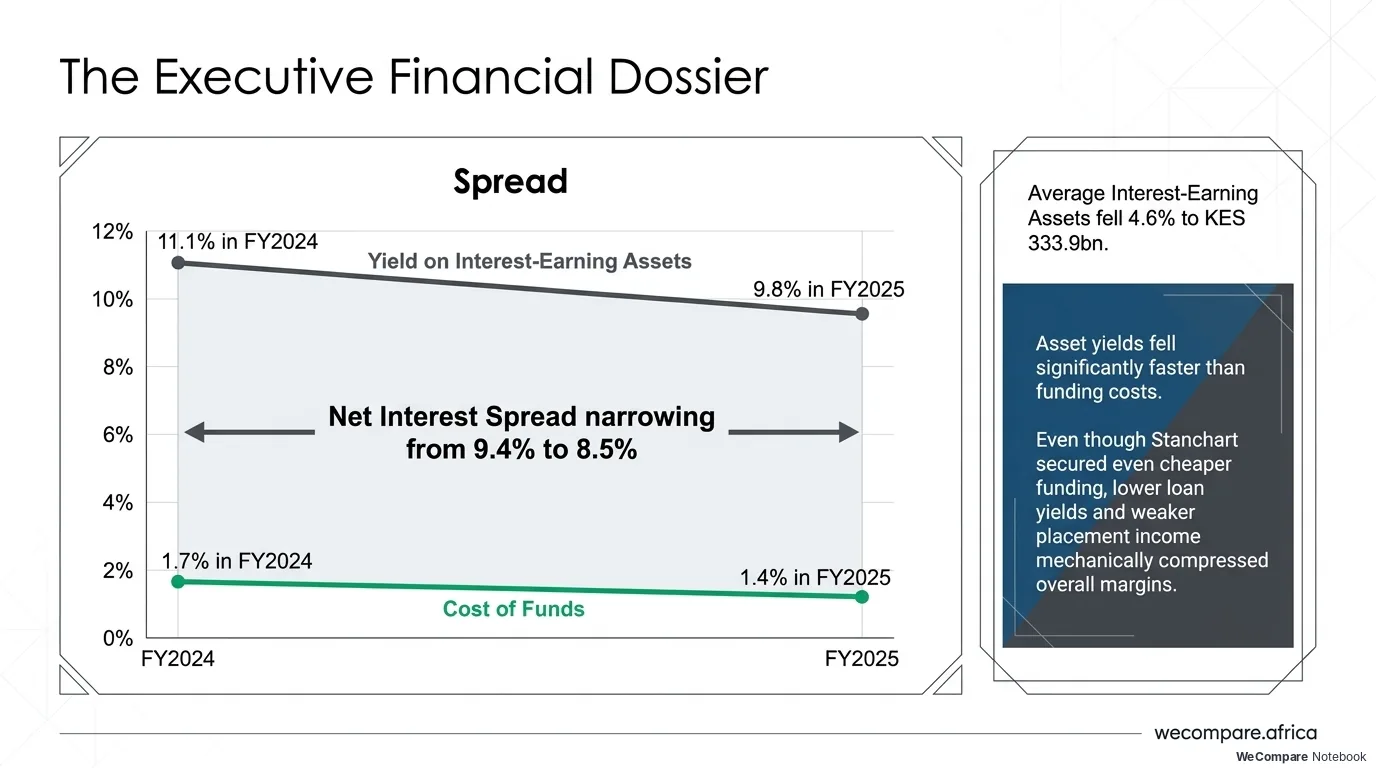
- Rate cuts. Net interest income dropped 13.1% in 2025 and 20% in H1 2026 on falling rates through 2025 and into 2026 (the CBK benchmark was cut to 8.75% in February 2026).
- Softer fee income. Non-interest income contracted in 2025 on weaker foreign exchange and fee volumes.
- A one-off pension settlement of about KSh 2.5bn. It ended a 16-year legal dispute with former employees and explains virtually the whole FY2025 cost increase. H1 2026 costs were flat (+0.4%), so the H1 fall comes from squeezed margins, not rising costs.
| FY2024 | FY2025 | H1 2026 | |
|---|---|---|---|
| Profit after tax | KSh 20.1bn | KSh 12.4bn (-38%) | KSh 6.7bn (-17%) |
FY2025 in detail: a revenue shock, not a credit problem
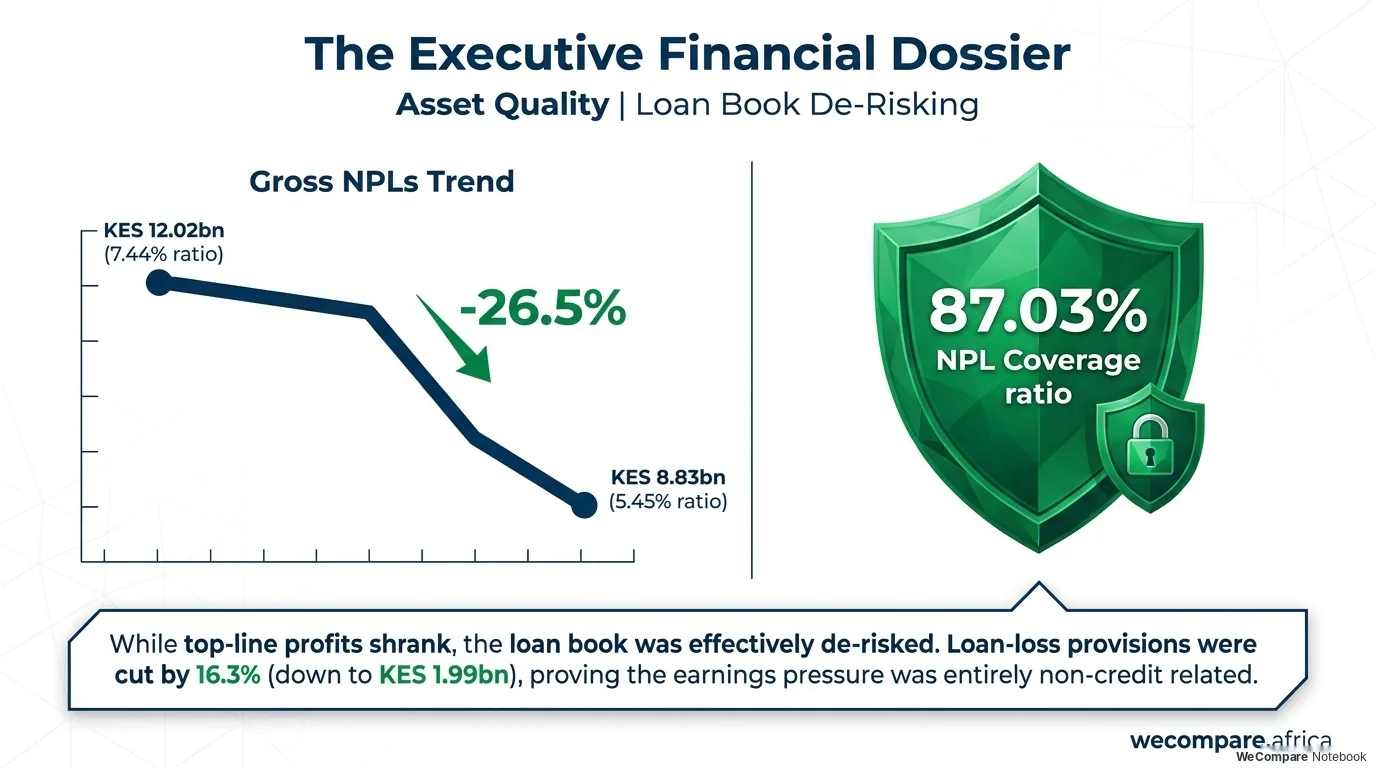
The full-year numbers show where the profit went. Profit before tax fell 40.3% to KSh 16.8bn. Total operating income dropped 16.5% to KSh 42.3bn: net interest income fell 13.1% to KSh 28.9bn and non-interest income fell 23% to KSh 13.4bn, mainly because foreign exchange trading income dropped 58.6% to KSh 3.4bn. Operating expenses, including loan-loss provisions, rose 13.3% to KSh 25.5bn, with staff costs up 23.7% to KSh 11.2bn and the one-off pension charge of about KSh 2.5bn on top. Provisions themselves fell 16.3% to KSh 2.0bn, a partial offset.
| FY2025 | FY2024 | FY2025 | Change |
|---|---|---|---|
| Profit before tax | KSh 28.2bn | KSh 16.8bn | -40.3% |
| Net interest margin | 9.5% | 8.7% | -0.8 points |
| Return on average equity | 30.1% | 18.0% | -12.1 points |
| Cost-to-income ratio | 44.3% | 60.2% | +15.9 points |
| Gross NPL ratio | 7.4% | 5.5% | Improved |
| NPL coverage | 81.8% | 87.0% | Improved |
The rumours: is it exiting?
Observers point to three signs: a corporate headquarters held for sale since June 2025, shrinking branches and staff, and a 94% payout ratio. The bank paid KSh 11.7bn in total dividends (KSh 31 a share), about 94% of 2025 profit; the parent's 73.89% share is about KSh 8.6bn. The bank says the property sale and restructuring are routine. The accurate reading is that capital is being sent back to the parent while the Kenya business is reshaped. It is a deliberate margin-defence strategy and nothing in the numbers shows distress.
It is also no longer a "large" bank on the CBK scale. Its market-size index fell to 4.5% in 2025, below the 5% threshold, so the CBK reclassified it as a medium-tier bank. In 2012 the figure was 8.29%.
The pivot: wealth and foreign exchange
Management points to wealth and fee income as the way forward:
- Wealth: New CEO Birju Sanghrajka says Nigeria and Kenya are the bank's two big wealth hubs in Africa.
- Fees and foreign exchange: in H1 2026, fee income rose 15.9% to KSh 7.86bn and foreign exchange trading income rose 16.4% to KSh 2.32bn (Khusoko).
What it still has going for it
The FY2025 balance sheet is the bank's strongest argument that this is a reshaping and not a retreat.
- Cleanest loan book: gross non-performing loans fell 26.5% to KSh 8.8bn, taking the gross NPL ratio from 7.4% to 5.5% in FY2025 and to about 5.0% in H1 2026, the lowest among the major banks. Provisions cover 87% of bad loans.
- Cheapest funding: about 95% of customer deposits (KSh 309bn at H1 2026) are in current and savings accounts (CASA).
- Strong capital: core capital was 20.4% of risk-weighted assets at end-2025, against a 10.5% minimum.
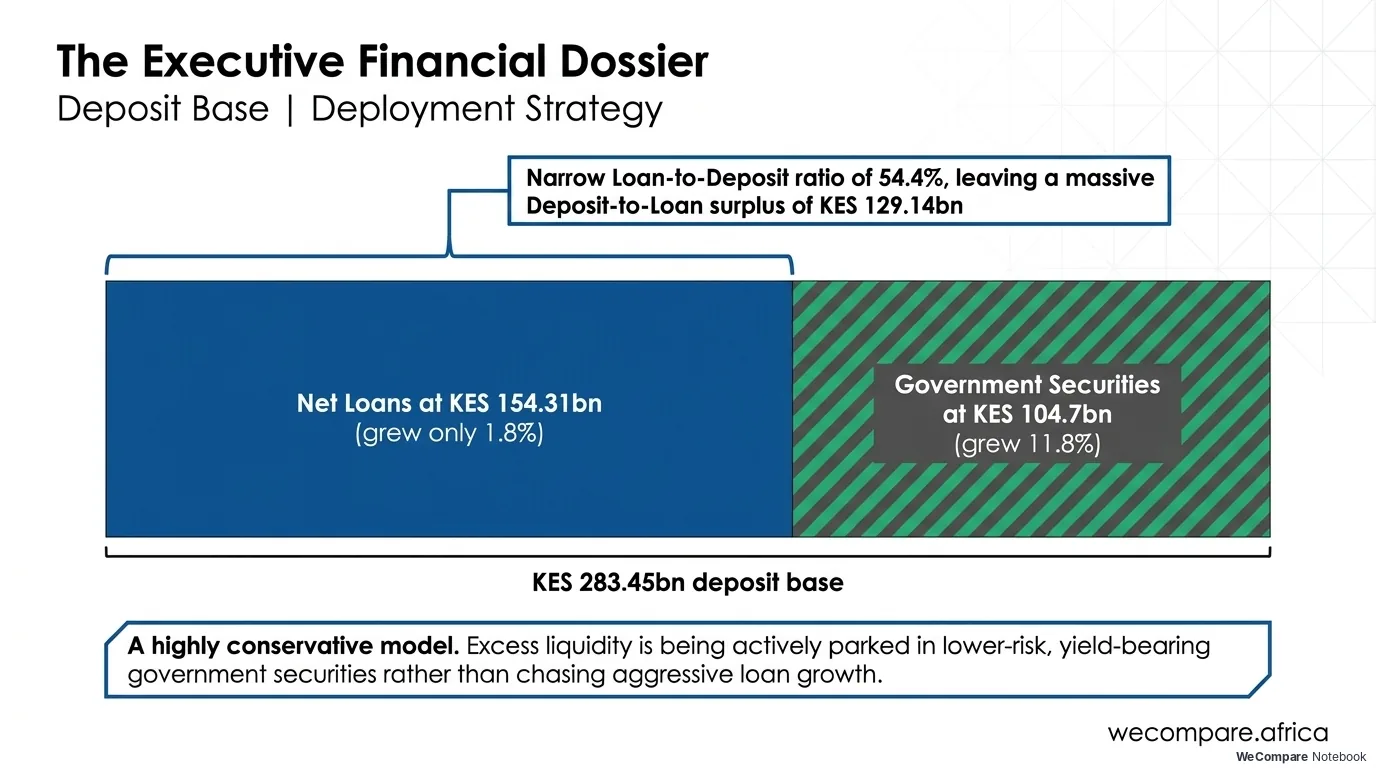
- Lots of room to lend: net loans were only KSh 154.3bn (+1.8%) against KSh 283.5bn of deposits, a loan-to-deposit ratio of 54.4%. Surplus funds went into government securities, up 11.8% to KSh 104.7bn.
Deposits fell 4.1% to KSh 283.5bn at end-2025 as the bank let low-balance accounts go. At H1 2026 they stood at KSh 309bn, up 6.4% year on year.
Who is competing for the same customers
Stanbic Kenya is the closest institutional rival. It is growing deposits at more than four times StanChart's pace (+28% to KSh 422bn against +6.4% to KSh 309bn). Absa Kenya is expanding in trade finance, digital and SME services, and NCBA and Nedbank are positioning for cross-border corporate flows once Nedbank completes its stake.
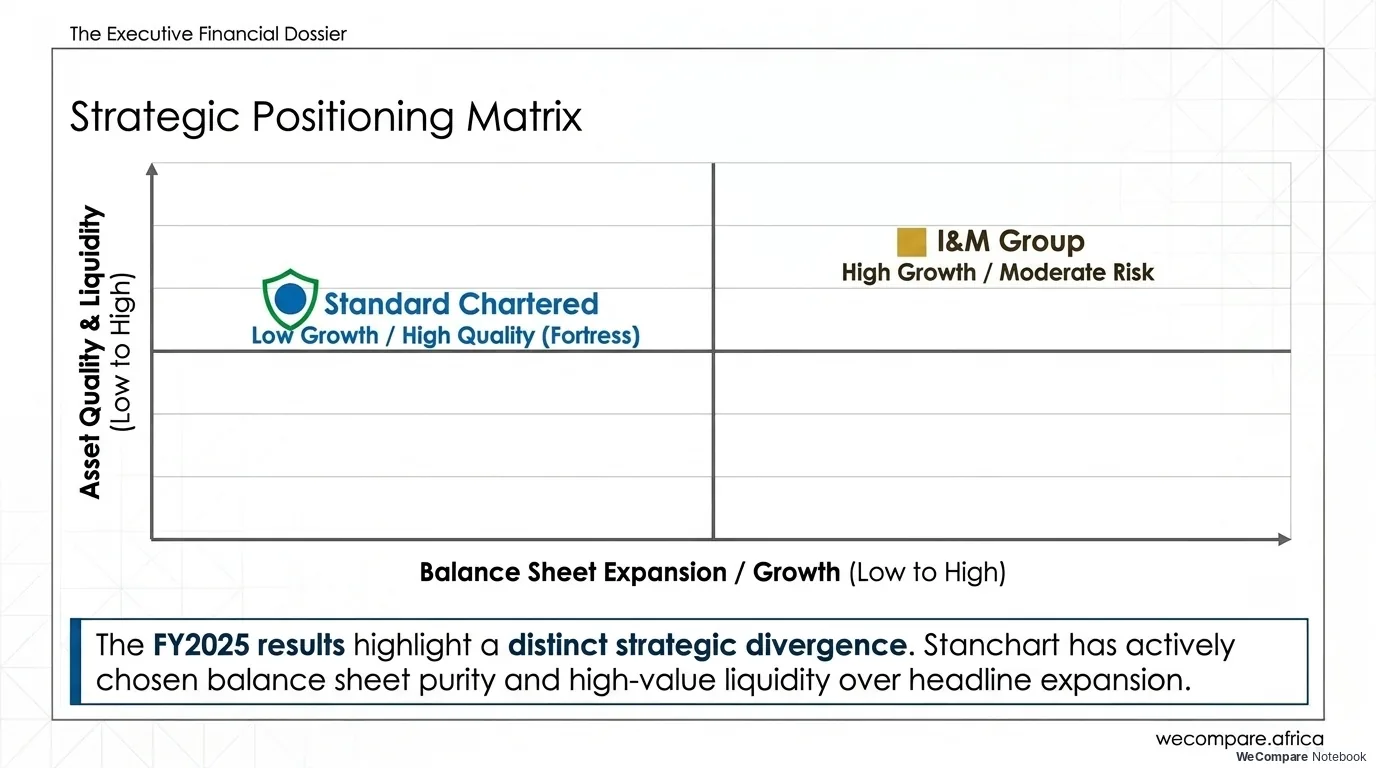
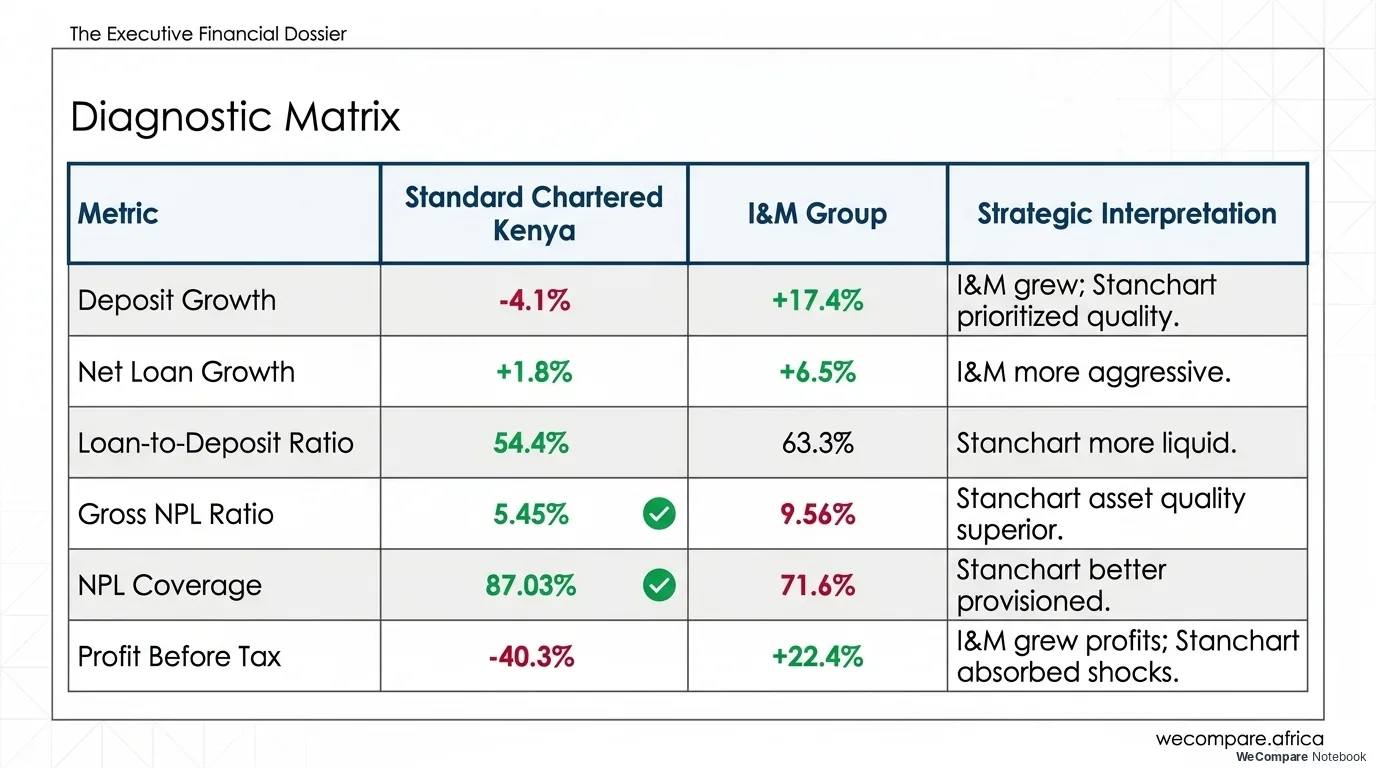
I&M Group shows the opposite choice. In FY2025 it grew deposits 17.4% and net loans 6.5% while profit before tax rose 22.4%, against StanChart's deposits -4.1%, loans +1.8% and profit before tax -40.3%. I&M's gross NPL ratio is 9.6% against StanChart's 5.5%, so StanChart is safer and slower, I&M is growing faster with more bad loans on its books. See how I&M grew deposits.
What it means for customers
If you bank with Standard Chartered as a mass-market retail customer, expect fewer branches and more digital service. If you are an affluent or business customer, you are the group it is investing in. Check branch access and fees before you rely on it.
Keep reading
- Kenya bank performance H1 2026: the Tier-1 hub analysis
- Best savings accounts in Kenya
- Equity vs KCB: how Kenya's two biggest banks make money
- How I&M Bank Kenya grew deposits 18% with free M-PESA transfers
- CBK rate at 8.75%: what falling interest rates mean for savers and borrowers
Frequently asked questions
Is Standard Chartered leaving Kenya?
The bank says its property sale and restructuring are routine and not an exit. Observers point to a corporate headquarters held for sale since June 2025, shrinking branches and staff, and a 94% payout ratio, but nothing in the numbers shows distress. The accurate reading is that capital is being sent back to the parent while the Kenya business is reshaped.
Why did Standard Chartered Kenya's profit fall?
Three pressures: rate cuts (net interest income dropped 13.1% in 2025 and 20% in H1 2026 on falling rates through 2025 and into 2026; the CBK benchmark was cut to 8.75% in February 2026), softer fee income including a 58.6% fall in foreign exchange trading income, and a one-off pension settlement of about KSh 2.5bn. Profit after tax fell 38% in FY2025 to KSh 12.4bn and a further 17% in H1 2026 to KSh 6.7bn.
Is Standard Chartered Kenya's loan book healthy?
Yes. Gross NPLs fell 26.5% to KSh 8.8bn in FY2025, a gross NPL ratio of 5.5%, with 87% of bad loans covered by provisions. The ratio was about 5.0% at H1 2026.
Is Standard Chartered Kenya still a large bank?
No. Its CBK market-size index fell to 4.5% in 2025, below the 5% threshold, so the CBK reclassified it as a medium-tier bank. In 2012 the figure was 8.29%.
What does the shrinking mean for customers?
Mass-market retail customers should expect fewer branches and more digital service. Affluent and business customers are the group the bank is investing in. Check branch access and fees before you rely on it.
Sources
- CBK MPC press release, 7 October 2026
- Standard Chartered Bank Kenya H1 2026 results (Khusoko)
- Standard Chartered Kenya H1 2026: profit falls 16.8% to KSh 6.73bn (Business.co.ke)
- Standard Chartered Bank Kenya FY2025 earnings note (Cytonn)
- Standard Chartered Kenya profit falls 38%, dividend holds at KSh 31 (Khusoko)
- I&M Group FY2025 earnings note (Cytonn)
- CBK MPC press release, 10 February 2026
- Stanbic Holdings H1 2026 results (Bizna Kenya)
- Stanbic Kenya H1 2026: net profit rises to KSh 6.6bn (Capital FM)
- StanChart books Sh2.5bn pension charge after Kenya Court ruling (Capital FM)
Disclaimer: This article is published for educational, informational and news purposes only. The metrics, ratios and commentary do not constitute investment, tax, legal or financial advice. Consult a licensed financial adviser before making decisions about listed securities.

Join the discussion
Please do not share account numbers, phone numbers, links or other personal details. Comments are general discussion, not advice. All comments are reviewed before they appear, and we may remove comments that break these rules.