Best Money Market Funds in Kenya: Net Yields Compared (October 2026)
Information current as at 19 October 2026
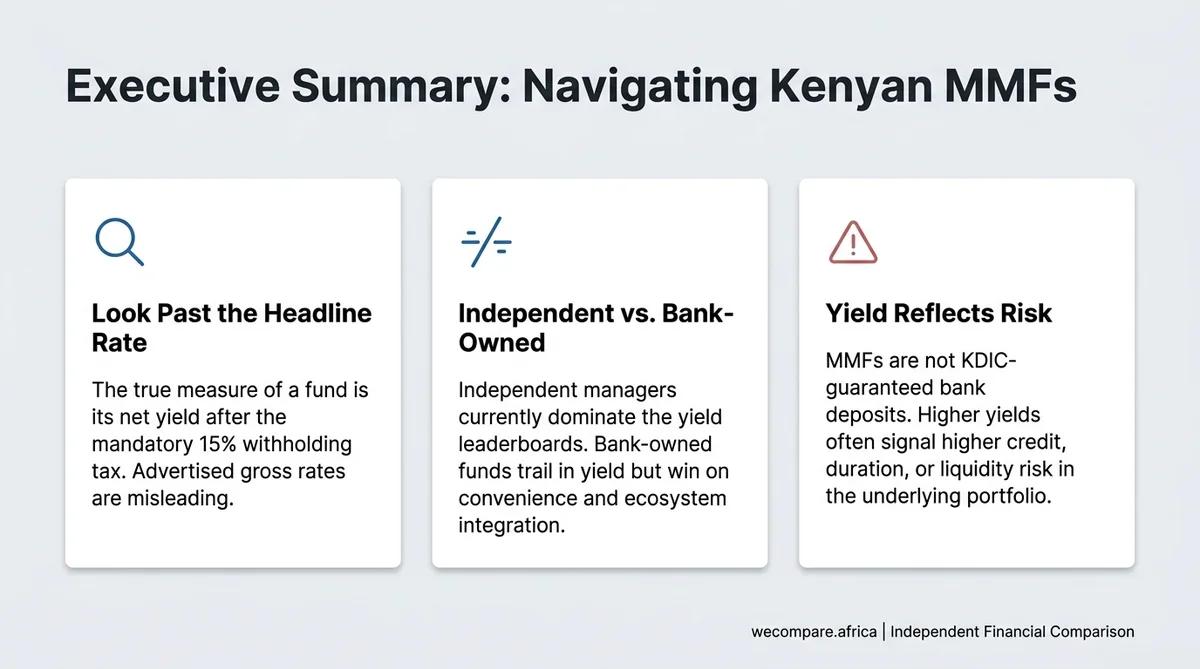
The best money market fund in Kenya depends less on the highest advertised rate and more on the net yield after 15% withholding tax, fees, liquidity, fund size, and the credibility of the manager. As of 19 October 2026, independent managers such as Cytonn, Faulu, Nabo Africa, Madison and GenAfrica lead on yield, while bank-owned funds such as KCB, NCBA and Co-op generally offer lower but often more familiar, distribution-friendly options.
This article distinguishes gross from net returns, shows the reporting date, explains the calculation, and flags the risks a yield table alone can't capture.
How we compared MMFs
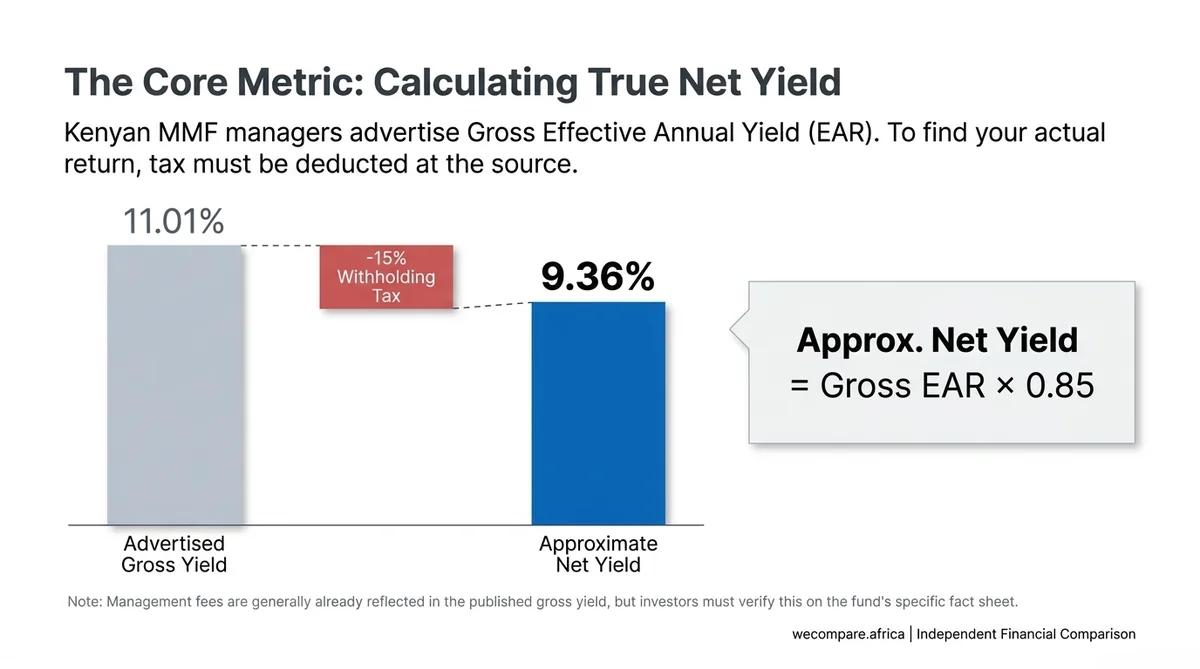
Kenyan MMF managers commonly publish a gross effective annual yield (EAR). Your actual return is reduced by 15% withholding tax, deducted at source; management fees are generally already reflected in the published yield, but investors should verify each fund's fact sheet.
Approximate net yield = gross EAR × 0.85
For example, an 11.01% gross yield is approximately 9.36% net, before any account-level charges or timing differences.
Source: Serrari Group MMF Index, https://serrarigroup.com/serrari-mmf, as of 19 October 2026.
Net-yield comparison
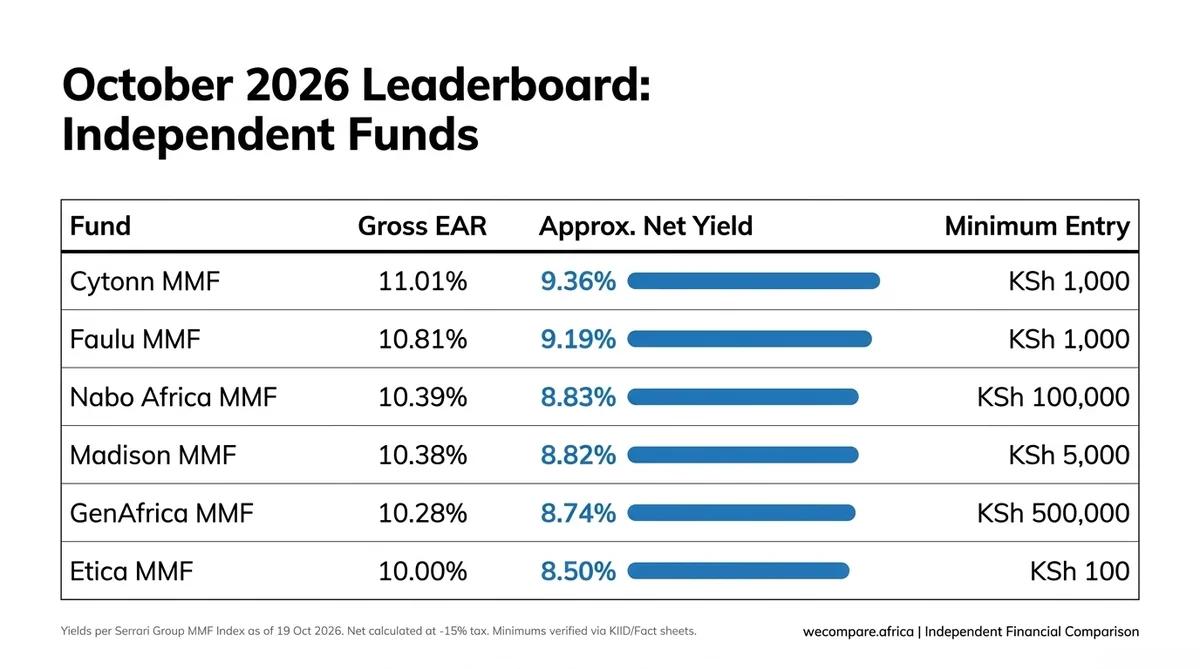
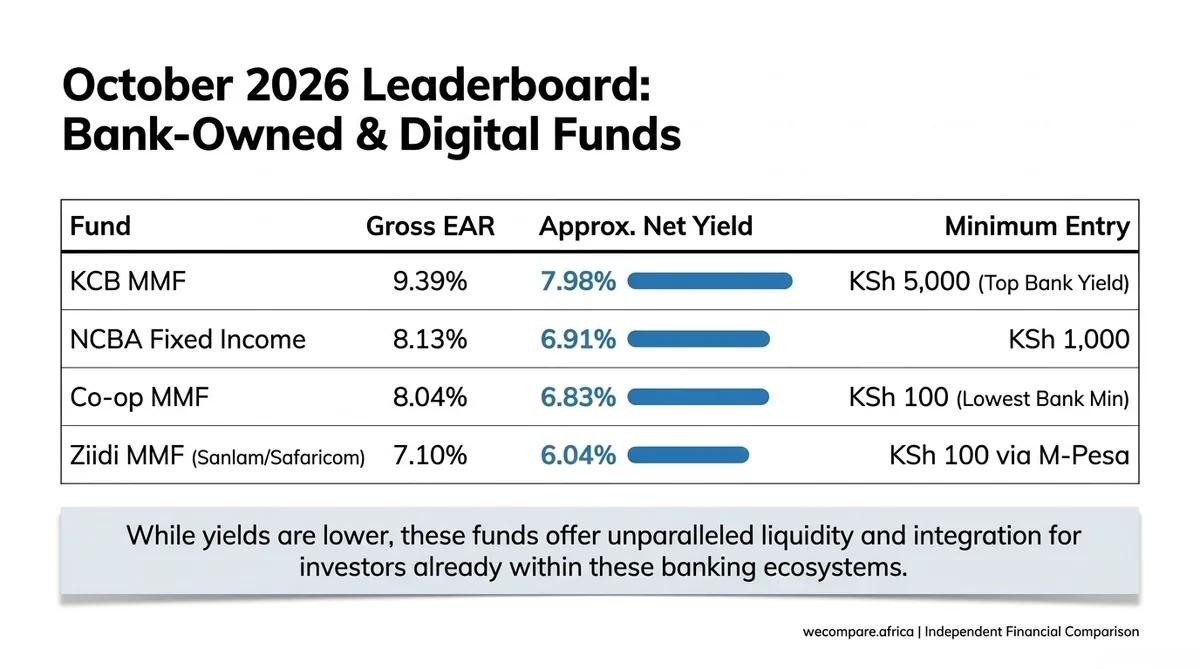
*Net figures are calculated by applying 15% withholding tax to the published gross yield. They are indicative, not personalised investment advice; confirm the live rate and tax treatment with the fund manager before investing.
Source: Serrari Group MMF Index (yields), https://serrarigroup.com/serrari-mmf, as of 19 October 2026. Minimums cross-checked against: Cytonn fact sheet (Jul 2026), Etica KIID (May 2026), NCBA fact sheet (Oct 2025), and Serrari's consolidated minimums guide (updated 12 Oct 2026) — plus direct confirmation from KCB's and Co-op's own pages, linked above in-line.
Best by investor need
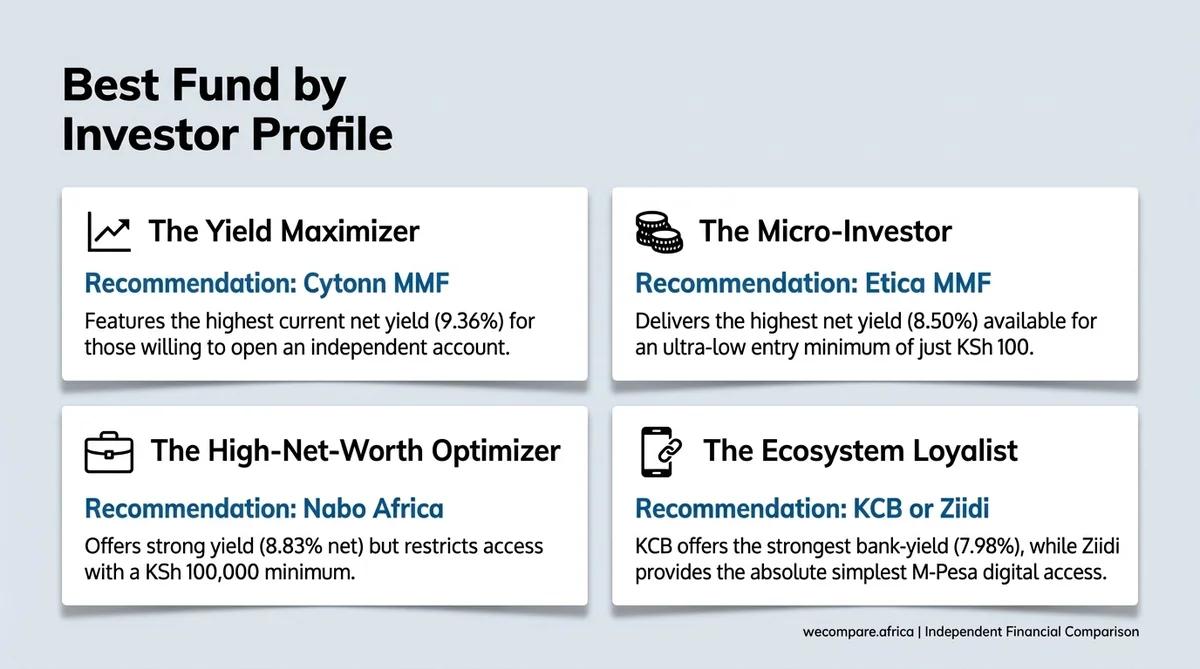
- Highest current net yield: Cytonn MMF, at roughly 9.36% net based on an 11.01% gross EAR.
- High yield with a large minimum: Nabo Africa MMF, about 8.83% net, but it requires KSh 100,000 to open.
- Lowest-cost entry among the yield leaders: Etica MMF accepts from KSh 100, with a net yield of about 8.50% — the best net yield of any fund with a KSh 100 minimum in this comparison (Co-op and Ziidi also open at KSh 100, but yield meaningfully less).
- Best bank-owned yield: KCB MMF, approximately 7.98% net, with a 2.0% management fee and a KSh 5,000 minimum.
- Bank-owned option, lowest minimum: Co-op MMF opens at KSh 100, with a net yield of about 6.83%.
- Simple digital access: Ziidi MMF, opened entirely through M-Pesa from KSh 100, though its 7.10% gross yield is the lowest of the funds compared here.
Bank-owned vs independent MMFs
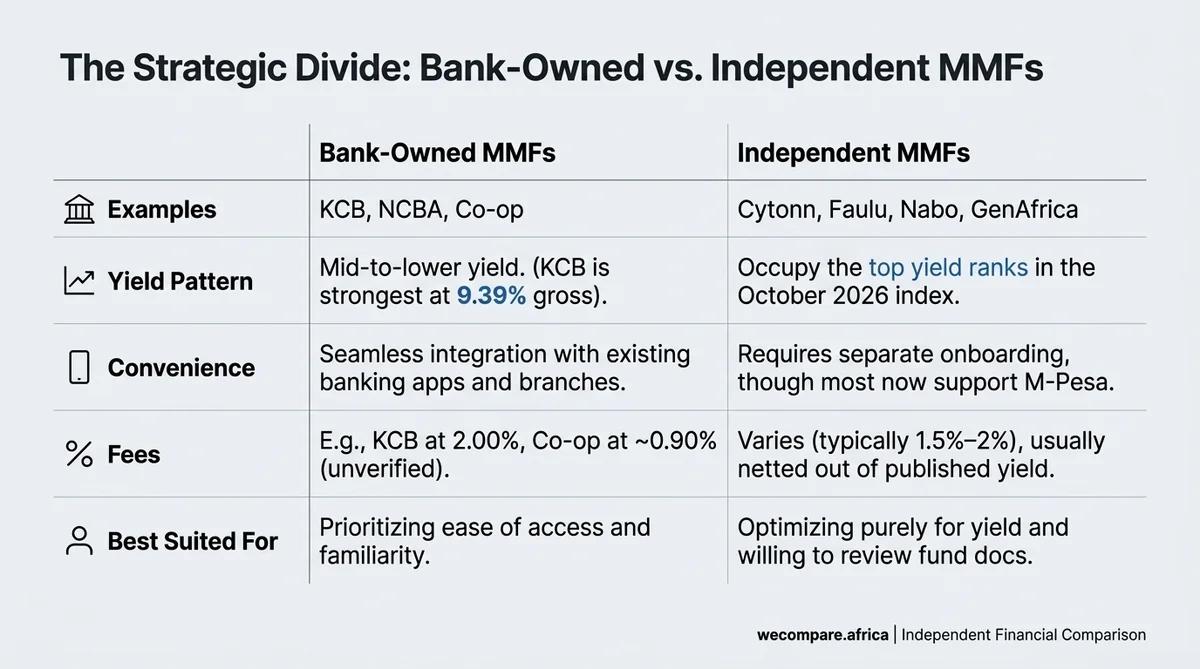
| Factor | Bank-owned MMFs | Independent MMFs |
|---|---|---|
| Examples | KCB, NCBA, Co-op, Stanbic, Equity | Cytonn, Faulu, Nabo Africa, Madison, GenAfrica, Etica |
| Current yield pattern | Generally mid-to-lower yield; KCB is the strongest bank-affiliated fund in this comparison at 9.39% gross. None of the bank-run funds compared here cracked the top 10 by yield. | Generally occupy the top yield ranks in the current Serrari index. |
| Convenience | Easy if you already bank with the group; familiar app and branch ecosystem. | May require separate onboarding, though most now support mobile apps and M-Pesa deposits. |
| Fees | KCB's fee is 2.00%. Co-op's ~0.90% figure is commonly cited but not published on Co-op's own page — verify directly. | Fees vary by manager, typically 1.5%–2% a year, and are usually already netted out of the published yield — always confirm the basis with the fund's fact sheet. |
| Best suited for | Investors prioritising convenience, an existing banking relationship, and simpler access. | Investors optimising for yield who are comfortable reviewing fund documentation and manager risk. |
Why the yield gap matters
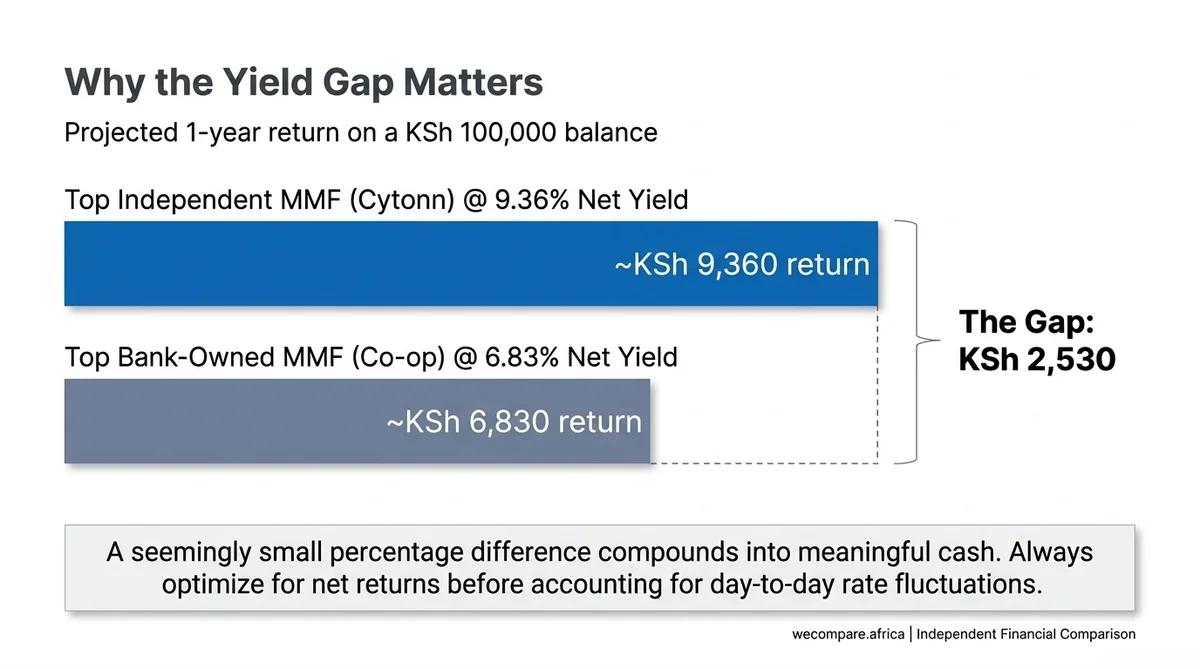
On KSh 100,000 for one year: a 9.36% net return (Cytonn) produces about KSh 9,360, while a 6.83% net return (Co-op) produces about KSh 6,830 — a difference of roughly KSh 2,530 before accounting for day-to-day changes in yield.
Why the "highest rate" can mislead
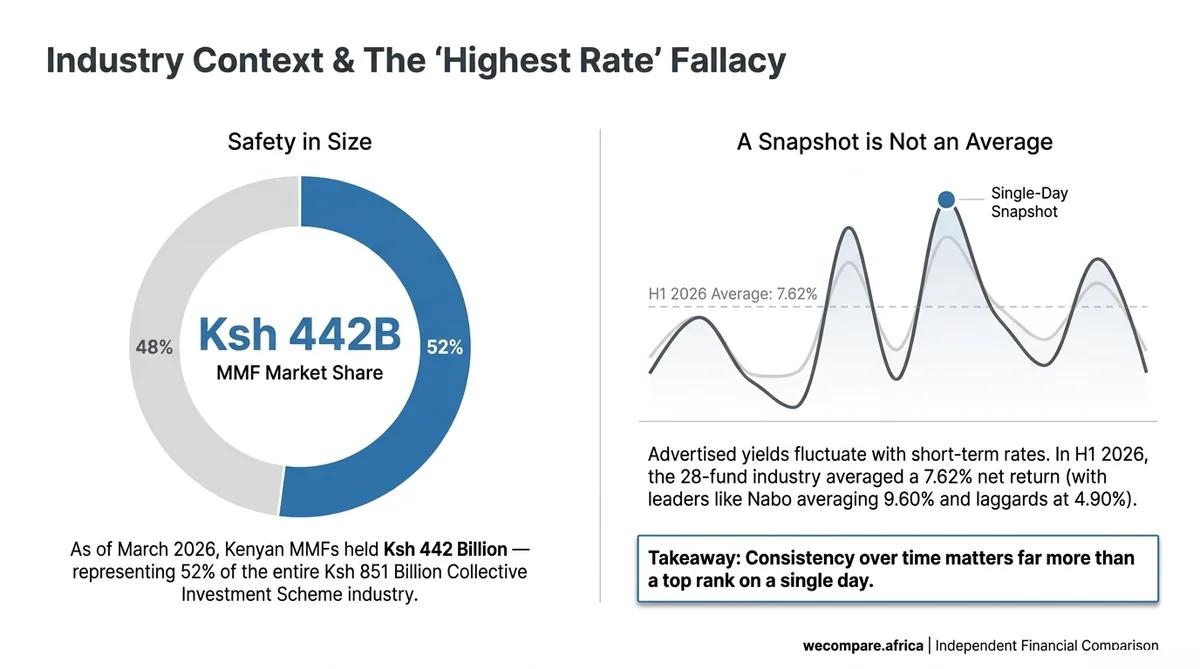
A fund's advertised yield changes with short-term interest rates, the maturity profile of its holdings, and the manager's investment approach. Kenya's MMF industry averaged a 7.62% net return across 28 funds in the first half of 2026 — Money254 found Nabo Africa led that period's average at 9.60% net and Cytonn followed at 9.40% net, while Equity (4.90%) and African Alliance (4.91%) posted the weakest returns. This shows that today's top single-day yield isn't necessarily this year's average, and it's worth weighing a fund's consistency over a snapshot.
As of March 2026, Kenyan MMFs held Ksh442 billion — 52% of the entire Ksh851 billion collective investment scheme industry.
Also compare like with like:
- Gross EAR is before 15% withholding tax.
- Net yield is the closer estimate of what reaches your account.
- Management fee is usually embedded in published yields, but confirm the basis with each fund's fact sheet.
- Liquidity is typically strong, with withdrawals often processed in one to three days, but redemption timing can vary by manager.
Sources: Money254 — Top 15 MMFs by net returns, H1 2026; Serrari Group FAQs.
Risks to weigh
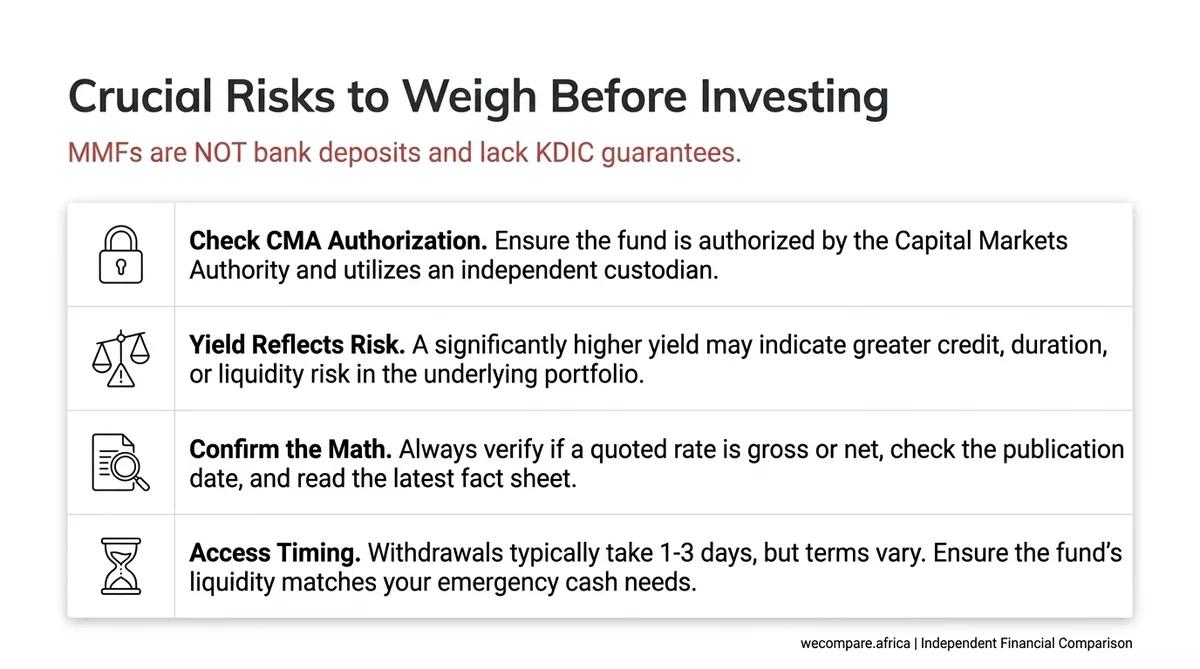
MMFs are not bank deposits and are not guaranteed by the Kenya Deposit Insurance Corporation. Their value and yield can fluctuate, and a higher yield may reflect greater credit, duration, or liquidity risk in the underlying portfolio.
Before investing, check:
- Whether the fund is authorised by the Capital Markets Authority and who acts as independent custodian.
- The fund's size, latest fact sheet, portfolio quality, and withdrawal terms.
- Whether the quoted rate is gross or net, and the date it was published — some comparison sites republish snapshots that are weeks old.
- Whether the manager's past performance is consistent rather than a short-term spike (see the H1 2026 average above).
- Your own need for access: an emergency fund may justify a slightly lower yield for smoother liquidity.
Practical choice
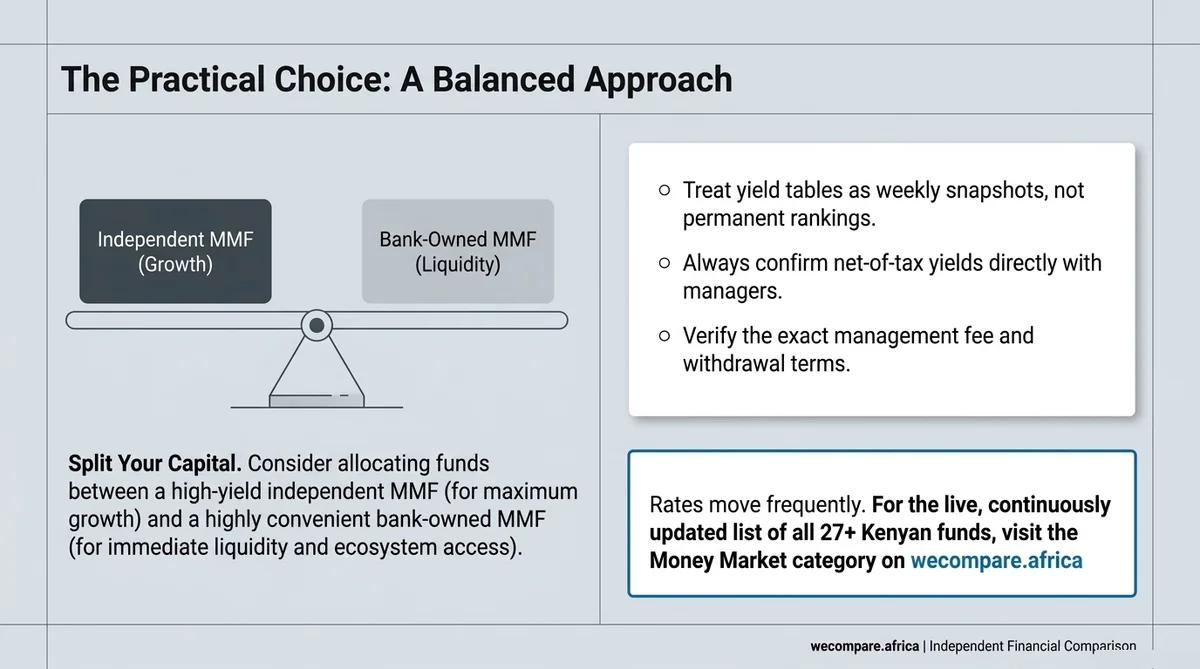
For a yield-focused investor, the 19 October 2026 data points to Cytonn, Faulu, Nabo Africa, Madison and GenAfrica as the leading independent options by current gross yield. For investors who value banking integration and a familiar platform, KCB is currently the strongest bank-owned yield among the funds compared here, while Co-op now stands out for its KSh 100 minimum rather than a published low fee.
A balanced approach is to split money between a high-yield independent MMF and a convenient bank-owned MMF — provided you first confirm the current fact sheet, net-of-tax yield, fees, and redemption process directly with the manager. Rates move frequently (weekly, in some cases), so treat any table — including this one — as a snapshot rather than a permanent ranking. For the full, continuously-updated list of 27+ funds, see wecompare.africa's Money Market Funds category page.
Join the discussion
Please do not share account numbers, phone numbers, links or other personal details. Comments are general discussion, not advice. All comments are reviewed before they appear, and we may remove comments that break these rules.