Charting Kenyan Government Securities: A Practical Guide to T-Bills, Treasury Bonds and DhowCSD
Short answer. Kenyan T-bills are good for parking cash for a known short-term horizon. Treasury bonds are good for locking in medium- or long-term income. Neither is "risk-free": you swap default risk for inflation, reinvestment, liquidity and interest-rate risk. Match the instrument to when you will need the money, and compare returns after tax and inflation, not on the headline rate.
Every week, thousands of Kenyans chase the highest advertised rate on a Treasury bill or bond. The investors who do best are usually asking a different question: what happens if I need this money early? This guide walks through the instruments, the 4 pitfalls that cost investors money, the 2 ways to buy, and a 5-question checklist to run before every bid.
Who wrote this and how we checked it. Oscar Oyomba is an ACCA-qualified finance professional with an MBA in Corporate Finance and more than 20 years of commercial experience across East Africa, including finance, taxation and analytics work. Rules, minimums and tenors below were checked against the Central Bank of Kenya (CBK) on 19 October 2026 (see Sources). Rates move weekly, so we deliberately do not quote today's auction rates here; check the latest CBK auction results before you bid. This is education, not personalised investment advice.
1. "Risk-free" is the wrong label. Think "risk-shifted"
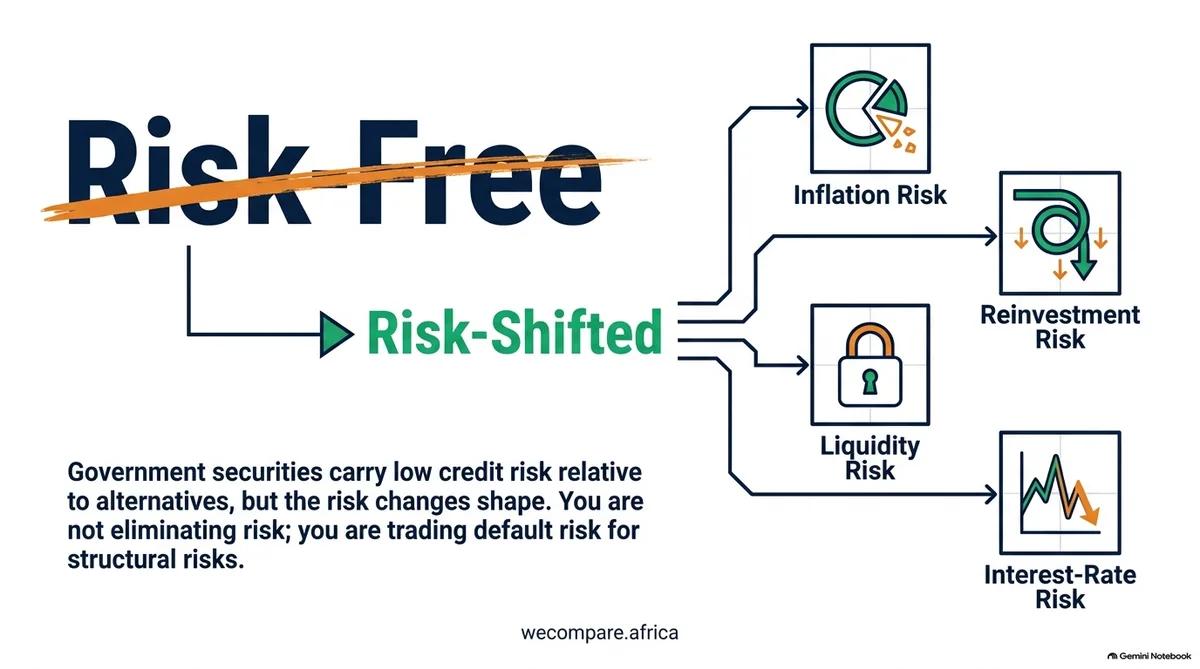
Government securities carry low credit risk relative to most alternatives, because the borrower is the government. But the risk does not disappear. It changes shape. You are trading default risk for four structural risks:
- Inflation risk: rising prices can eat the real value of your interest.
- Reinvestment risk: when your bill or bond matures, rates may be lower than when you started.
- Liquidity risk: you may not be able to exit early at a fair price (more on this below).
- Interest-rate risk: if market rates rise, the price of bonds you already hold falls.
2. The terrain: mapping Kenya's government instruments
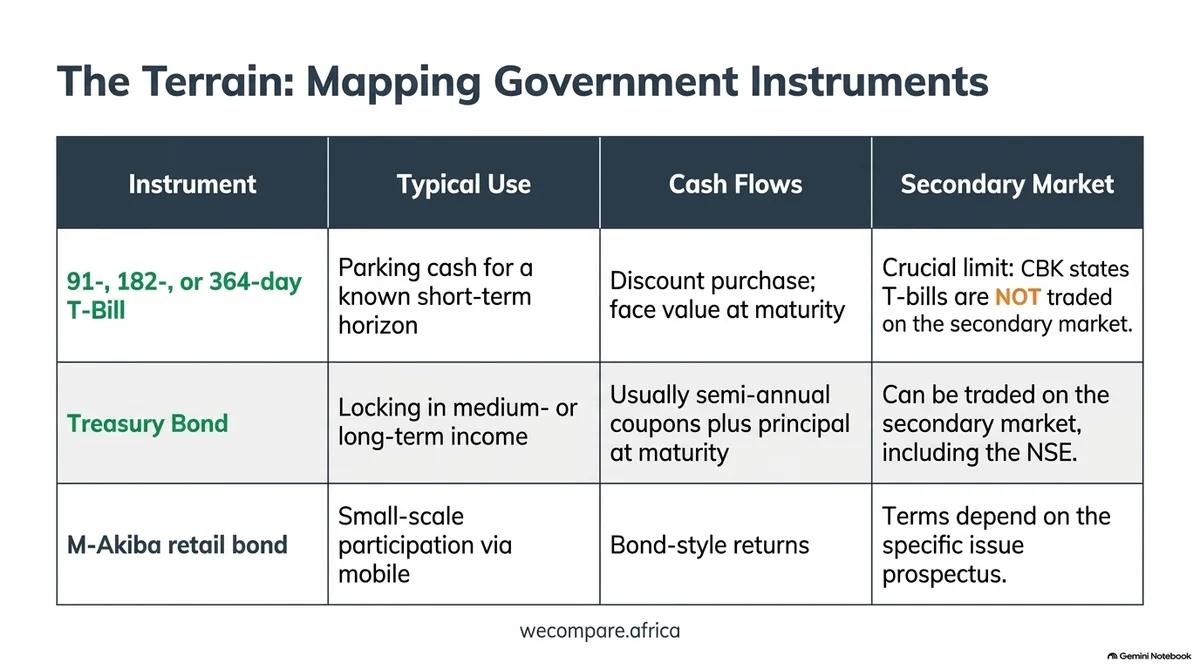
| Instrument | Typical use | Cash flows | Secondary market |
|---|---|---|---|
| 91-, 182- or 364-day T-bill | Parking cash for a known short-term horizon | Bought at a discount; you receive face value at maturity | CBK states T-bills are not traded at the Nairobi Securities Exchange (NSE). Plan to hold to maturity. |
| Treasury bond | Locking in medium- or long-term income | Usually semi-annual coupons plus principal at maturity | Can be traded on the secondary market, including the NSE |
| M-Akiba retail bond | Small-scale participation via mobile | Bond-style returns | Terms depend on the specific issue prospectus |
One nuance worth knowing: CBK notes that bills can be transferred between CDS holders, and that the 364-day bill can be tradable over the counter through CBK. That is not the same as a deep, listed market where you can reliably sell on any day. For planning purposes, treat a T-bill as a hold-to-maturity product.
3. Pitfall 1: the liquidity trap
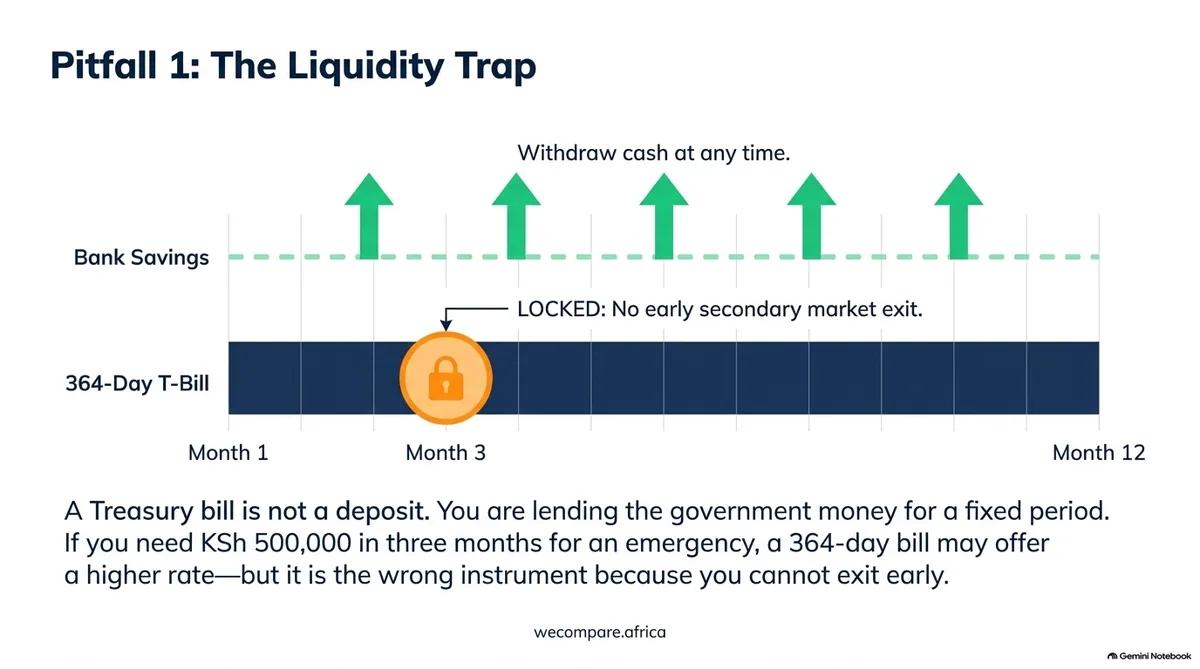
A Treasury bill is not a deposit. You are lending the government money for a fixed period. If you might need KSh 500,000 in 3 months for an emergency, a 364-day bill may offer a higher rate, but it is the wrong instrument, because you cannot exit early at a predictable price. Bank savings let you withdraw at any time. A 364-day bill does not.
4. Pitfall 2: confusing gross yield with real return
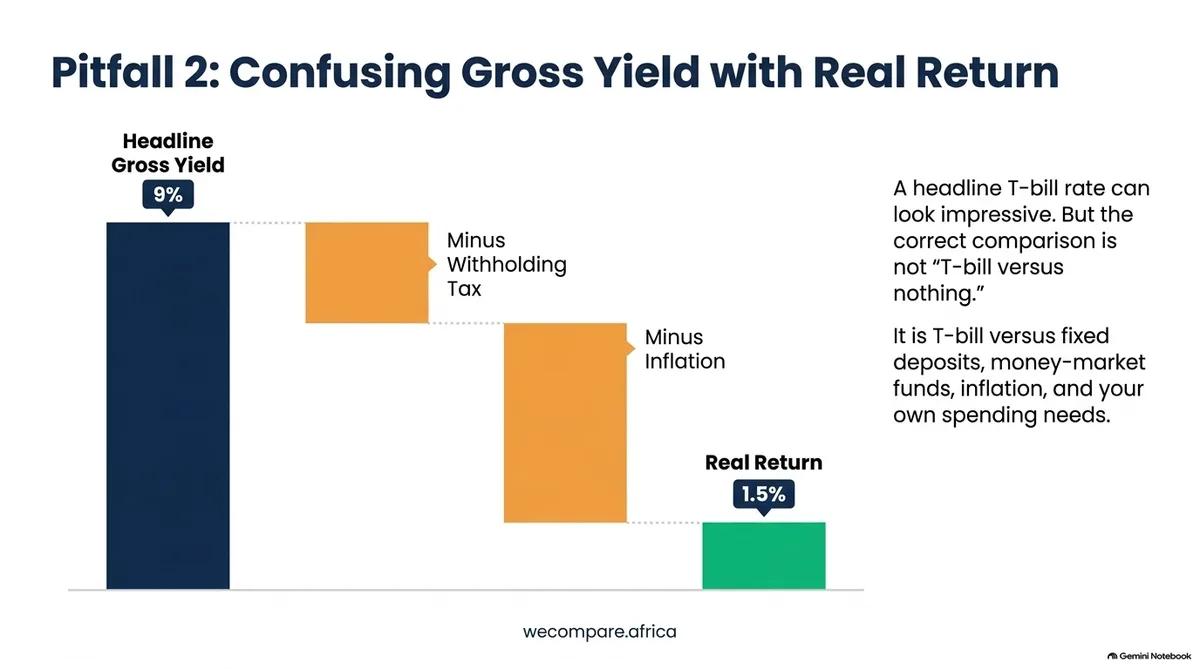
A headline T-bill rate can look impressive. Here is the illustrative maths behind the chart, using a 9% headline gross yield:
- Withholding tax at 15% takes about 1.35 percentage points, leaving roughly 7.65% after tax.
- If inflation is around 6.2%, your purchasing power grows by only about 1.5% a year.
These figures are an illustration, not a forecast. The point is the method. The correct comparison is not "T-bill versus nothing". It is T-bill versus fixed deposits, money-market funds, inflation and your own spending needs, each measured on the same after-tax basis.
Tax note. CBK's guidance applies 15% withholding tax to T-bills and to Treasury bonds with tenors up to 9 years, and 10% to bonds with tenors of 10 years or more. Infrastructure bond interest has been exempt from tax. Rules can change through the Finance Act, so confirm your own position with the Kenya Revenue Authority (KRA) or a tax adviser.
5. Pitfall 3: the bond seesaw
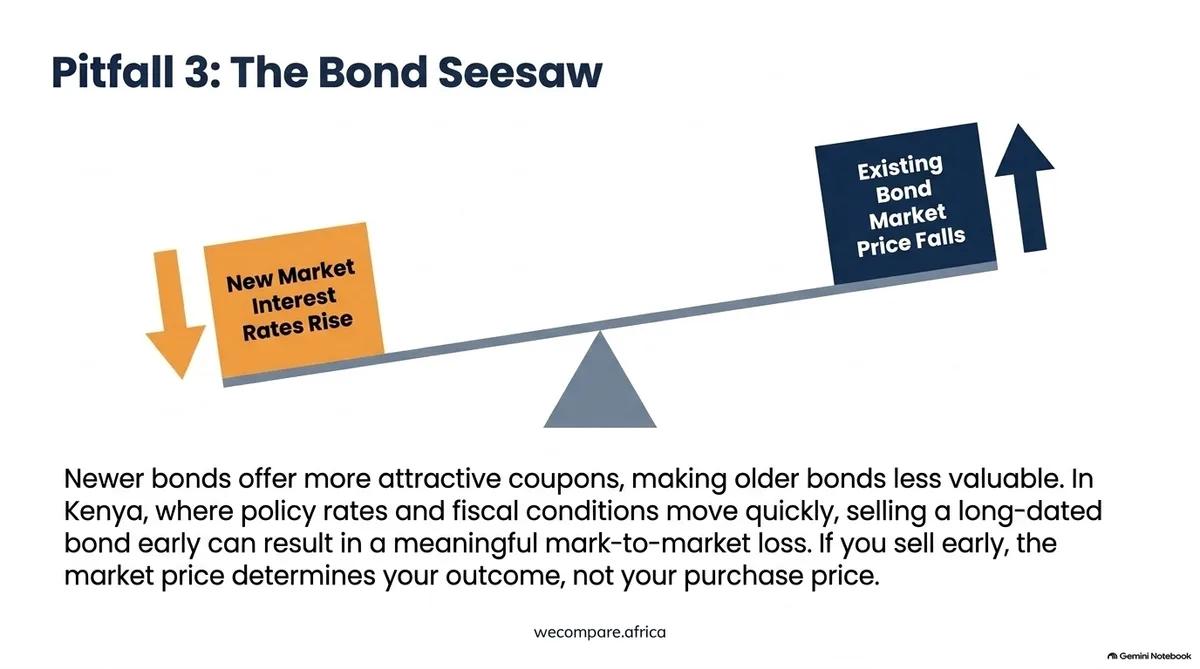
Interest rates and bond prices move in opposite directions. Newer bonds offer more attractive coupons, which makes older bonds less valuable. In Kenya, where policy rates and fiscal conditions can move quickly, selling a long-dated bond early can mean a meaningful mark-to-market loss. If you sell early, the market price determines your outcome, not your purchase price.
6. Pitfall 4: secondary market realities
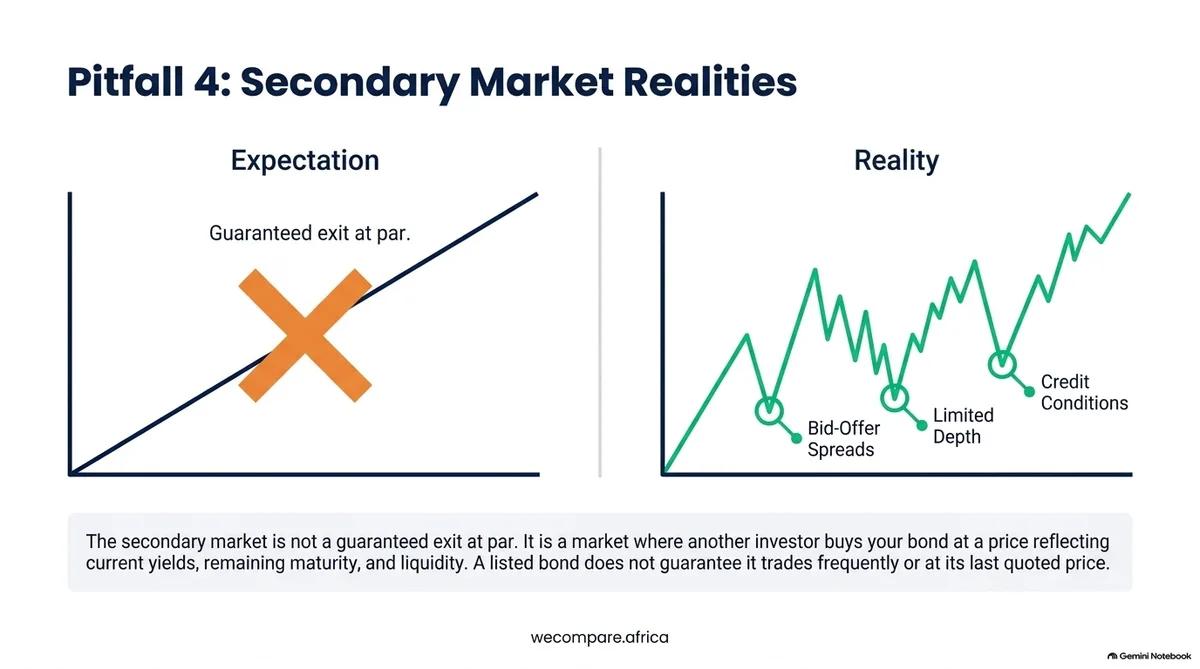
The secondary market is not a guaranteed exit at par. It is a market where another investor buys your bond at a price that reflects current yields, remaining maturity and liquidity. Three things shape what you actually get:
- Bid-offer spreads: buyers pay less than sellers ask.
- Limited depth: few buyers at your size on your day.
- Credit conditions: market sentiment about government borrowing.
A listed bond does not guarantee that it trades frequently, or at its last quoted price.
7. The gateway: DhowCSD
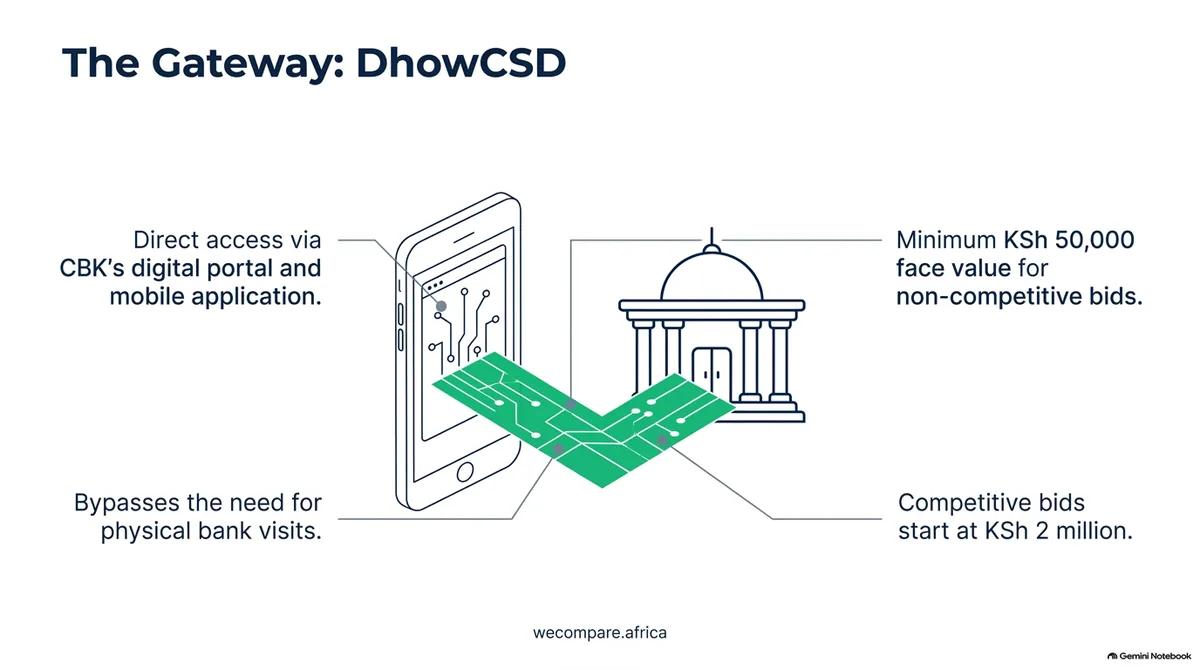
DhowCSD is CBK's digital platform for buying government securities. Per CBK:
- You get direct access through CBK's web portal and mobile application, without an intermediary, and without physical bank visits.
- The minimum face value is KSh 50,000 for non-competitive bids, in multiples of KSh 50,000.
- Competitive bids start at KSh 2 million face value, and you must name the yield you want.
- Auctions run weekly on Thursdays, and successful bidders pay by 2pm on the settlement date, normally the following Monday.
Check before you bid: CBK has revised its minimums over time, and older CBK material shows a higher minimum for bills. Always confirm the current minimum on the CBK Treasury bills page or inside DhowCSD.
8. Purchasing path 1: the auction route
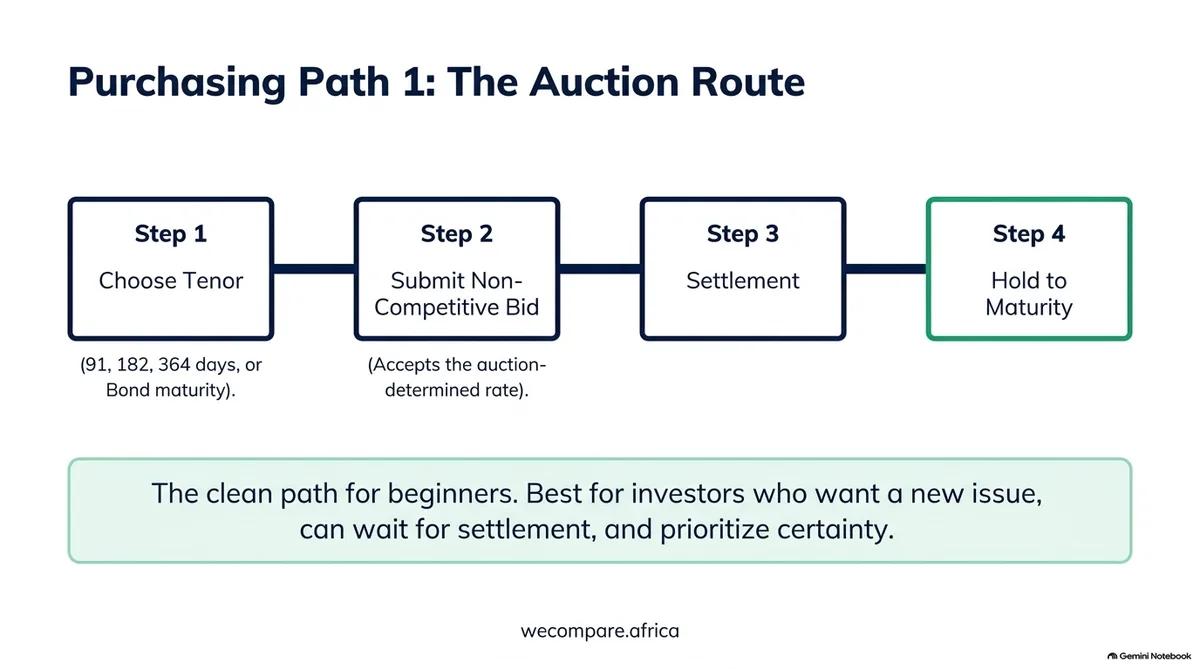
- Choose your tenor: 91, 182 or 364 days, or a bond maturity.
- Submit a non-competitive bid: you accept the auction-determined rate.
- Settlement: pay by the deadline on the settlement date.
- Hold to maturity.
This is the clean path for beginners. It is best for investors who want a new issue, can wait for settlement, and prioritise certainty over cleverness.
9. Purchasing path 2: the secondary route
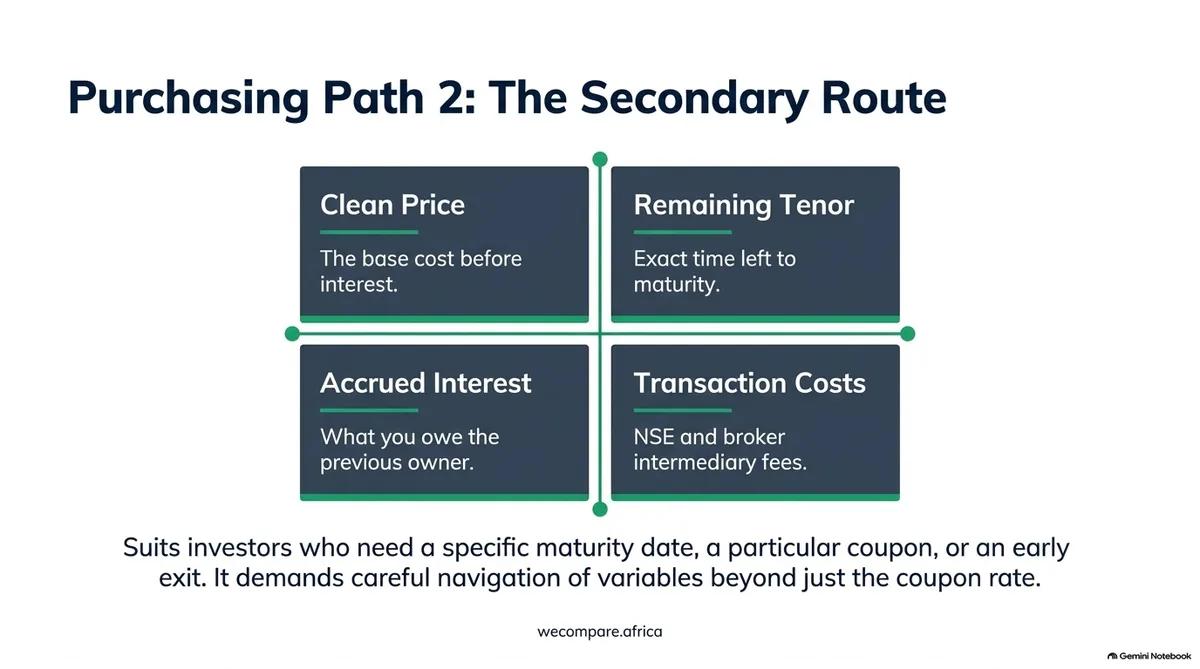
Buying an existing bond from another investor suits you if you need a specific maturity date, a particular coupon, or an early exit. It demands that you navigate variables beyond the coupon rate:
- Clean price: the base cost before interest.
- Remaining tenor: the exact time left to maturity.
- Accrued interest: what you owe the previous owner for coupon time already earned.
- Transaction costs: NSE and broker intermediary fees.
10. Decoding the lingo: coupon vs. yield to maturity (YTM)
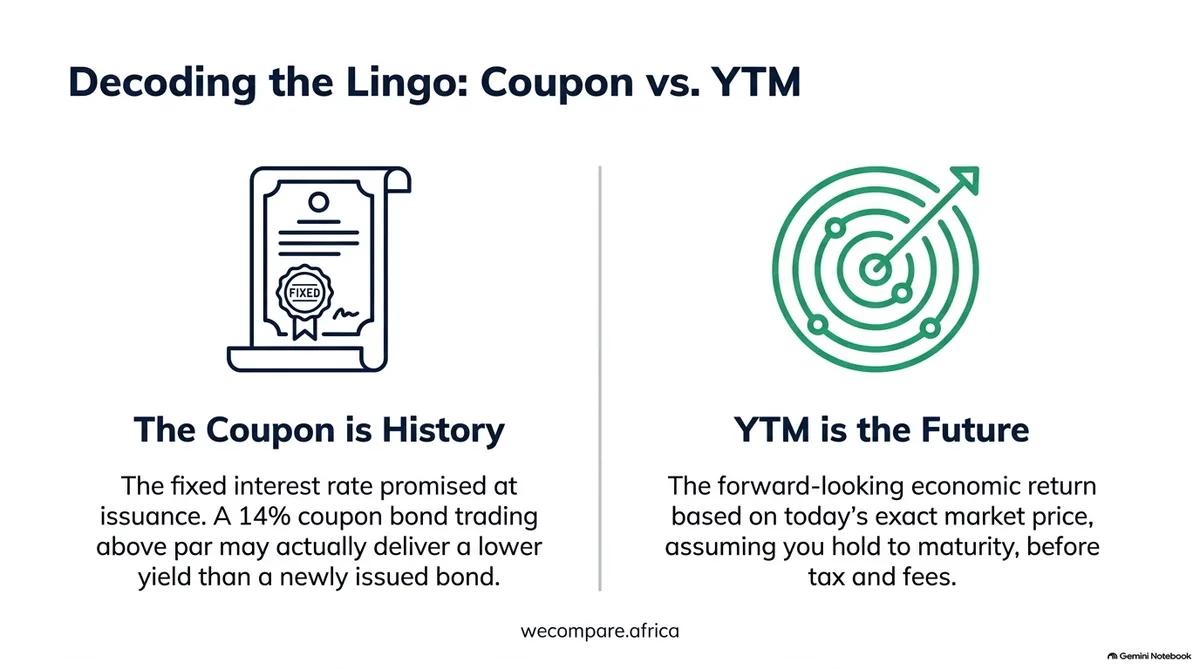
The coupon is history. YTM is the future.
The coupon is the fixed interest rate promised at issuance. Yield to maturity is the forward-looking economic return based on today's exact market price, assuming you hold to maturity, before tax and fees. So a bond with a 14% coupon trading above par may actually deliver a lower yield than a newly issued bond. Always compare YTM, not coupons.
11. The pre-bid diagnostic checklist
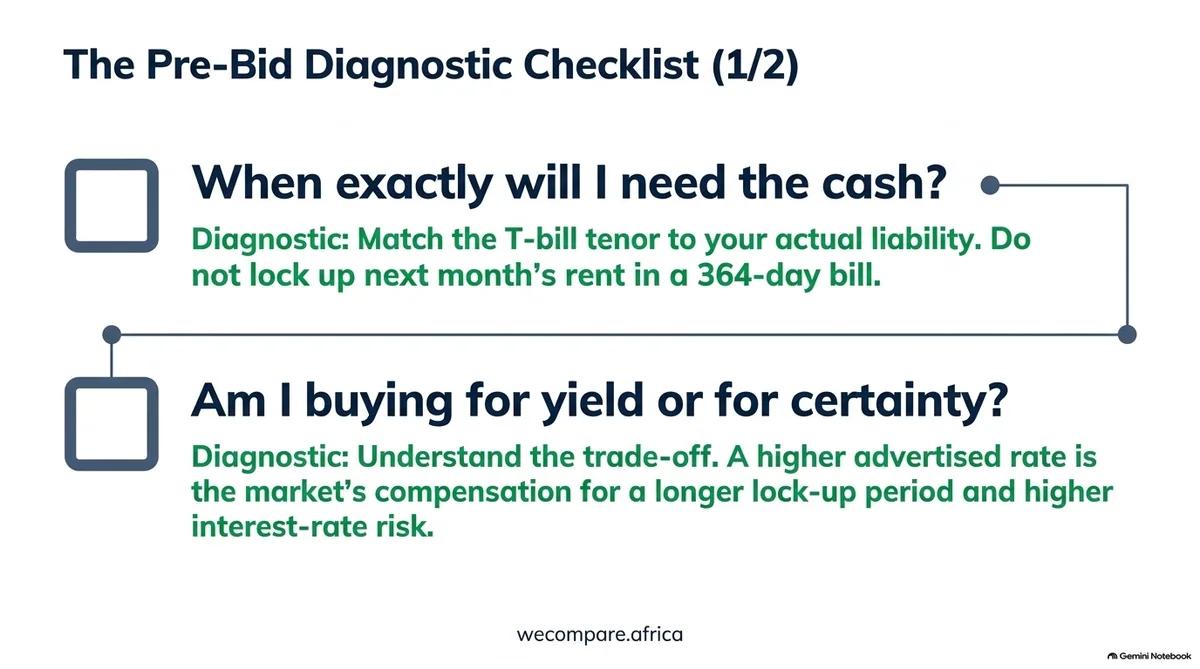
- When exactly will I need the cash? Match the tenor to your actual liability. Do not lock up next month's rent in a 364-day bill.
- Am I buying for yield or for certainty? A higher advertised rate is the market's compensation for a longer lock-up and higher interest-rate risk.
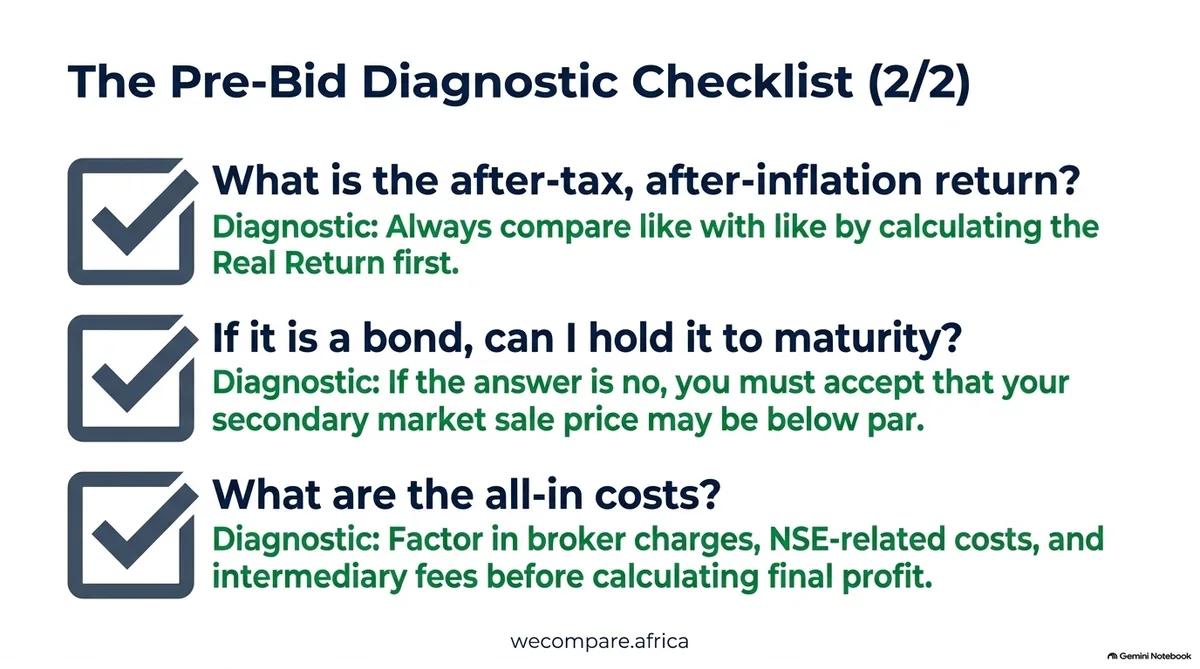
- What is the after-tax, after-inflation return? Always compare like with like by calculating the real return first.
- If it is a bond, can I hold it to maturity? If not, accept that your secondary-market sale price may be below par.
- What are the all-in costs? Factor in broker charges, NSE-related costs and intermediary fees before calculating final profit.
12. The golden rule
Kenya's T-bills can be an excellent tool for disciplined cash management, and bonds can lock in income. But the investor who understands the difference between holding to maturity and selling into the market will make far better decisions than the one who simply chases the highest advertised rate.
13. Navigate with clarity
Apply the checklist to your next DhowCSD bid. Then compare financial instruments intelligently at wecompare.africa, including fixed deposits and money-market funds, so you measure government securities against the real alternatives.
Frequently asked questions
Are Kenyan T-bills risk-free?
No. Credit risk is low relative to alternatives, but you still face inflation, reinvestment, liquidity and interest-rate risk.
Can I sell a Treasury bill before it matures?
Plan as if you cannot. CBK states T-bills are not traded at the NSE. Bills can be transferred between CDS holders, and the 364-day bill is tradable over the counter through CBK, but there is no guaranteed exit at a fair price.
What is the minimum to invest through DhowCSD?
KSh 50,000 face value for non-competitive bids, in multiples of KSh 50,000. Competitive bids start at KSh 2 million. Confirm current figures with CBK before bidding.
What is the difference between a competitive and a non-competitive bid?
A competitive bid names the yield you want and may be rejected if it is too high. A non-competitive bid accepts the rate set at auction, which makes it the simpler route for beginners.
Is a high coupon always better?
No. The coupon is the rate promised at issue. Yield to maturity reflects the price you actually pay today. A 14% coupon bond bought above par can yield less than a new issue.
How are T-bill and bond returns taxed?
CBK guidance applies 15% withholding tax to T-bills and bonds up to 9 years, 10% to bonds of 10 years or more, with infrastructure bonds exempt. Verify current rules with KRA.
Sources and methodology
- Central Bank of Kenya, Treasury Bills (tenors, minimums, DhowCSD access, auction and settlement timing). Accessed 19 October 2026.
- Central Bank of Kenya, FAQs on Government of Kenya Securities (secondary market, withholding tax, coupon frequency).
- Kenya Revenue Authority, withholding tax guidance: kra.go.ke.
Methodology. We explain mechanics, not forecasts. Worked examples are illustrative. We update this guide whenever CBK changes minimums, tenors or tax treatment, and the "last reviewed" date above reflects that.
About the author and editorial standards
Oscar Oyomba is Editor-in-Chief of WeCompare Africa and Founder and Director of Savanna Digital Labs in Nairobi. He is ACCA-qualified, holds an MBA in Corporate Finance, and has more than 20 years of commercial and marketing experience, with consultancy work spanning finance, taxation and ERP implementation across East Africa. Full profile · Editorial policy.
Disclosure. WeCompare Africa is a comparison platform. This guide was not paid for by any bank, broker or issuer, and no provider can buy a placement in it. If our commercial relationships ever touch a topic, we will say so on the page. This article is general education and not personalised financial advice. Government securities prices and rates change; speak to a licensed adviser for your own situation. Contact: info@savannadigitallab.com.
Join the discussion
Please do not share account numbers, phone numbers, links or other personal details. Comments are general discussion, not advice. All comments are reviewed before they appear, and we may remove comments that break these rules.